Peakstone Realty Trust (PKST): Tenant Footprint, Lease Durability, and the Brookfield Exit
Peakstone Realty Trust operates as an internally managed REIT that owns and leases predominantly single-tenant industrial and office properties and monetizes through contractual base rent plus recoverable operating expense reimbursements; the business generates cash flow from long-duration leases and periodic re-leasing of vacated assets. Investors should view Peakstone as a lease-centric landlord with concentrated tenant exposure and meaningful transaction activity in 2025–26 that changed the ownership narrative. For more context on tenant concentration and transaction signals, visit https://nullexposure.com/.
Why tenants and leases drive valuation here
Peakstone’s income profile is fundamentally rental revenue from single-tenant assets. The portfolio scale and long-dated contracts create predictable cash flow, but concentration among a handful of tenants creates asymmetric downside if key credits fail to renew or terminate. The company reported a portfolio spanning multiple states with a material portion of revenue coming from its top five tenants. Institutional investors should weigh the probability of lease roll, tenant credit, and the pricing dynamics evident in the Brookfield transaction activity when modeling upside.
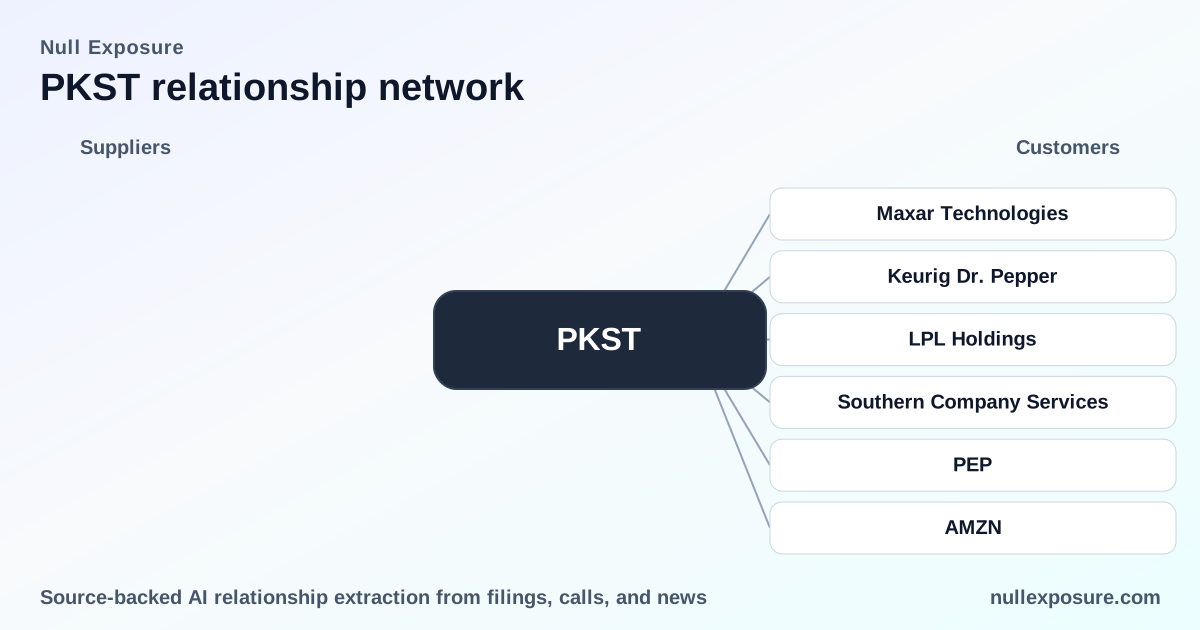
Customer (tenant) relationships: itemized coverage from filings and market coverage
Southern Company Services (10-K, FY2024)
Southern Company Services is listed among Peakstone’s five largest tenants, contributing approximately 5.1% of Annualized Base Rent as of December 31, 2024, reflecting a meaningful single-tenant position within the top five by ABR (Peakstone 2024 Form 10‑K).
Keurig Dr. Pepper (10-K, FY2024)
Keurig Dr. Pepper is Peakstone’s single largest tenant by disclosed ABR, representing about 6.4% of Annualized Base Rent at year-end 2024, anchoring revenue concentration among the top five tenants (Peakstone 2024 Form 10‑K).
LPL Holdings (10-K, FY2024)
LPL Holdings is named among the five largest tenants and accounts for approximately 4.8% of Annualized Base Rent, contributing to the concentrated top-tenancy revenue bucket that underpins near-term cash flow (Peakstone 2024 Form 10‑K).
Maxar Technologies (10-K, FY2024)
Maxar Technologies is disclosed as one of the top five tenants, at approximately 4.3% of Annualized Base Rent, demonstrating Peakstone’s exposure to diversified corporate tenants across industries (Peakstone 2024 Form 10‑K).
Brookfield Asset Management (PR Newswire, May 3, 2026)
Brookfield Asset Management is central to Peakstone’s near-term corporate event: Peakstone’s sale to Brookfield has drawn regulatory and shareholder attention, and a shareholder firm announced an investigation into the transaction (PR Newswire, May 3, 2026).
AMZN — market commentary (ChronicleJournal, March 10, 2026)
Market coverage framed Peakstone’s portfolio valuation for Brookfield on the back of high-credit tenants such as Amazon, highlighting Amazon’s role as a valuation anchor in the deal narrative (ChronicleJournal, March 10, 2026).
Amazon — alternate press reference (ChronicleJournal, March 10, 2026)
Independent press reiterated that Amazon is among the portfolio’s high-credit anchors, cited explicitly when analysts and writers discussed Brookfield’s acquisition rationale (ChronicleJournal, March 10, 2026).
PepsiCo (ChronicleJournal, March 10, 2026)
PepsiCo is referenced in market coverage as another high-credit tenant anchoring Peakstone’s industrial portfolio, supporting Brookfield’s valuation thesis in commentary about the transaction (ChronicleJournal, March 10, 2026).
BN — advisor/sale notice (StockTitan, March 9, 2026)
A news item reported that Sterlington advised Peakstone’s management on a $1.2 billion sale to Brookfield, underscoring the advisory and deal-side activity surrounding the transaction (StockTitan, March 9, 2026).
AMZN — 10‑K listing (FY2024)
Separately in Peakstone’s 2024 Form 10‑K, Amazon is cited as one of the five largest tenants with approximately 5.4% of Annualized Base Rent, confirming Amazon’s material presence in the leasing roster (Peakstone 2024 Form 10‑K).
Amazon — duplicated 10‑K entry (FY2024)
A duplicate listing in the harvested results again records Amazon at ~5.4% of ABR in the Form 10‑K, reinforcing the audited filing’s disclosure that Amazon is a top tenant by contracted rent (Peakstone 2024 Form 10‑K).
Operational constraints and what they imply for investors
Peakstone’s leasing profile and portfolio geography provide clear structural signals for modeling and risk assessment:
-
Long-term contracting posture: The company disclosed a weighted average lease term of approximately 6.4 years by ABR and indicated most leases include fixed rental rate increases, giving durable cash-flow visibility and embedded contractual rent escalators (Peakstone 2024 Form 10‑K). Management completed 837,400 square feet of new leases and extensions during 2024 with a weighted average lease term of 4.5 years, supporting near-term roll stability.
-
U.S.-centric geography: Peakstone’s holdings are concentrated in North America, with 103 properties across 24 states and a November 4, 2024 acquisition of a 51-property industrial outdoor storage portfolio for $490.0 million, concentrating operational footprint within U.S. industrial and office markets (Peakstone 2024 Form 10‑K).
-
Concentration and materiality: Five tenants supply roughly one quarter of revenue, a material concentration that elevates single-tenant credit risk as a portfolio-level driver of valuation and volatility (Peakstone 2024 Form 10‑K).
-
Lessor role and lease economics: Peakstone operates as a lessor under non-cancelable operating leases with recoverable operating expense clauses; the business is therefore service/revenue-focused on rental income rather than property operations or ancillary services.
-
Active, revenue-generating relationships: Most leases are currently active; the single-tenant nature of many properties makes each lease critical to underlying property returns and to re-leasing risk when vacancies occur.
These characteristics mean investors should model cash flows with low short-term volatility from contractual rents but incorporate downside scenarios for tenant departures among the top five and sensitivity to re-leasing assumptions.
Bottom line and what to watch next
Peakstone offers a predictable lease cash flow profile supported by long-term, escalated contracts but carries concentrated tenant risk and event-driven valuation implications because of the Brookfield acquisition process and associated advisory and shareholder actions. Monitor tenant renewals of the top five credits, the final terms and integration outcomes of the Brookfield transaction, and occupancy/re-leasing performance on any properties that transition during ownership change.
For deeper visibility into tenant exposure and transaction signals that affect underwriting, visit https://nullexposure.com/ for our analytical coverage and ongoing updates.