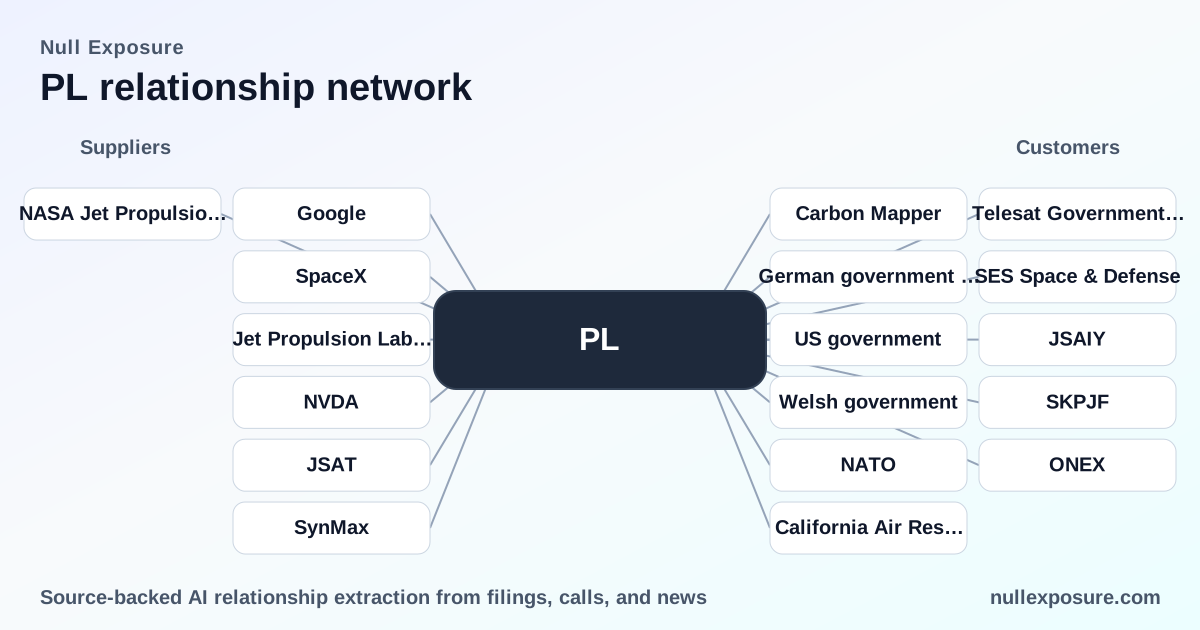
Planet Labs PBC (PL): Government and strategic customers underpin recurring licensing revenue
Planet Labs PBC operates and monetizes a global constellation of Earth-observing satellites by selling licensed access to imagery and analytics via subscription and usage-based contracts, and by securing multi-year public-sector and commercial agreements for tailored satellite services. Revenue is primarily licensing-driven, delivered through a cloud platform and recurring contracts, while public-private partnerships and subcontract roles expand addressable markets and scale. For investors evaluating Planet’s customer relationships, the mix combines high-value defense and government mandates with diversified commercial subscription demand—creating both predictable backlog and concentrated revenue exposures. Learn more at https://nullexposure.com/.
Why customer relationships matter for Planet’s valuation
Planet’s business model is centered on licensing and recurring revenue. That structure drives high gross margins on imagery and insight products but concentrates risk where large public contracts and a handful of enterprise clients account for material portions of revenue. The company’s contracting posture—subscription, usage-based and licensing agreements—supports a predictable revenue stream, while government and defense contracts increase strategic importance and long-term revenue visibility.
Two quick implications for investors:
- Upside: Multi-year government contracts validate pricing power and encourage platform adoption across national agencies and defense customers.
- Risk: Customer concentration and large contracts mean contract renewals or procurement shifts materially affect near-term revenue.
All cited customer relationships from the record (one-by-one)
Below are concise, plain-English takeaways for each relationship captured in the source results, with the reporting context.
-
US government — Planet’s management reported meetings with various US government leaders during the Q1 2026 earnings call, signaling active engagement across federal and civil agencies that support both sales and procurement pipelines. Source: Q1 2026 earnings call (Mar 7, 2026).
-
German government entity BKG — Management announced an expansion of a seven-figure countrywide contract with Germany’s BKG during the Q1 2026 earnings call, indicating incremental public-sector scale in Europe. Source: Q1 2026 earnings call (Mar 7, 2026).
-
Carbon Mapper — Planet described a $95 million award to its partner Carbon Mapper to provide the state of California with methane monitoring based on Tanager hyperspectral collections, illustrating Planet’s role in enabling partner-led large environmental monitoring programs. Source: Q1 2026 earnings call (Mar 7, 2026).
-
Welsh government — Planet expanded business with the Welsh government to support agriculture policy and natural resource management, reflecting regional public-sector adoption of Planet’s analytics for policy decisions. Source: Q1 2026 earnings call (Mar 7, 2026).
-
NATO — Defence-Industry.eu reported that NATO awarded Planet a new seven-figure contract for advanced daily monitoring and early-warning capabilities across strategic Alliance regions, reinforcing Planet’s strategic defense positioning (reported Mar 10, 2026). Source: Defence-Industry.eu (Mar 10, 2026).
-
Swedish Armed Forces — Multiple reports note a multi-year contract in the low nine-figure range with the Swedish Armed Forces, marking one of Planet’s largest defense contracts and a shift towards high-value sovereign procurement (reported May 3, 2026). Sources: Investing.com SEC/Insider coverage and related filings (May 3, 2026).
-
California Air Resources Board — PayloadSpace and company communications indicate that Tanager collections are being certified for use under existing Planet contracts and serve a key mission for the California Air Resources Board, highlighting Planet’s role in state-level environmental enforcement and monitoring. Source: PayloadSpace coverage and Planet communications (Mar 10, 2026).
-
Telesat Government Solutions — Planet is subcontracted to Telesat Government Solutions (and SES Space & Defense) for NASA’s Commercial Smallsat Payload (CSP) program, demonstrating Planet’s integration into larger public-private launch and service ecosystems. Source: Planet press materials regarding Pelican launches (Mar 10, 2026).
-
SES Space & Defense — As above, Planet operates as a subcontractor to SES Space & Defense on the NASA CSP program, which underscores public-private collaboration and Planet’s role as both service provider and subcontractor for institutional programs. Source: Planet press materials regarding Pelican launches (Mar 10, 2026).
-
JSA / JSAIY — Management noted that revenue from the Defense, Intelligence and National Security (DNI) sector grew over 20% year-over-year in Q1 2026, driven in part by Planet’s satellite services contract with JSA, indicating material contribution from that customer relationship during the period. Source: Q1 2026 earnings call (Mar 7, 2026).
-
SKPJF / SKY Perfect JSAT — PayloadSpace reported that a new constellation of Pelicans will prioritize capacity for SKY Perfect JSAT under a $230 million deal, showing Planet’s commercial capacity commitments to satellite operators and regional customers in Asia. Source: PayloadSpace report (Mar 10, 2026).
-
ONEX / Onyx — Planet announced a multiyear expansion with Onyx (an outdoor digital navigation company) to integrate PlanetScope products into recreation and mapping applications, demonstrating diversified commercial subscription growth beyond enterprise and government. Source: Q1 2026 earnings call (Mar 7, 2026).
What the relationship mix reveals about Planet’s operating model
Planet’s customer portfolio and contract evidence signal several company-level characteristics:
- Contracting posture: Planet sells primarily through licensing, subscription and usage-based arrangements that produce recurring revenue and remaining performance obligations (company disclosures support subscription and usage pricing models).
- Counterparty mix: The company serves governments and large enterprises—a dual market that elevates strategic importance but concentrates negotiation complexity and procurement cycles.
- Revenue concentration: Planet discloses that one customer historically accounted for roughly 19–21% of revenue, a material concentration that investors must factor into scenario analyses.
- Global footprint and maturity: Planet’s contracts span the US, Europe, Asia and subnational agencies (e.g., California and Wales), confirming global reach and a business still scaling into larger sovereign and commercial mandates.
- Role and margin dynamics: Planet acts as the principal seller and licensor—recognizing revenue on a gross basis—while also functioning as a subcontractor on select public-private programs.
- Relationship stage and backbone: Most relationships are active and multi-year, with remaining performance obligations providing visibility into near-term revenue recognition and backlog.
Investment takeaways and operational watchpoints
- Positive: Government and defense contracts (NATO, Swedish Armed Forces, US agencies, BKG) materially increase revenue visibility and validate Planet’s sensor and analytics roadmap. Public-sector mandates also accelerate adoption in adjacent commercial verticals (agriculture, environmental monitoring).
- Negative: Customer concentration and large-ticket public contracts create outsized sensitivity to procurement timing, renewals, and geopolitical shifts; investors must model potential churn or contract delays.
- Monitor: Renewal cadence of major contracts, certification status for new sensors (e.g., Tanager), and how Planet balances direct sales versus subcontracting roles will be determinant factors for gross margin trajectory and free cash flow timing.
For a deeper look at Planet’s customer signals and to track future relationship disclosures, visit https://nullexposure.com/.