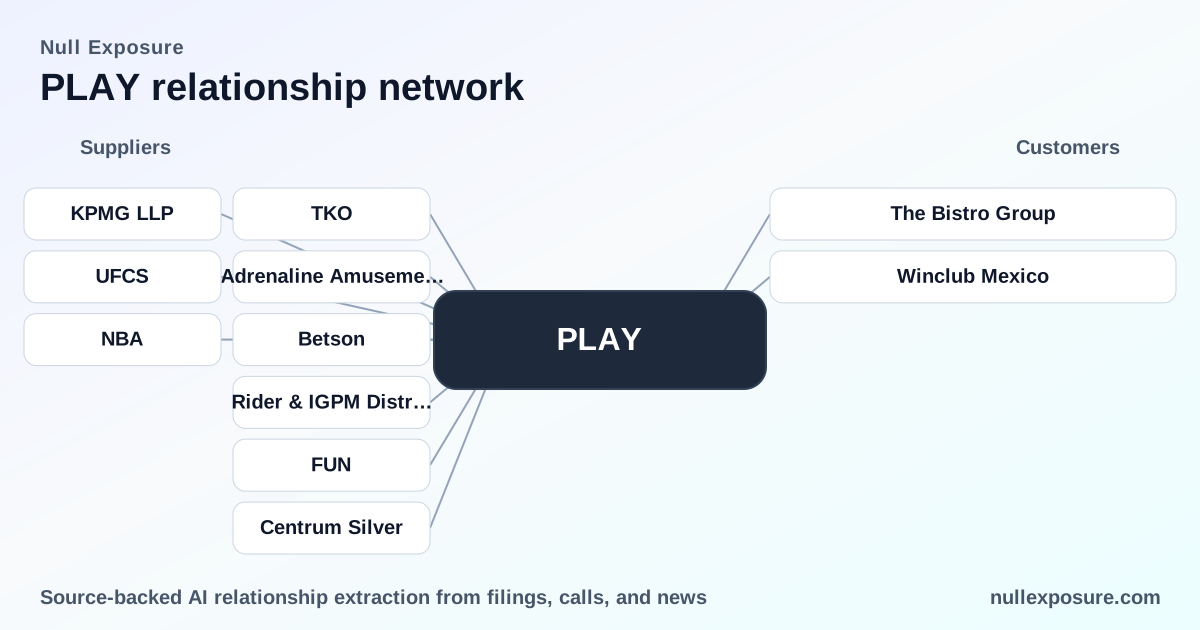
PLAY (Dave & Buster’s): Customer relationships driving international rollouts and the operational constraints investors must price
Dave & Buster’s Entertainment (NASDAQ: PLAY) operates high-volume, eatertainment venues combining dining and paid game play; the company monetizes through a blended revenue model of food & beverage sales, game-play credits (deferred entertainment revenue), and event/venue services. Strategic growth now centers on international franchising and partner-led market entry while the company’s financial profile remains defined by substantial North American footprint, meaningful deferred game-credit economics, and thin near-term profitability despite solid EBITDA. For investors evaluating customer and partner exposures, the key story is execution of franchise relationships that extend the brand beyond its owned store base while leaving core economics and audit-sensitive deferred revenue squarely on the company’s balance sheet.
Visit the company profile and data at https://nullexposure.com/ for a concise view of PLAY’s corporate disclosures and partner announcements.
Why partners matter to PLAY’s growth story
Dave & Buster’s historically scales through company-operated stores; recent relationship disclosures show a deliberate pivot to local partners and master-franchise agreements to accelerate international presence with lower capital intensity. These relationships reduce upfront store capex for PLAY while transferring local development, permitting, and operating risk to experienced regional operators — a model that preserves the brand’s customer-facing economics but increases dependency on partner performance and local market execution.
Key takeaway: international partnerships are growth multipliers for revenue and brand reach but raise counterparty and execution risk that investors must price separately from committed corporate store economics.
Relationship-level coverage (each result from the public record)
The Bistro Group — Philippines (Philstar coverage, FY2025 reporting)
Dave & Buster’s entered the Philippines through a partnership with The Bistro Group, the local restaurant franchiser that will develop and operate the brand’s first venue there, introducing a VR-centric attraction as part of the rollout. According to a lifestyle piece in Philstar (published October 14, 2025) the launch marked the start of the brand’s partnership with The Bistro Group to bring U.S. franchise concepts to the Philippines. (Philstar, Oct 2025)
Source: https://www.philstar.com/lifestyle/2025/10/14/2479847/watch-exclusive-vr-attraction-american-faves-1st-dave-busters-philippines/amp/
The Bistro Group — Philippines (PR Newswire release, FY2025 disclosure)
A company press release confirmed the opening of Dave & Buster’s first Philippine location at Opus Mall, executed in partnership with The Bistro Group, which PR Newswire described as the Philippines’ leading restaurant group. This release establishes the commercial relationship and the first operating site under the regional partner agreement. (PR Newswire, March 2026)
Source: https://www.prnewswire.com/news-releases/dave--busters-opens-first-location-in-the-philippines-at-opus-mall-302585688.html
Winclub Mexico — planned Mexican market entry (market commentary, FY2025)
Dave & Buster’s announced entry into Mexico through a planned partnership with Winclub Mexico, targeting 10 locations and initiating development with a Mexico City site by late 2025; this is a partner-led expansion intended to replicate the company’s North American play-eat model through a local operator. The plan was reported in a December 2025 market commentary focused on the company’s turnaround strategy. (FinancialContent / PredictStreet, Dec 2025)
Source: https://markets.financialcontent.com/wral/article/predictstreet-2025-12-10-dave-and-busters-entertainment-inc-play-navigating-a-turnaround-in-the-eatertainment-landscape
How these partnerships interact with PLAY’s operating constraints
The relationship evidence must be read alongside company-level constraints and audit disclosures to understand risk and operational posture:
- Geographic concentration is predominantly North America. PLAY continues to own and operate 232 stores in North America (171 Dave & Buster’s-branded stores in 43 states, Puerto Rico and Canada as of Feb 4, 2025), so international partnerships are extensions, not replacements, of the core footprint. This is a company-level signal that international rollouts are growth initiatives layered onto an already large North American base.
- Deferred game-credit revenue is material and audit-sensitive. Management and auditors call out the estimation of future use for unused game credits as a critical audit matter, which makes the company’s revenue recognition and cash-conversion mechanics central to valuation and risk assessment.
- The core product is service-driven game play bundled with food & beverage. Game play is described as the brand’s differentiator and a core product segment; this elevates customer experience and machine uptime as operational priorities that partners must replicate.
- Counterparty type leans toward commercial operators, but an ‘individual’ signal exists in source text. The textual evidence classifies the company as a leading operator of high-volume venues, which is a corporate-level characterization rather than a partner-specific classification.
Together, these constraints indicate a contracting posture that balances capital-light international growth with concentrated operational exposure (critical deferred revenue, experiential core product) that requires partners to meet brand and accounting standards.
Investment implications — risk-adjusted views for operators and allocators
- Upside: Partnerships with established local franchisors (The Bistro Group, Winclub Mexico) deliver low-capex expansion, faster market entry, and brand awareness in key global leisure markets. If partners execute on unit economics similar to North American peers, incremental revenue with limited capex strengthens long-term ROIC.
- Execution risk: These relationships shift operating risk to franchisees; investors must underwrite partner capabilities, development timelines, and the ability to replicate game-play experience — a critical driver of customer retention and per-visit spend.
- Accounting and cash flow sensitivity: The critical audit matter around deferred entertainment revenue means growth financed through rising game-credit sales affects cash recognition and future revenue realization; robust disclosure and conservative estimates are essential for credible forecasts.
- Concentration and maturity: With a dominant North American footprint, international relationships are growth-stage bets rather than core earnings drivers in the near term; valuation should reflect staged earnings conversion and potential volatility in partner-driven markets.
Bottom line and recommended next step
Dave & Buster’s is executing a deliberate partner-first international growth strategy that preserves capital but increases dependency on third-party operators to replicate its game-centric eatertainment model. Investors should value international partnership announcements as potential long-term upside while stressing partner execution and deferred revenue accounting in near-term risk assessments.
For a consolidated view of PLAY’s filings, partner announcements, and structured relationship tracking, see the company overview at https://nullexposure.com/.