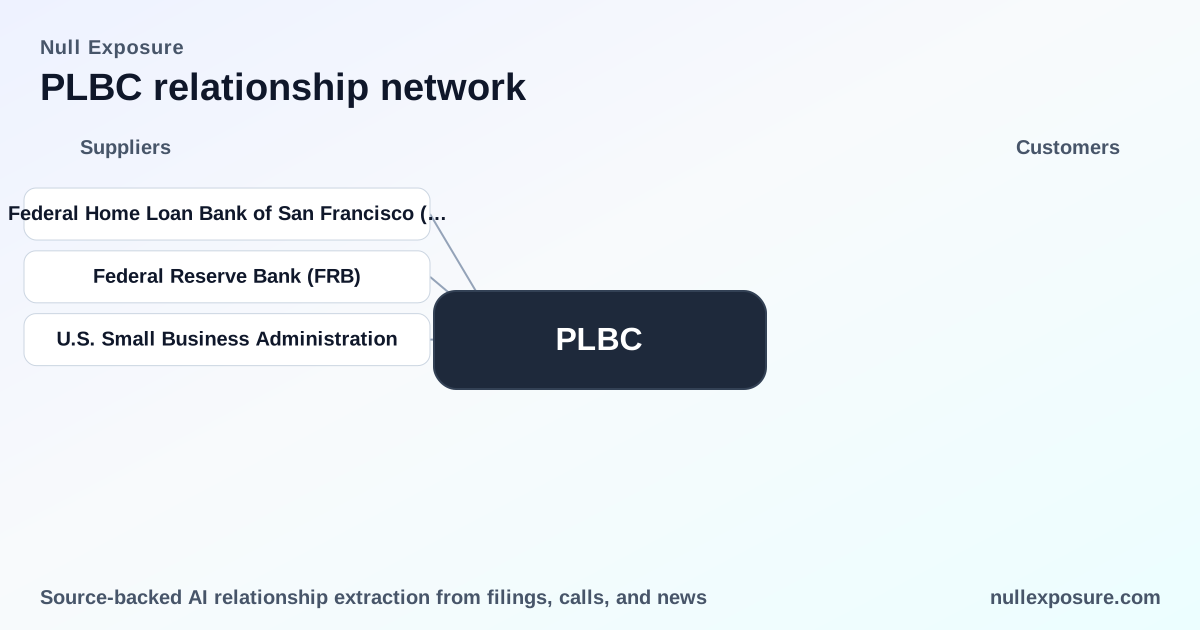
Plumas Bancorp (PLBC) — Customer Relationships and What Investors Should Know
Plumas Bancorp operates as the holding company for Plumas Bank, a community regional bank that monetizes through net interest margin on loan portfolios and fee income from deposit and transaction services concentrated in Northeastern California and Northwestern Nevada. The bank’s business model is a classic community-bank mix: core deposit gathering, middle-market and small-business lending, and recurring account and transaction fees that drive predictable cash flows and underwriting discipline.
For a concise monitor on customer exposures and relationship-level events, visit https://nullexposure.com/ for ongoing coverage and alerts.
Why customer-level reads matter for PLBC investors
Plumas Bank’s financial profile — modest market cap, solid ROE and concentrated geographic footprint — means single relationship actions (brokered deposits, large loan wins or losses) have outsized impacts on liquidity and funding cost even when management states no single customer is material. Understanding each disclosed counterparty interaction is essential to anticipate short-term funding and interest-cost movements that feed directly into earnings.
What the record filings show about Cornerstone Community Bank
Two press items published in April/May 2026 disclose a single, discrete funding relationship with Cornerstone Community Bank (CCB). Both items report the same transaction; they differ only in their distributor.
- Plumas Bancorp accepted a $10 million brokered time deposit from Cornerstone Community Bank at an interest rate of 3.80% during Q1 FY2026. This was recorded as the bank’s only brokered deposit for the quarter, indicating a targeted, one-off funding transaction rather than an ongoing brokered-deposit program. According to the company’s Q1 2026 results press release on GlobeNewswire (April 15, 2026), the deposit was reported as a single brokered deposit. (GlobeNewswire, April 15, 2026)
- A trade publication repost of the same Q1 results confirms the transaction and terms: the $10 million time deposit from CCB at 3.80% is listed as the sole brokered deposit for the period. This duplication in coverage provides corroboration of the transaction in the public record. (Sahm Capital news republishing of Plumas Bancorp Q1 results, April 2026)
Every relationship disclosed (no omissions)
Plumas Bancorp’s customer-scope results include two items, both describing the Cornerstone Community Bank brokered-deposit transaction. I cover each source individually:
- GlobeNewswire press release (Q1 FY2026): The bank’s brokered deposits “consisted of a single $10 million time deposit acquired from CCB, bearing an interest rate of 3.80%.” This is the primary company-filed disclosure of the funding event and should be treated as the authoritative source for the quarter’s brokered-deposit activity. (GlobeNewswire, April 15, 2026)
- Sahm Capital republished item (Q1 FY2026): A syndicated copy of the Q1 results repeats the same language on the single $10 million CCB time deposit at 3.80%, providing independent media confirmation of the same event. (Sahm Capital coverage of Plumas Bancorp Q1 results, April 2026)
Operating model and contracting posture — what the constraints tell investors
Plumas Bancorp runs a service-provider banking model built around recurring deposit relationships and transaction fees. The disclosures and company materials reveal a mix of contract types and counterparty profiles that shape both revenue predictability and sensitivity to regional cycles:
- Contracting posture: The bank collects subscription-like recurring fees (account maintenance and analyzed account fees billed monthly) and usage-based transactional fees (NSF, overdraft, wire fees recognized when services occur). This hybrid billing model produces a steady baseline of fee income with episodic upside from transactional activity.
- Concentration & counterparty mix: Operations are geographically concentrated across Northeastern California and Northwestern Nevada, with customers largely composed of individuals, small businesses and mid-market enterprises, plus a portion of smaller municipal entities. Management explicitly states that no single customer or group is material to deposits, implying a diversified deposit base even within a narrow geographic footprint.
- Criticality: Deposits and loan relationships are core to revenue generation; interest income on real-estate, commercial and consumer lending is the primary profit engine, supplemented by fee income tied to servicing deposit and loan customers.
- Maturity: The bank operates as an established community lender with domestic operations across a small number of adjacent states, indicating a mature regional footprint rather than an early-stage or national expansion posture.
These signals combine into a clear operational profile: stable recurring revenues, geographically concentrated credit and deposit risk, and limited single-counterparty concentration — features that both underpin earnings predictability and constrain upside diversification.
For ongoing tracking of counterparty-level disclosures and to integrate them into portfolio monitoring workflows, see https://nullexposure.com/.
Risk considerations stemming from customer relationships
- Funding cost sensitivity: The single $10 million brokered deposit at 3.80% signals tactical use of brokered funding to manage liquidity; if repeated, such funding is more expensive than core deposits and would compress net interest margin.
- Geographic cyclicality: With operations tied to California and Nevada real estate and local business cycles, recession or local real-estate stress could simultaneously depress loan performance and reduce deposit stickiness.
- Fee mix limits: While account maintenance and transaction fees provide steady revenue, they are bounded in scale relative to interest income; credit-cycle shocks therefore remain the dominant earnings risk.
Investment implications and bottom line
- Short-term: The FY2026 Q1 brokered-deposit event is a manageable, disclosed liquidity action — noteworthy for cost-of-funds analysis but not, on its own, a material credit signal given management’s statement that no single customer is material.
- Medium-term: Plumas Bancorp’s business model is predictable: NIM-driven earnings, supported by recurring fee income and focused community lending. The bank’s regional concentration is the primary structural risk and also the source of its localized franchise value.
- Watchlist: Monitor frequency and scale of brokered funding, regional loan-loss trends, and fee-income stability; recurring use of brokered deposits would flag higher funding costs and potential margin pressure.
If you evaluate regional banks, adding granular customer-relationship tracking to your due-diligence toolkit materially improves signal-to-noise when reading quarterly statements and press releases. For a centralized view of such disclosures and relationship-level alerts, visit https://nullexposure.com/.