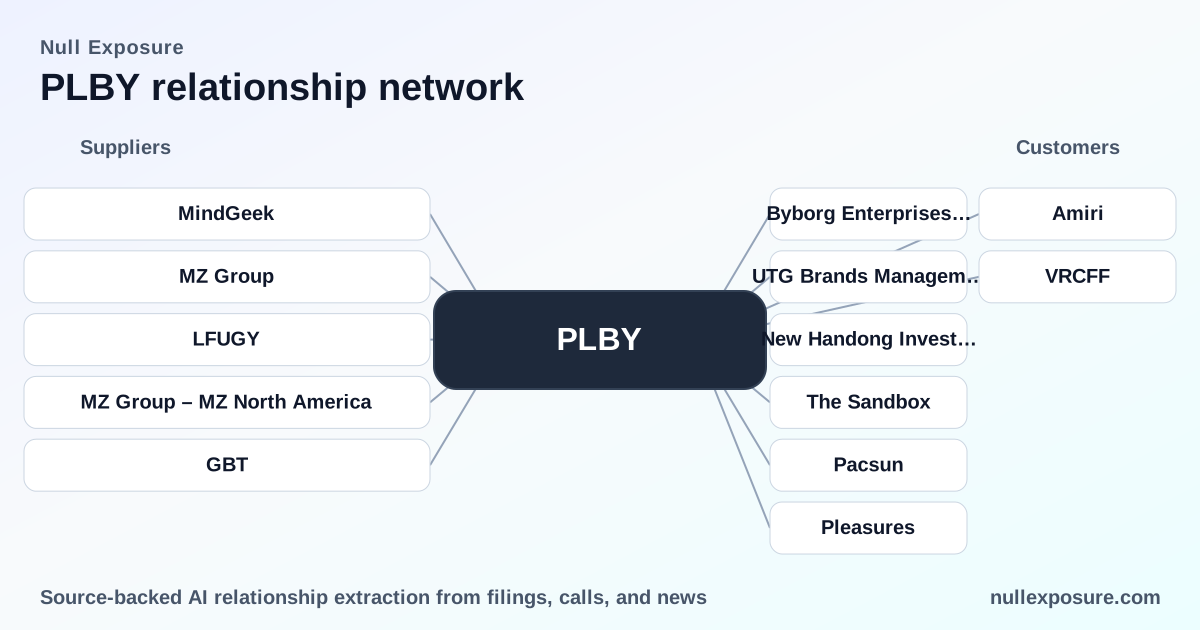
PLBY’s customer relationships: an investor roadmap to an asset-light licensing engine
PLBY Group monetizes the Playboy brand primarily through an asset-light licensing model, selling rights to operators and brand partners worldwide while capturing royalties, minimum-guaranteed payments and profit‑share on content and consumer products. Recent heavyweight transactions—most notably a 15‑year Byborg digital license and a partial sale of the China licensing business to UTG—transform cash flow visibility and materially reshape balance‑sheet risk. Learn more at https://nullexposure.com/.
The business model in one line: brand IP sold to operators, cash booked up front, upside retained
PLBY is a brand owner that converts intellectual property into recurring revenue by licensing trademarks, digital platforms and content franchises to third‑party operators. The company pursues long‑dated licenses with annual minimum guarantees and selective JV monetizations to accelerate cash realization while keeping the upside through royalties and profit shares.
What that contract posture implies for investors
- Contracting posture: asset‑light and license‑centric. PLBY systematically transfers operating responsibility (distribution, digital platforms, local marketing) to licensees while retaining trademark control and economics through minimum guarantees and royalties.
- Concentration of economic events. Material lump‑sum and multi‑year guarantees (see Byborg and UTG) concentrate near‑term cash inflows but also create dependency on a small number of large counterparties.
- Criticality of IP. The Playboy brand is the company’s core asset; partner performance directly drives royalty streams and the company’s ability to scale revenue without heavy capex.
- Contract maturity: multi‑year, sometimes multi‑decade. Long terms (e.g., 15 years) increase revenue visibility but lock PLBY into counterparty execution risk for extended periods.
Relationship map: who PLBY partners with and what each deal delivers
Byborg Enterprises SA
Byborg is PLBY’s anchor digital licensee for global digital content: a 15‑year licensing agreement with $300 million in minimum guaranteed payments for Playboy digital IP and operation of Playboy Plus, Playboy TV and the Playboy Club. Source: GlobeNewswire and subsequent company filings describing the December 2024 Byborg licensing agreement and the $300M, 15‑year guarantee (reported in FY2025 disclosures).
UTG Brands Management Group / United Trademark Group (UTG)
PLBY sold 50% of its China licensing business to UTG in a deal delivering roughly $122 million of contracted cash, structured as a $45M purchase price (paid over multiple closings), $67M of guaranteed minimum distributions over eight years, plus $10M for brand support services; UTG initially acquired a ~16.67% stake in the local JV at first close. Source: PLBY FY2025/FY2026 results and GlobeNewswire March 2026 announcements.
Borg / Borg Strategic Partnership
PLBY references a digital licensing anchor that delivers an annual $20 million minimum guarantee under a strategic Borg partnership that underpins the company’s digital licensing revenue baseline. Source: Q4 2025 earnings commentary and related transcripts reported by The Globe and Mail / Motley Fool coverage in FY2026.
Propagate
Propagate has been contracted to develop original television content based on historic Playboy franchises, structured as licensing revenue plus profit share to preserve PLBY’s asset‑light stance. Source: Q4 2025 earnings call transcript summarized by InsiderMonkey (FY2026).
The Sandbox (Animoca Brands)
PLBY licensed brand rights to The Sandbox to create a Playboy‑themed immersive gaming/metaverse experience, representing brand extension into web3/gaming and non‑traditional licensing categories. Source: Animoca Brands announcement (original collaboration announced FY2022, referenced in FY2026 recaps).
Gaming Technologies, Inc. (GMGT)
GMGT partnered with PLBY to launch a Playboy‑branded, real‑money Rummy mobile game in India, representing PLBY’s expansion into regulated gaming and local market product licensing. Source: Licensing International announcement documenting the GMGT collaboration (FY2021 original transaction noted in later coverage).
Honey Birdette
Honey Birdette is a retail partner whose performance contributed to PLBY’s reported strength in global licensing; the company’s product and store footprint (Australia, U.S., U.K.) supports consumer product revenue and retail royalty flows tied to lingerie and intimate‑wear categories. Source: PLBY’s FY2025/FY2026 financial results highlighting Honey Birdette and store geography.
New Handong Investment
PLBY prevailed in arbitration against former Chinese licensee New Handong Investment, winning approximately $81 million in damages, a legal outcome that clears a legacy dispute and removes a historical drag on monetization in China. Source: arbitration coverage summarized in market commentary and PLBY filings (reported in FY2025).
Amiri
Amiri is one of a string of fashion collaborators; PLBY has co‑branded denim and apparel collaborations with Amiri that extend Playboy into premium streetwear channels. Source: WWD fashion coverage (FY2022 origin, cited in subsequent summaries).
Pleasures
Pleasures is another apparel collaborator used to drive streetwear and cultural relevance through limited‑run collections, supporting wholesale and retail licensing economics. Source: WWD fashion write‑ups (FY2022).
Pacsun
Pacsun represents a retail distribution partner used by PLBY for mass‑market apparel collaborations and seasonal collections that generate royalty and wholesale revenue. Source: WWD’s 2022 fashion reporting.
Supreme / VRCFF
Playboy has engaged in collaborations with Supreme and other streetwear names; referenced listings include Supreme (ticker VRCFF in some datasets) that provide high‑visibility co‑brands and licensing royalties across limited‑edition drops. Source: WWD (FY2022) and supporting market data entries showing VRCFF mapping.
Constraints and what they mean for underwriting PLBY
- Licensing and long‑term commitments are core to the model. Company disclosures confirm long‑dated licensing agreements (explicitly cited for Byborg: a 15‑year $300M minimum guarantee), which creates durable top‑line visibility but transfers operational execution risk to licensees.
- Material spend bands are concentrated. The Byborg deal is a clear >$100M counterparty commitment, a company‑level signal that PLBY relies on a small number of large minimum guarantees to drive cash flows.
- Geographic footprint is global but locally executed. Evidence shows PLBY’s brand is sold in ~180 countries and that retail partners like Honey Birdette operate across APAC, NA and EMEA; PLBY therefore leverages local operators to scale without heavy capex.
- Counterparty mix is diverse in type and maturity. Relationships span strategic long‑term licensees, retail collaborators, content studios and gaming operators—supporting diversified revenue channels but requiring active partner governance.
- Counterparty legal outcomes matter. The New Handong arbitration recovery (~$81M) underscores how legacy disputes can create material financial volatility and how legal resolution can unlock cash or reduce uncertainty.
Final read for investors
PLBY is executing an intentional pivot to monetize brand equity through long‑dated licensing and selective JV sales that generate near‑term cash while preserving upside. That strategy enhances free‑cash‑flow potential but concentrates execution risk in a few large partners; investors should monitor counterparties’ operational performance, minimum guarantee collections and the pace of royalty recognition. For a deeper relationship map and deal chronologies visit https://nullexposure.com/.
Key sources include PLBY corporate releases and earnings materials (FY2024–FY2026), GlobeNewswire press releases, earnings‑call transcripts reported by major outlets and industry press coverage cited above.