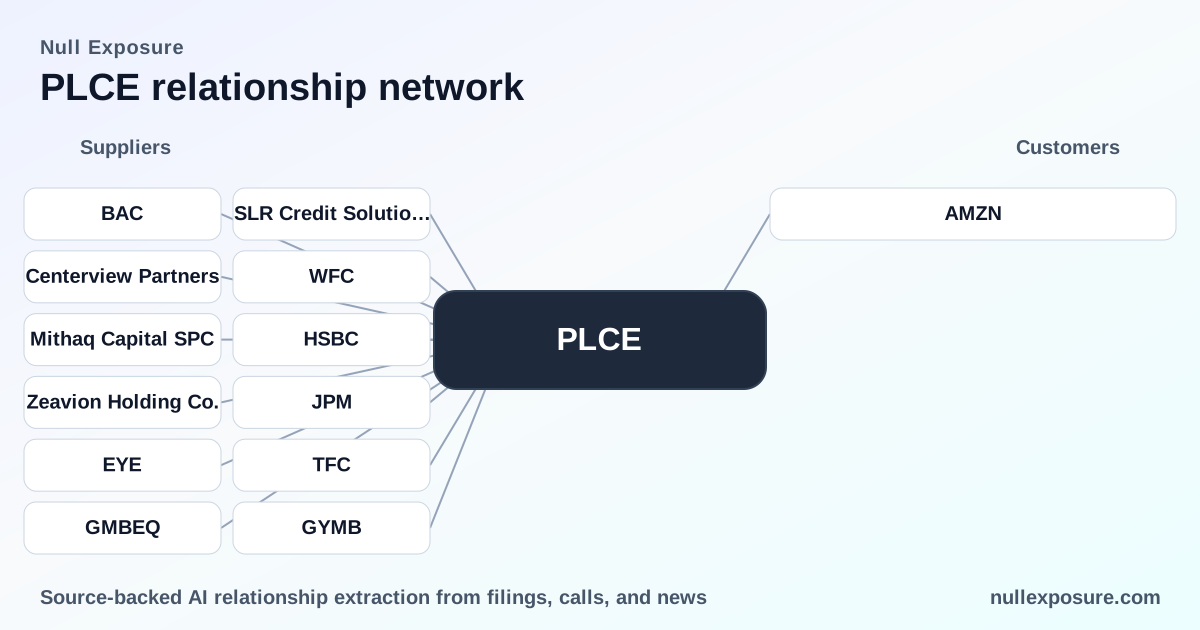
Children's Place (PLCE): Customer Map and What It Means for Investors
Children’s Place is a specialty children’s apparel retailer that monetizes through omnichannel retail sales, wholesale placements and loyalty-driven repeat purchases; the company runs an extensive store footprint and digital storefronts while supplementing revenue with wholesale distribution and franchise partnerships. Revenue comes from three channels — company stores and ecommerce, wholesale placements, and international franchises — with loyalty and private‑label credit driving high repeat purchase rates. For a concise view of relationship signals and implications, see Null Exposure’s research hub: https://nullexposure.com/
Quick thesis for investors
The company’s operating model is retail-first with wholesale distribution as a strategically significant secondary channel. Loyalty economics are central — a very large share of sales flow through MyPLACE and the private‑label credit program — while wholesale and third‑party channels provide reach and inventory turnover levers. Given constrained profitability metrics and negative EPS, the immediate investment case hinges on concentration risk management and successful inventory discipline.
Who buys and distributes Children’s Place products (relationship snapshot)
Amazon
Children’s Place sells product through an official Amazon storefront and also engages in wholesale shipments to the platform, but wholesale revenue contracted after the company reduced shipments to rebalance inventory levels. According to PR Newswire, collaborative collections have been sold via The Children’s Place Amazon storefront (PR Newswire, Mar 2023), while reporting around the FY2026 period noted a planned reduction in wholesale shipments to Amazon to rebalance inventory (FashionUnited, Apr 2026; TradingView coverage of company filings, May 2026). Key takeaway: Amazon functions both as a retail storefront partner and a wholesale channel, and recent shipment reductions directly affected wholesale revenue.
Source: PR Newswire press release on the Mariah Carey collaboration (March 2023) — https://www.prnewswire.com/news-releases/queen-of-christmas-and-music-icon-mariah-carey-teams-up-with-the-childrens-place-to-ring-in-the-holidays--unveil-the-final-launch-of-its-three-part-holiday-2023-campaign-301958710.html; FashionUnited coverage (April 2026) — https://fashionunited.uk/news/business/the-childrens-place-experiences-significant-downturn-in-q4-financials/2026041387410; TradingView reporting on the company 10‑K/FY2025 summary (May 2026) — https://www.tradingview.com/news/tradingview:e6c4565cade23:0-childrens-place-reports-1-208-8m-revenue-and-4-01-eps-in-fiscal-2025-10-k/
Shein
Children’s Place has extended distribution to Shein’s marketplace to broaden reach and gain access to the platform’s consumer base, allowing the company to list and sell product on Shein’s storefront. Retail Dive reported that this partnership enables The Children’s Place to distribute products through Shein (Retail Dive coverage, 2026). Key takeaway: Shein expands distribution reach into fast‑fashion marketplaces, diversifying channels beyond traditional wholesale and company retail.
Source: Retail Dive coverage of the Shein partnership (2026) — https://www.retaildive.com/news/shein-the-childrens-place-storefront/731778/
Operational constraints and what they signal for partners and investors
The relationship signals in filings and press coverage generate a compact set of company‑level constraints that shape negotiating posture, counterparty risk and execution priorities:
-
Geographic concentration and retail footprint (North America focus): The company describes itself as “the largest pure‑play children’s specialty retailer in North America,” operating roughly 495 stores in North America plus two digital storefronts and 190 international points of distribution via six franchise partners. This is a mature, regionally concentrated retail franchise model that relies on North American traffic and wholesale channels for the bulk of sales. (Company overview disclosures; fiscal details in filings.)
-
Revenue concentration and counterparty exposure: Management discloses one U.S. wholesale customer that accounted for more than 10% of net sales — $170.7 million in Fiscal 2024 — and represented the majority of accounts receivable ($31.6 million as of Feb 1, 2025). This is a material concentration signal that elevates receivables and counterparty credit risk for the company. (Company filing excerpts referenced in internal constraints.)
-
Loyalty program criticality: At the end of Fiscal 2024, members of MyPLACE Rewards and/or the private‑label credit program accounted for approximately 85% of sales, underscoring that the company’s retention economics are central to revenue stability and margin management. This is a critical revenue driver that investors should monitor as a barometer of customer stickiness and promotional leverage.
-
Spend band and relationship scale: The company‑level evidence places at least one wholesale relationship in the $100m+ spend band, indicating materially sized commercial agreements that have outsized P&L impact when volumes swing.
-
Relationship posture and stage: Constraints characterize the wholesale relationship as active and the company as engaging in inventory rebalancing — operational levers that influence shipment cadence and negotiating flexibility with buyers.
For deeper analysis across counterparties, see the Null Exposure research hub: https://nullexposure.com/
How these relationship signals alter the investment case
Children’s Place reports roughly $1.21 billion in trailing revenue with negative operating margins and an EPS loss (RevenueTTM: $1.2088B; OperatingMarginTTM: -11.1%; DilutedEPSTTM: -3.84). The business is operating under margin pressure while relying on concentrated sales channels and loyalty economics to sustain cash flow. The Amazon shipment reductions described in recent press directly connect inventory management to wholesale revenue volatility, and the Shein distribution agreement is a strategic move to diversify channels but does not eliminate concentration risk.
- Positive: omnichannel distribution, large loyalty base (85% of sales), established franchise footprint in North America and select international markets.
- Negative: high counterparty concentration to a single large wholesale buyer, negative profitability metrics, and inventory sensitivity that has already triggered shipment curtailments to wholesale partners.
Investors should value Children’s Place as a retail operator whose upside depends on restoring operating leverage while preserving diversified distribution and managing receivables risk.
Practical signals operators and procurement teams should watch next
Operators and counterparties can prioritize a short watchlist of measurable indicators:
- Inventory-to-sales ratios and the cadence of shipments to major wholesale partners (public filings and press releases have shown these directly affect wholesale revenue).
- Receivables aging and credit exposure to the single large U.S. wholesale customer (the company has disclosed AR concentration totals).
- Loyalty program activation and retention metrics; a decline from the 85% share of sales would materially affect revenue predictability.
- New distribution agreements beyond Shein that reduce exposure to any single wholesale buyer.
Bottom line
Children’s Place runs a concentrated, loyalty‑driven retail business with meaningful wholesale channels that can swing revenue through inventory decisions. The company’s immediate outlook rests on inventory discipline, the health of loyalty economics and the ability to de‑risk a materially large wholesale exposure. For continued signal monitoring and structured relationship intelligence, visit Null Exposure: https://nullexposure.com/