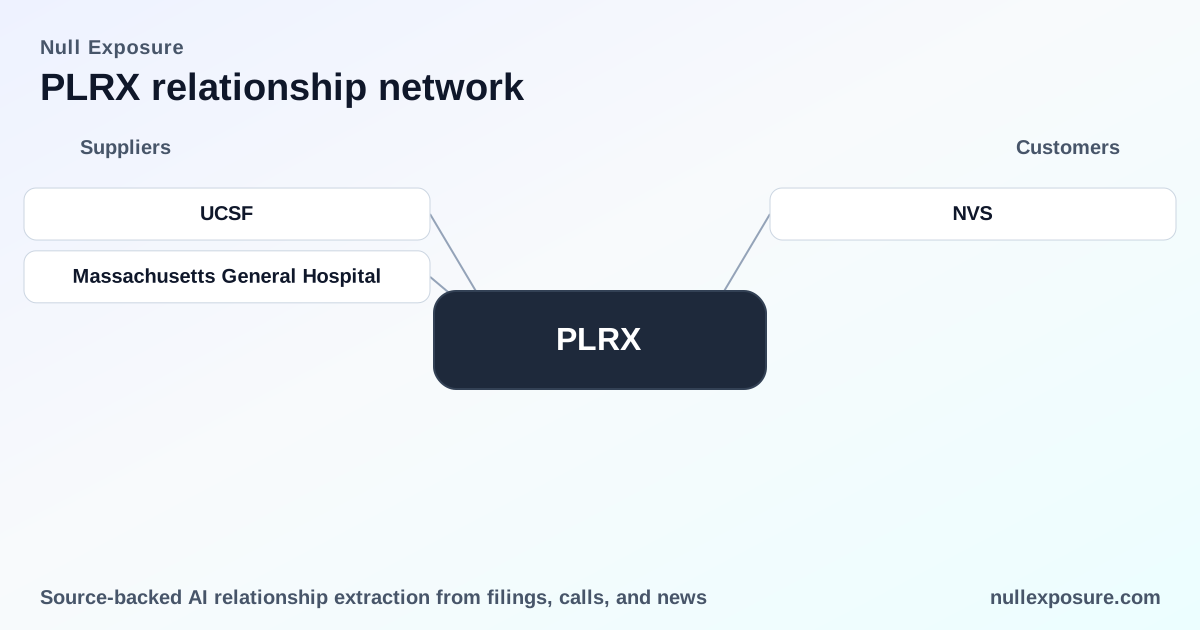
Pliant Therapeutics (PLRX): How the Novartis relationship shaped revenue and strategy
Pliant Therapeutics operates as a clinical-stage biotech focused on discovering and developing fibrosis therapies and monetizes primarily through licensing deals, development partnerships, upfront and milestone payments, and future royalties, while maintaining a core objective to commercialize its own product candidates. For investors evaluating customer exposure, the company’s most consequential commercial relationship historically was with Novartis — a licensing and development arrangement that delivered a material cash infusion but ultimately terminated, returning program rights to Pliant. For a concise dossier on customer impacts and deal history, see NullExposure for additional context: https://nullexposure.com/.
Executive thesis: concentrated cash from licensing, then strategic reset
Pliant’s commercial model for near-term financing has relied on large, one-off licensing transactions rather than recurring product sales. The Novartis agreement generated the company’s only reported revenue in the referenced periods, delivering upfront and milestone proceeds but not an ongoing revenue stream after termination. That structure produced a short-term liquidity boost while simultaneously exposing Pliant to single-counterparty concentration risk and a subsequent strategic reset when the partner terminated the agreement and rights reverted.
- Contracting posture: The relationship was a licensing and development partnership delivering intellectual property licenses, R&D services, and milestone economics.
- Concentration: Novartis accounted for 100% of Pliant’s revenue and accounts receivable in 2022 and 2023, indicating extreme revenue concentration during those years.
- Criticality and materiality: The Novartis receipts were material to the company’s reported revenue profile and cash position in the relevant fiscal periods.
- Maturity: The agreement terminated in April 2023, causing an immediate change in commercial trajectory and reversion of rights to Pliant.
Primary relationship entries in public records (each listing from the search results)
GlobeNewswire press release (Jan 22, 2023) — Novartis (FY2023)
Pliant noted that it had transferred PLN‑1474, a selective αvβ1 inhibitor for NASH with liver fibrosis, to Novartis under the development partnership; the press release highlighted program transfers and development collaboration. (GlobeNewswire press release, Jan 22, 2023: https://www.globenewswire.com/news-release/2023/01/22/2592836/0/en/Pliant-Therapeutics-Announces-Positive-Data-from-the-INTEGRIS-IPF-Phase-2a-Trial-Demonstrating-Bexotegrast-320-mg-was-Well-Tolerated-and-Achieved-Statistically-Significant-FVC-Incr.html)
GlobeNewswire press release (Jan 22, 2023) — NVS (FY2023)
The same GlobeNewswire item is indexed again under the ticker NVS; it repeats that PLN‑1474 had been transferred to Novartis pursuant to the development partnership, reinforcing the public announcement of program assignment. (GlobeNewswire press release, Jan 22, 2023: https://www.globenewswire.com/news-release/2023/01/22/2592836/0/en/Pliant-Therapeutics-Announces-Positive-Data-from-the-INTEGRIS-IPF-Phase-2a-Trial-Demonstrating-Bexotegrast-320-mg-was-Well-Tolerated-and-Achieved-Statistically-Significant-FVC-Incr.html)
SEC filing / Exhibit (2022) — Novartis (FY2022)
Pliant’s SEC disclosure details the Novartis Agreement terms: an upfront license fee of $50.0 million, an additional $29.0 million tied to specified R&D milestones, and provisions for royalties and other payments; the filing also documents Novartis’s termination right and the mechanics for reversion of rights upon termination. (Pliant Therapeutics SEC filing, Exhibit (Form 8‑K disclosure), 2022: https://www.sec.gov/Archives/edgar/data/1746473/000119312522190873/d356984dex991.htm)
SEC filing / Exhibit (2022) — NVS (FY2022)
This index entry mirrors the preceding SEC exhibit and reiterates that PLN‑1474 was transferred to Novartis under the agreement, with the same financial and reversion mechanics disclosed in the company filing. (Pliant Therapeutics SEC filing, Exhibit (Form 8‑K disclosure), 2022: https://www.sec.gov/Archives/edgar/data/1746473/000119312522190873/d356984dex991.htm)
How the documented constraints shape Pliant’s operating model
The public excerpts and constraints drawn from filings and press releases define how investors should view Pliant’s business risk and runway.
- Licensing-first monetization: The Novartis deal is explicitly a licensing arrangement that included upfront fees, milestone payments, cost reimbursements, R&D services, and royalty mechanics — a classic biotech cash strategy to de‑risk programs and fund operations while retaining upside via milestones and royalties when partners commercialize. This is a company-level operating signal: licensing is central to how Pliant historically funded development.
- Material single-counterparty exposure: Disclosures state Novartis accounted for all reported revenue and accounts receivable for at least two reporting years — a concentration signal that elevates counterparty risk and compresses revenue diversification until Pliant builds its own commercial franchise or replaces partner income.
- Dual role: licensor and service provider: The agreement combined IP licensing with paid R&D services and reimbursements, meaning Pliant both sold rights and acted as a vendor on development work — this hybrid posture changes negotiation leverage and cost recognition timing.
- Termination and reversion: Novartis exercised its termination right (effective April 18, 2023) and rights reverted to Pliant; termination converts a previously steadying cash relationship into a strategic opportunity and a near-term revenue gap. Where constraints explicitly name Novartis, the historical facts are tied directly to that relationship; where a constraint excerpt is generic, treat it as a company-level characteristic.
Investment implications: risks, runway, and optionality
The Novartis engagement delivered a meaningful cash infusion via upfront and milestone proceeds but underscored three durable investment considerations:
- Short-term liquidity vs long-term revenue generation: Licensing produces lump-sum inflows but not recurring sales; Pliant’s post-termination path depends on either re-licensing retained programs or advancing candidates toward commercialization to create sustained revenue.
- Concentration risk until diversification: With Novartis historically providing 100% of recorded revenue in the cited periods, Pliant requires new partnerships, product approvals, or direct commercialization to diversify counterparty and revenue sources.
- Value of returned assets: The reversion of PLN‑1474 and other rights creates optionality; Pliant can re-license, pursue alternative partnerships, or push candidates internally — each path carries distinct capital and dilution tradeoffs that will affect valuation multiples and investor returns.
Analyst coverage reflects cautious positioning: consensus target price in the provided data sits at $2.67, which investors should weigh against Pliant’s balance of cash, negative EBITDA, and pipeline progress.
Key takeaways and recommended actions
- Novartis was the single material commercial counterparty in 2022–2023 and delivered upfront and milestone cash that materially affected Pliant’s revenue profile. (See SEC exhibit and GlobeNewswire announcements.)
- The agreement terminated in April 2023 and rights reverted to Pliant, creating both a near-term revenue gap and medium-term strategic optionality around PLN‑1474.
- Pliant’s business model is licensing-driven for near-term financing, with R&D services bundled into partner deals; investors should track new partnerships, milestone receipts, and clinical readouts as primary value catalysts.
- Monitor cash runway and financing moves closely — absent replacement licensing income or rapid clinical advance, dilution risk and dependency on capital markets remain the principal investor concerns.
For a synthesized deal and counterparty dossier, and to track subsequent partnership announcements or revenue disclosures, consult the NullExposure company page: https://nullexposure.com/.