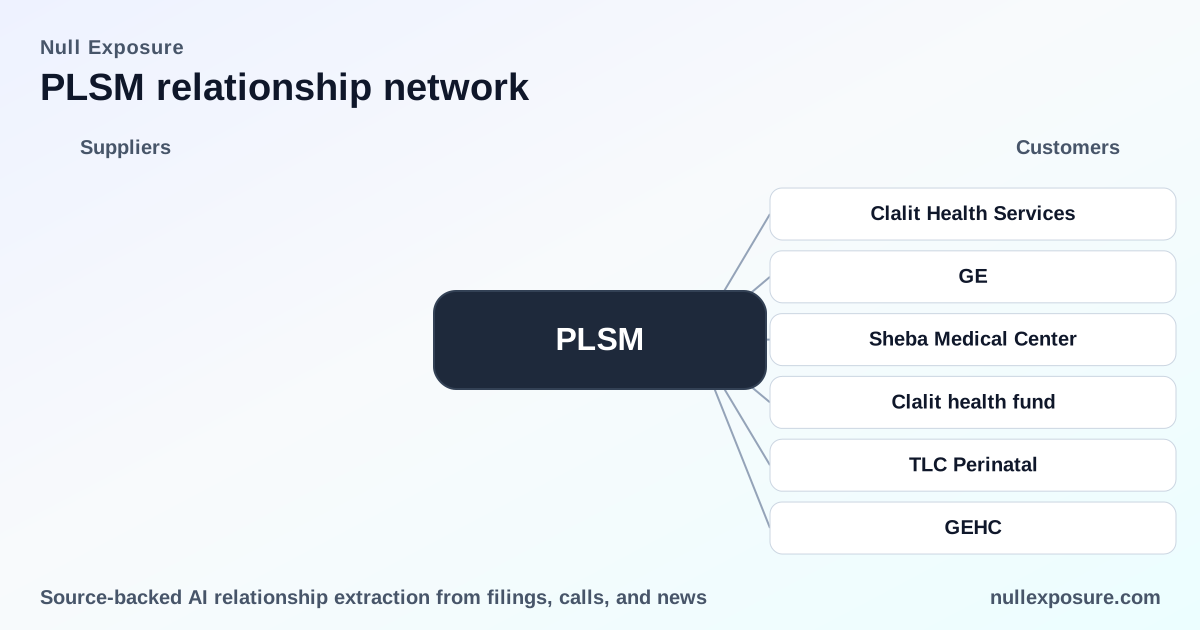
Pulsenmore (PLSM): Customer relationships that define early commercial scaling
Pulsenmore designs and sells self‑scan home ultrasound devices and accompanying remote diagnostic services, monetizing through device sales to payers and clinics, recurring service contracts that embed the company’s Early Screening and FC solutions into care pathways (fertility and prenatal), and occasional one‑time settlements that materially affect near‑term revenues. The company is moving from an R&D/validation phase into commercial rollouts after U.S. regulatory clearance, with customer contracts concentrated among large Israeli payers and a growing set of U.S. clinical partners. For a concise portfolio view of Pulsenmore’s customer engagements and what they imply for revenue quality and commercial risk, see https://nullexposure.com/.
Business model in one line: sell hardware + service subscriptions through B2B agreements with HMOs and specialty clinics, and scale by embedding at‑home scans into physician‑directed pathways.
What investors should watch about how Pulsenmore sells
Pulsenmore’s contracts are commercially oriented toward institutional buyers (HMOs, medical centers, specialty practices). That contracting posture produces three practical consequences:
- Revenue concentration risk: a small number of large institutional customers can deliver most early orders and backlog, magnifying the impact of any single renewal or termination.
- Criticality to care pathways: the product is sold as part of clinical workflows (IVF follicular monitoring, prenatal monitoring, hybrid telehealth programs), which increases stickiness if medical teams adopt the device but also raises adoption friction from payers and clinicians.
- Maturity of recurring revenue: regulatory clearance in the U.S. and early commercial agreements are accelerating revenue recognition, but the company’s reported trailing revenue through FY2025 was nil and recent FY2026 results include material one‑time items tied to a settlement with GE.
These characteristics create upside from rapid institutional adoption and downside from single‑customer dependence and the early stage of recurrent service monetization.
Customer relationships — line‑by‑line analysis
Below are the named counterparties appearing in Pulsenmore’s disclosures and press coverage, with a concise, plain‑English summary and a source note for each.
Clalit Health Services / Clalit health fund
Pulsenmore has multiple commercial agreements with Clalit — Israel’s largest HMO — to supply devices and launch at‑home follicular monitoring and prenatal services, and earlier disclosures tied a multi‑thousand‑unit order backlog to the Clalit relationship (historically described as the “Clalit health fund”). According to Pulsenmore press releases and Israeli reporting, Clalit is a strategic commercial partner used to pilot large-scale deployments and drove early backlog figures reported around the company’s TASE IPO and subsequent PR activity in 2026. (See Pulsenmore PR Newswire March 2026 and Globes reporting, FY2021–FY2026.)
Why it matters: Clalit is a concentration point for initial unit demand and a validation channel for payer adoption.
Sheba Medical Center
Sheba Medical Center is cited as a clinical partner where Pulsenmore devices have been used in physician‑led remote care initiatives, including prenatal imaging in humanitarian settings and virtual hospital programs. Pulsenmore and press reports list Sheba alongside other institutional partners, positioning clinical endorsement as part of the company’s credibility building. (See PR Newswire and Globes reports, FY2025–FY2022.)
Why it matters: Academic and tertiary hospital use cases support clinical acceptance and reimbursement conversations.
GE Precision Healthcare LLC (GEHC) / GE / GE Healthcare / GEHC (variants)
Pulsenmore previously had a strategic distribution and marketing relationship with GE/GE Healthcare and later executed a settlement with GE Precision Healthcare LLC that produced approximately $9.6 million in one‑time recognized revenue and an additional ~$2.2 million recognized from cancelled GEHC orders under the settlement. Earlier coverage described a planned GE investment and distribution arrangement that was later terminated as regulatory timing diverged. (See Pulsenmore FY2025–FY2026 filings summarized in PR Newswire, Sahm Capital, Bitget and Globes reporting, FY2022–FY2026.)
Why it matters: The GE relationship has been both a prior strategic distribution channel and a material source of one‑time income via settlement — a reminder that non‑recurring items can meaningfully distort early revenue figures.
TLC Perinatal / TLC Perinatal PA
Pulsenmore announced a services agreement with TLC Perinatal (Maryland) to incorporate Early Screening home ultrasound services into TLC’s care model, enabling physician‑directed hybrid care pathways with at‑home scans and telehealth follow‑ups. The engagement is presented as part of Pulsenmore’s U.S. commercial momentum following FDA clearance. (See PR Newswire and Intellectia reporting around March 2026, FY2025–FY2026.)
Why it matters: TLC provides a U.S. outpatient channel and a pathway to recurring clinical service revenues if the hybrid care model scales.
Center for Fetal Medicine & Women's Ultrasound (CFFM)
Pulsenmore signed a commercial engagement with the Center for Fetal Medicine & Women’s Ultrasound to purchase Pulsenmore ES home ultrasound services, putting at‑home monitoring into a traditional diagnostic center workflow and reducing unnecessary in‑clinic visits. The arrangement is described in news coverage announcing Pulsenmore’s commercial progress in early 2026. (See Sahm Capital and Intellectia reporting, FY2026.)
Why it matters: Specialist clinics adopting the device reinforce product fit for prenatal workflows and broaden clinical distribution beyond HMOs.
Operating constraints and company‑level signals
There are no explicit third‑party constraints listed in the relationship dataset, but company‑level signals visible across the disclosures are actionable for investors:
- Contracting posture: Pulsenmore sells via institutional B2B agreements and service contracts; adoption depends on payer and clinic acceptance rather than direct consumer purchases.
- Concentration: Early commercial activity is concentrated with large institutional partners (notably Clalit and a few U.S. clinics), so customer churn or contract renegotiation could materially affect near‑term revenue.
- Criticality: When integrated into IVF or prenatal pathways, devices become clinically important to workflow, creating the potential for durable service revenue if clinicians adopt the model.
- Maturity: Pulsenmore transitioned from no reported revenue in trailing periods to recognizing significant one‑time settlement income in FY2026, demonstrating both commercial progress and volatility from non‑recurring events.
Financial backdrop from filings: the company reported negative EBITDA and EPS through FY2025, MarketCapitalization roughly $21.9M (per available snapshot), and RevenueTTM reported as zero before FY2026 disclosures — reinforcing that recurring revenue is still nascent even as commercial partnerships expand.
Bottom line for investors
Pulsenmore’s early commercialization strategy is institution‑first, using large HMOs and specialty clinics to prove workflow integration and scale orders. Clalit represents the single largest strategic customer narrative; GE delivered both a distribution thesis and a material settlement that altered FY2026 revenue recognition; and U.S. clinical partners such as TLC Perinatal and specialist centers like CFFM demonstrate the company’s path to recurring service contracts. Monitor renewal cadence with Clalit, conversion of pilot programs into recurring service fees, and the ratio of one‑time to recurring revenue. For a strategic overview of these customer relationships in context, visit https://nullexposure.com/.
If you want a tailored investor memo that maps expected revenue pathways from each named customer and models downside from concentration, contact us through the site: https://nullexposure.com/.