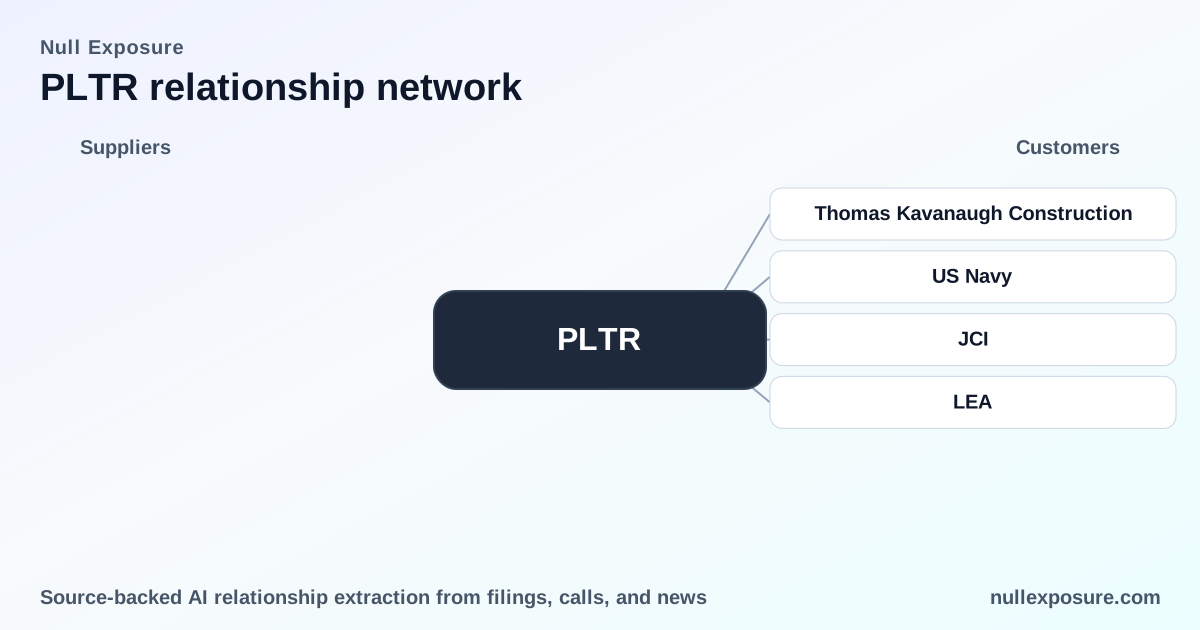
Palantir (PLTR) Customer Map — what recent contracts reveal about revenue quality and go-to-market
Palantir builds and sells operational AI platforms (Foundry and AIP) and a hosted Palantir Cloud, monetizing through a mix of software subscriptions, term licenses, and embedded professional services that are typically sold with ongoing operation-and-maintenance (O&M) support. Contract lengths skew toward multi-year engagements with large government and enterprise buyers, producing outsized average revenue per top customer and a revenue base that is both recurring and services-heavy. For a concise investor briefing on Palantir’s customer exposure and commercial posture, visit https://nullexposure.com/.
How Palantir sells — the business model signals investors should track
Palantir’s commercial footprint combines software licensing with hands-on deployment and managed services; this shapes revenue durability and margin dynamics:
- Contracting posture: Palantir sells both hosted subscriptions (Palantir Cloud) and on‑premises term licenses, typically bundled with stand‑ready O&M and professional services that are recognized over the contract term. This mix makes the company a licensor and incumbent service provider, which supports higher retention but also requires ongoing delivery investment (company filings, FY2024–FY2025).
- Duration and structure: The company generally offers one-to-five year contract terms with significant instances of long-term, multi‑year deals; short-term pilots are an explicit go‑to for customer onboarding and expansion.
- Concentration and spend: Palantir derives a majority of revenue from government customers (55% of 2024 revenue) while targeting large enterprises in commercial verticals; average trailing revenue of the top 20 customers was $64.6M, implying typical customer spend in the $10M–$100M band.
- Geography and maturity: Revenue is U.S.-weighted (66% in 2024) while commercial expansion targets manufacturing, defense primes, aviation, healthcare and cloud partners — a mix that balances sovereign demand and high-margin enterprise deployments.
- Go-to-market realities: The sales motion is deployment-intensive and often upgrades from pilots to enterprise rollouts, so revenue growth is driven by expansion within large accounts as much as net-new logos.
For more context on how these dynamics translate to contract durability and risk, see our customer intelligence hub at https://nullexposure.com/.
Customer relationships — concise takeaways by counterparty
Below are plain-English summaries for every customer mention in the source set, with source attribution for each.
Defense, federal and national security
- US Navy — Palantir won a program worth up to $448 million to modernize the shipbuilding supply chain and accelerate naval vessel delivery, illustrating sizable defense contracting play. (PLTR Q4 2025 earnings call, Mar 7, 2026)
- Knightscope (KSCP) — Entered a two‑year agreement to join Palantir’s FedStart program to accelerate entry into the U.S. federal marketplace. (SEC filings reported on Investing.com, 2026)
- Boeing (BA) — Boeing deployed Palantir’s AI software across defense, space and security programs and factories, reflecting integration with large aerospace manufacturing lines. (Manufacturing Dive, May 2026)
- Red Cat Holdings (RCAT) — Completed flight testing of Palantir’s VNav navigation software on its Black Widow drone, indicating embedded software integration in defense robotics. (ASD News, Mar 2026)
- Centrus (LEU) — Uses Palantir Foundry/AIP to integrate classified and unclassified systems and optimize project controls for uranium enrichment capacity expansion. (Sahm Capital reporting, Mar–Apr 2026)
Government and critical infrastructure
- Thomas Kavanaugh Construction — Company executive described an “all in” deployment where other software must justify its existence, signaling deep platform adoption at operational level. (PLTR Q4 2025 earnings call, Mar 7, 2026)
- Rackspace Technology (RXT) — Strategic partnership to run Foundry and AIP in Rackspace Private Cloud and UK sovereign data centers, addressing hosting and data‑sovereignty needs for regulated customers. (Rackspace press release/FinancialContent, Feb–Mar 2026)
Automotive and industrial manufacturing
- Lear Corporation (LEA / Lear) — Expanded to a five‑year partnership, growing from a small pilot to thousands of users and hundreds of use cases across manufacturing and planning. (PLTR Q4 2025 earnings call; Automotive Manufacturing Solutions, 2026)
- Trinity Industries (TRN) — Embedded Palantir alongside other platform partners to add AI into manufacturing, logistics and financial workflows. (Earnings call transcript, 2025Q4)
- Cleveland‑Cliffs (CLF) — Signed a three‑year AI partnership to deploy Palantir across flat‑rolled steel operations and commercial functions. (Manufacturing Dive / BusinessNorth, May 2026)
- Westrock Coffee (WEST) — Management cited a three‑year partnership with Palantir as a driver of efficiency in planning and manufacturing. (Globe and Mail / TipRanks coverage, FY2026)
Aviation, mobility and transportation
- Surf Air Mobility (SRFM) — A five‑year exclusive software partnership with Palantir powers SurfOS; the tie includes implementation, go‑to‑market support and equity considerations, and is central to Surf Air’s software-first strategy. (Company filings, earnings, and multiple news outlets, 2025–2026)
- FTAI Aviation (FTAIM / FTAIN) — Multi‑year strategic partnership to apply Palantir AI to production turnaround and unit economics in turbine manufacturing and data‑center power projects. (Intellectia / Sahm Capital reporting, Mar 2026)
- Ondas Holdings (ONDS) — Integrated Palantir AIP across an autonomous fleet for operational capabilities and global adoption. (Ondas press release / Sahm Capital, 2026)
Healthcare, life sciences and real‑world data
- OneMedNet (ONMD) — Publicly announced its iRWD™ Real‑World Data platform powered by Palantir Foundry, with commercial launch phases and material stock reaction following the news. (OneMedNet press release & news coverage, Feb–Mar 2026)
- R1 (RCM) — Formed R37 AI lab in partnership with Palantir to embed agentic AI into revenue-cycle management and RCM data repositories. (Precedence Research / TechTarget / R1 press, 2025–2026)
- Encompass Health (EHC) — Recently extended and expanded its agreement with Palantir and expects further measurable benefits in 2026. (EHC Q4 2025 earnings commentary, Mar 2026)
Enterprise software and partners
- PDYN — Reported using Palantir Foundry for AI-enhanced robotics in its operations, indicating Palantir’s use in robotics analytics. (TradingView investor commentary, 2026)
- Stagwell (STGW) — Partnered with Palantir to enhance performance media targeting by combining Stagwell ID Graph with Palantir analytics. (Stagwell investor communications, 2025–2026)
Other strategic / smaller partners
- Johnson Controls (JCI) — Publicly praised Palantir’s transformative AI work for modernizing long‑standing industrial operations. (PLTR Q4 2025 earnings call, Mar 2026)
- Thomas Kavanaugh Construction — (Listed above under infrastructure) signals deep operational lock‑in with enterprise customers through expanded use cases.
- Additional small/mid-cap partners and pilot engagements include a range of firms (PDYN, KSCP, RCAT, TRN and others) that have announced integrations, pilots, or FedStart participation with Palantir across 2025–2026 (various press releases and earnings calls, 2025–2026).
Investment implications — what to watch next
- Revenue durability is driven by multi‑year contracts and expansion inside large accounts, but delivery intensity keeps gross margin sensitive to service costs; monitor productized AIP offerings and scale of Palantir Cloud to improve operating leverage (company filings, FY2024–FY2025).
- Government exposure provides large, stable deals but concentrates political and procurement risk; the commercial roster (steel, aerospace, aviation, healthcare) shows broadening TAM capture.
- Top customer concentration is material: the average top‑20 customer revenue (~$64.6M) means churn or weakening at a few large accounts would move results materially.
Palantir’s model is highly differentiated by long-term, high-spend customers who convert pilots into enterprise rollouts, but investors should track the pace at which Palantir scales managed operations and transitions revenue toward less labor‑intensive subscription models (company risk disclosures, FY2024–FY2025).
For a closer look at contract-level signals and counterparty exposure across Palantir’s customer base, explore our platform at https://nullexposure.com/ — we curate customer-level evidence that feeds investment diligence and operational risk assessment.