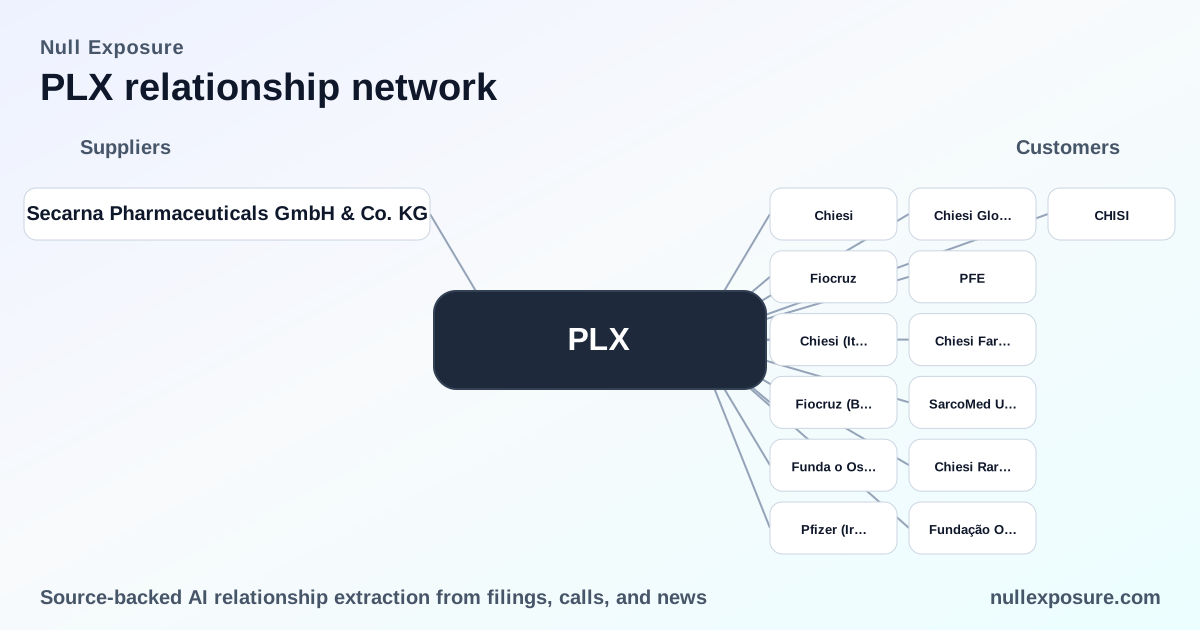
Protalix (PLX) — Customer Relationships Drive Manufacturing Revenue and Milestone Upside
Protalix Biotherapeutics monetizes a plant-cell platform (ProCellEx) by manufacturing and selling recombinant therapeutic proteins, licensing global commercialization rights to large partners and capturing revenue through direct sales of drug substance, government supply contracts in Brazil, and milestone payments tied to regulatory approvals. The business model is manufacturing-heavy and partner-driven: core revenue comes from a small set of commercialization partners (Chiesi, Pfizer) and a Brazilian public health counterparty (Fiocruz/BioManguinhos), with material milestone and supply-agreement mechanics that amplify both upside and concentration risk. For a concise view of the company and its partners, visit https://nullexposure.com/.
High-level investment thesis in one paragraph
Protalix operates as a contract manufacturer and small-cap biotech licensor: it manufactures proprietary biologics for partners, sells drug substance under multi-year supply arrangements (notably with Pfizer), and secures commercialization partnerships (notably Chiesi for PRX‑102/Elfabrio) that create milestone and royalty potential while shifting market distribution and sales execution to larger partners. Revenue is therefore a function of manufacturing volumes, partner purchasing behavior, and discrete regulatory milestones rather than end-market direct sales execution by Protalix.
Quick strategic takeaways
- Concentration: A handful of counterparties account for the majority of product sales and revenue recognition.
- Contract tenor and optionality: Protalix operates with long-dated supply commitments (10-year terms with extensions) that provide revenue visibility from drug-substance sales.
- Partner commercialization: Chiesi handles global commercialization for PRX‑102 (Elfabrio); Protalix is the manufacturer and stands to receive milestone payments tied to regulatory approvals.
- Public-health exposure: Sales to Brazil’s Fiocruz/BioManguinhos are material and carry sovereign procurement risk.
- Cash catalysts: Regulatory milestones (e.g., the $25M EC-triggered payment) and partner purchasing anomalies (e.g., opportunistic Pfizer buys) have outsized impact on reported revenue.
If you want a structured dataset and analytics on Protalix counterparties, see https://nullexposure.com/ for our models.
Customer map: plain-English summaries and sources
Chiesi (and Chiesi Global Rare Diseases / Chiesi Farmaceutici S.p.A.)
Protalix partnered with Chiesi to develop and commercialize pegunigalsidase alfa (PRX‑102 / Elfabrio); Chiesi carries global commercialization duties and Protalix is eligible for a $25 million regulatory milestone tied to an EC dosing-regimen approval. According to multiple press releases and company commentary in early 2026, the EC approval triggered that milestone and Chiesi is the commercial partner for Elfabrio. (Sources: GlobeNewswire/press releases and company reports, FY2026 / March 2026 coverage.)
Chiesi (Italy)
Protalix’s disclosures break out sales to Chiesi (Italy) within Fabry disease revenues, showing multi‑million dollar annual receipts tied to the Elfabrio collaboration. (Source: Protalix 2024 Form 10‑K, FY2024 revenue table.)
Chiesi Rare Disease / Chiesi Global Rare Diseases (naming variants)
Company reporting and news references use several Chiesi legal/brand variations; all denote the same commercialization partner that runs PRX‑102 commercialization in global markets and has driven milestone payouts and launch execution. (Source: Proactive Investors and company press releases, FY2021–FY2026 commentary.)
Pfizer (Pfizer Inc. / PFE / Pfizer (Ireland))
Protalix licenses Elelyso (taliglucerase alfa) commercialization rights to Pfizer outside Brazil while retaining Brazil rights, and Protalix supplies drug substance to Pfizer under an amended supply agreement; in 2025 Pfizer increased purchases to cover its own manufacturing shortfalls, boosting Protalix’s Elelyso-related revenue. (Sources: Protalix press releases and filings; Finviz reporting on FY2025 results; multiple PR Newswire items, FY2021–FY2026.)
Pfizer (Ireland)
Protalix’s financial schedules list Pfizer (Ireland) as the counterparty for gaucher‑disease related revenues in some jurisdictional line items, reflecting how legal entities are used in global supply and licensing. (Source: Protalix 2024 Form 10‑K, FY2024 revenue table.)
Fiocruz / Fundação Oswaldo Cruz / Fiocruz (Brazil)
Protalix has a supply and technology transfer agreement with Fundação Oswaldo Cruz (Fiocruz/BioManguinhos) to provide alfataliglicerase in Brazil; Fiocruz accounted for double‑digit million dollar purchases and Protalix discloses risk around Fiocruz’s compliance with purchase obligations under that agreement. (Sources: Protalix 2024 Form 10‑K; FY2024 revenue breakdown and risk disclosures; FY2026 news coverage.)
Fiocruz (Brazil)
The Brazilian MoH arm Fiocruz is separately called out in revenue tables and press coverage as the purchaser of BioManguinhos product supplied by Protalix under its public‑health contract. (Source: Protalix 2024 Form 10‑K, FY2024 revenue table.)
BioManguinhos
BioManguinhos (part of Fiocruz) is the named program for alfataliglicerase supplied into Brazil’s public health system; Protalix reports BioManguinhos sales as a material revenue line. (Source: HeyGoTrade coverage and company reporting, FY2026.)
Fundação Oswaldo Cruz (alternate spelling/Portuguese formal name)
Protalix’s press and filings use the formal Portuguese name when discussing supply and transfer obligations; the disclosure highlights sovereign counterparty risk in procurement timelines. (Source: Protalix 10‑K risk disclosures and FY2026 news.)
SarcoMed USA
Protalix entered an exclusive worldwide license with SarcoMed USA for PRX‑110 (alidornase alfa) to advance pulmonary sarcoidosis and other respiratory indications, reflecting a business line where Protalix licenses assets to third parties. (Source: SarcoidosisNews / PRNewswire coverage, FY2021.)
Notes on naming variants: the dataset includes multiple legal‑name permutations (e.g., PFE / Pfizer Inc. / Pfizer (Ireland); Chiesi / Chiesi Farmaceutici S.p.A. / Chiesi Global Rare Diseases). All of the above are reflected in Protalix filings and public press across FY2021–FY2026; when Protalix reports revenue it allocates sales by these contractual/legal counterparties in its 10‑K and quarterly disclosures. (Sources: Protalix 2024 10‑K; earnings call transcripts FY2025 Q3; press releases March–May 2026.)
Contract and operating constraints: what the disclosures show about how Protalix runs the business
- Long-term supply posture: Protalix has multi‑year supply commitments (a 10‑year initial term for certain agreements, with Pfizer options to extend for two additional 30‑month periods). That structure creates predictable base demand for drug substance and ties revenue forward. (Source: constraints excerpts in company filings.)
- Manufacturer role and single‑site concentration: Protalix is the sole manufacturer for PRX‑102 under its Chiesi agreement, and manufacturing is the company’s operational core, which concentrates execution risk on production continuity. (Source: Form 10‑K manufacturing clauses.)
- Seller‑recognition and point‑in‑time revenue: The company recognizes revenue when control transfers at delivery, emphasizing transactional, volume‑driven revenue flows rather than recurring SaaS‑style annuity. (Source: 10‑K revenue recognition statements.)
- Spend band and commercial scale: Multiple disclosures show annual counterparty spend in the $10m–$100m range (e.g., $29.3m from Elfabrio sales in 2024; ~$12.6m Elelyso to Pfizer in 2024), indicating material but not massive single‑customer receipts. (Source: 10‑K FY2024 revenue breakdown.)
- Counterparty liquidity/credit posture: Trade receivable policy indicates customers are not required to post collateral, a company‑level signal that receivables are exposed to counterparty credit and procurement cycles. (Source: 10‑K accounting disclosures.)
- Active commercialization stage: Following regulatory approvals for Elfabrio in 2023, Protalix transitioned into an active manufacturing/revenue stage for that program, changing cash‑flow dynamics versus earlier R&D centric years. (Source: 10‑K and FY2025–FY2026 investor commentary.)
Investment implications and risk checklist
Protalix’s revenue profile is highly partner‑dependent: success or delay at Chiesi, purchasing patterns at Pfizer, and compliance by Fiocruz materially change cash flow. Regulatory milestones are explicit cash catalysts (the $25M EC milestone is a recent example). Operationally, single‑manufacturer concentration creates upside when production scales and downside if supply is interrupted. For diligence, prioritize examination of latest supply‑agreement terms, milestone schedules, and aged receivables tied to Brazil’s public purchases.
For model-ready summaries and to monitor contract events, visit our homepage at https://nullexposure.com/.
Overall, Protalix is a manufacturing‑anchored biotech whose short‑to‑medium term valuation will be driven by partner purchasing behavior, milestone crystallizations, and the company’s ability to convert manufacturing capacity into sustained, contractually backed revenue.