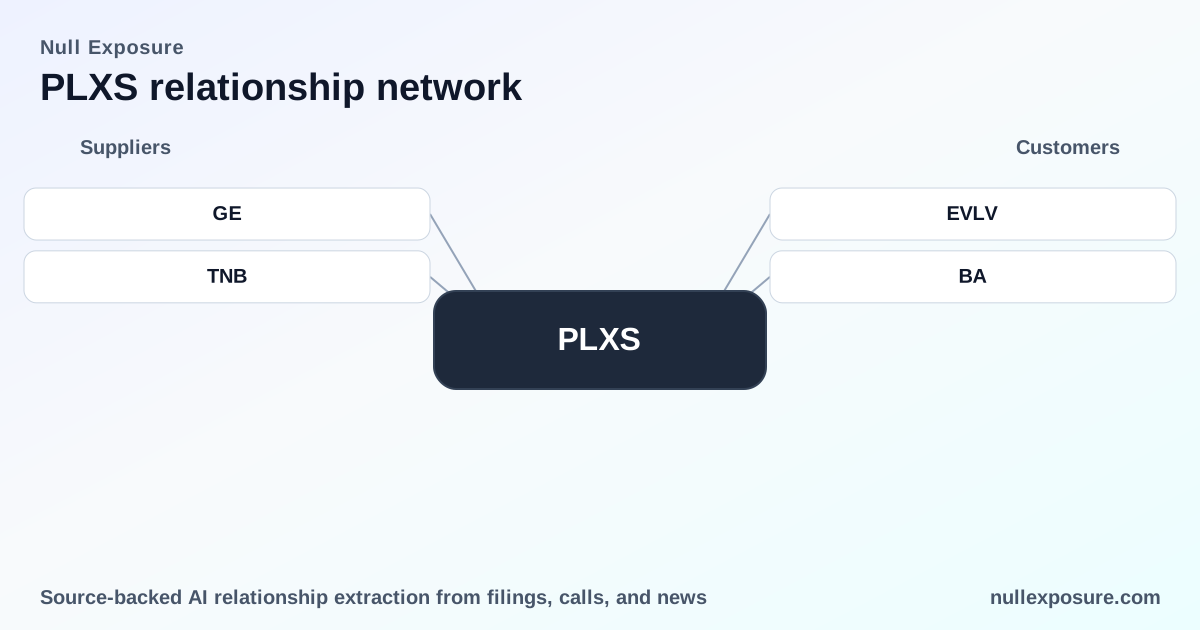
Plexus Corp (PLXS): Customer relationships that drive manufacturing revenue and margin expansion
Plexus is a global electronics manufacturing services (EMS) and engineering solutions provider that monetizes through contract manufacturing, design-for-manufacture services, and after-market support for customers across aerospace & defense, healthcare & life sciences, and industrial end-markets. Revenue is transactional and project-driven under master service frameworks with limited long-term purchase commitments, which creates revenue agility but also exposure to short-cycle demand swings. For investors, the company’s commercial footprint is characterized by diversified customers, geographically distributed operations, and a core role as a manufacturer and service provider to growth-stage and established OEMs.
For a concise vendor risk and opportunity briefing, visit the Null Exposure homepage: https://nullexposure.com/
Why the Evolv deal matters for PLXS growth momentum
Plexus’ recently disclosed strategic manufacturing partnership with Evolv Technologies (EVLV) is the clearest near-term commercial catalyst reflected in public coverage. Evolv is scaling production of AI-enabled security hardware, and Plexus will act as a strategic contract manufacturer, expanding Evolv’s capacity and global reach while locking in manufacturing revenue for Plexus. This type of engagement exemplifies Plexus’ playbook: win design/manufacture work with fast-growing technology customers and translate that into recurring assembly and service flows. Sources: Evolv press releases and earnings commentary (FY2025 / Q3 2025; various news outlets, Dec 2025–Mar 2026).
All relationship references in the public record
Below are every customer-relationship mention surfaced in the consolidated results; each entry is summarized in plain English with the source context indicated.
-
Evolv Technologies Holdings (EVLV) — A Yahoo Finance release on March 9, 2026, states Evolv entered a strategic contract manufacturing partnership with Plexus so Evolv can scale production of its security solutions. This is a formal go-to-market manufacturing arrangement. Source: Yahoo Finance press release (Mar 9, 2026).
-
EVLV (Finviz coverage) — Finviz reported on the same Evolv–Plexus strategic partnership, noting the November 6 announcement that Plexus will help scale manufacturing to meet global demand. The reporting reinforces that the relationship is oriented toward volume scale-up. Source: Finviz news item (Nov 6, reported Mar 2026).
-
Evolv Technologies Holdings (Finviz duplicate) — A second Finviz entry repeats the partnership language and confirms market coverage picked up the announcement across outlets. This duplication indicates broad press distribution rather than a separate commercial relationship. Source: Finviz (Nov 6 / Mar 2026).
-
Evolv Technologies (Evertiq) — Evertiq’s December 1, 2025 piece frames Plexus as the EMS partner selected to expand Evolv’s global supply chain capabilities, underscoring supply-chain and capacity elements of the deal. Source: Evertiq news (Dec 1, 2025).
-
EVLV (Earnings call excerpt, 2025Q3) — Evolv’s Q3 2025 earnings call includes executive commentary celebrating the strategic partnership with Plexus, emphasizing production capacity, global reach, and operational resilience. The customer explicitly positions Plexus as a key manufacturing partner. Source: Evolv Q3 2025 earnings call transcript (2025Q3).
-
EVLVW (Earnings call duplicate) — An alternate ticker/reference in the Q3 2025 call repeats the announcement that Plexus expands Evolv’s capacity and resiliency; this is the same customer engagement referenced under a different security suffix. Source: Evolv Q3 2025 earnings call (2025Q3).
-
BA / Boeing (Finviz coverage of Plexus earnings call) — Coverage of Plexus’ Q4 earnings call referenced analyst questioning about aerospace and defense demand with specific mention that full pull-through from large OEMs like Boeing has not yet materialized. This indicates Boeing is an industry-level reference for Plexus’ aerospace exposure rather than a discrete new contract in the dataset. Source: Finviz coverage of Plexus Q4 earnings call (FY2026).
-
Boeing (Finviz duplicate) — The same Finviz note quoting Plexus’ COO reiterates that while defense demand is robust, commercial aerospace recovery tied to major OEMs such as Boeing is not fully realized. This reinforces Plexus’ exposure to the aerospace OEM cycle. Source: Finviz (FY2026).
-
Harmonic Inc (HLIT) / TradingView report — Harmonic’s SEC 10‑K coverage via TradingView notes the company relies on third-party contract manufacturers and specifically cites Plexus Services Corp. as the primary manufacturer, indicating an ongoing manufacturing relationship where Plexus is named as the supplier. Source: TradingView news coverage of Harmonic’s 10‑K (FY2026).
-
Evolv (Finviz / duplicate Evertiq entries) — Additional news snippets in the results repeat the Evolv announcement language that Plexus will support scaling production and global supply chain capabilities, showing consistent messaging across media outlets. Sources: Finviz and Evertiq (Dec 2025–Mar 2026).
-
Evolv (Yahoo/other aggregated repeats) — A repeating item in the results references the March 9, 2026 Yahoo Finance announcement again; this redundancy demonstrates broad distribution of the same commercial disclosure. Source: Yahoo Finance and syndicated press (Mar 2026).
Constraints and what they mean for Plexus’ operating profile
The extracted constraints reflect company-level operating characteristics rather than being tied to any single customer:
-
Contracting posture: master service frameworks with short-term purchase visibility. Plexus typically operates under master services arrangements that establish conduct and terms, while firm long-term purchase commitments are uncommon; Plexus frequently sells services with limited forward visibility. This creates a commercial model that is flexible but sensitive to customer demand cycles.
-
Geographic breadth and capacity footprint. Plexus runs facilities across the Americas, APAC, and EMEA with over 20,000 employees and 26 locations, underlining a globally distributed manufacturing platform that supports customers with multi-region supply chain needs.
-
Revenue concentration: diversified, not customer-concentrated. No single customer exceeded 10% of sales in fiscal 2025 or 2024, signaling low single-customer concentration and a diversified customer base of roughly 190 customers in fiscal 2025.
-
Role and segment positioning: manufacturer and service provider. Plexus is primarily an EMS and services company—design, manufacture, and regulatory-compliant servicing of complex products—with engineering services contributing less than 5% of consolidated sales. The core revenue driver is manufacturing and associated services.
-
Relationship maturity and activity: active, transactional engagements. The company served about 190 customers in fiscal 2025, consistent with a portfolio of active, project-level engagements rather than long-term captive supplier relationships.
Investment implications and risk factors
- Growth vector: Strategic partnerships like the Evolv engagement illustrate Plexus’ path to capture incremental manufacturing revenue from high-growth technology customers, adding scale and margin leverage as volumes ramp.
- Cyclicality risk: The short-term nature of purchase commitments and exposure to aerospace OEM cycles (Boeing cited in earnings call coverage) create earnings sensitivity to end-market demand.
- Diversification cushion: Low customer concentration and multi-region operations reduce single-counterparty risk, while named relationships (Harmonic, Evolv) show both recurring EMS work and newest platform-scale engagements.
- Operational execution: Success depends on Plexus’ ability to convert framework agreements into sustained volume and maintain quality in regulated end-markets.
For an investor-oriented vendor-risk assessment and to monitor changes in customer relationships, visit https://nullexposure.com/
Bold takeaway: Plexus generates stable EMS revenue through diversified, framework-based engagements but carries demand-cycle exposure due to the absence of long-term guaranteed purchase contracts; recent strategic wins like Evolv materially enhance near-term production visibility and upside if volumes scale as management projects.