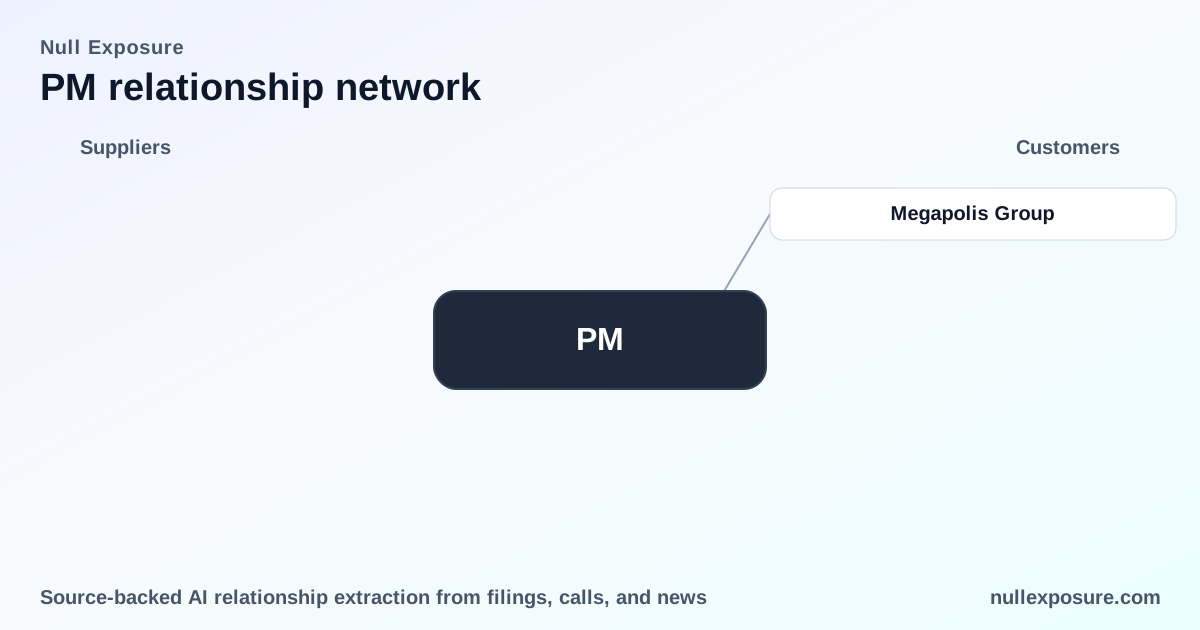
Philip Morris International — Customer Relationships and Commercial Risks
Philip Morris International (PMI) monetizes a global portfolio of combustible and smoke‑free nicotine products by selling through a mix of direct retail sales and third‑party distributors and resellers; revenue is recognized largely at shipment or delivery and margins accrue from scale, brand premium (Marlboro) and rising penetration of smoke‑free offerings. PMI reported roughly $41.5 billion in trailing revenue and a 26.7% profit margin, underpinned by distribution agreements and large regional distributors that concentrate meaningful portions of group sales. Learn more at NullExposure.
Market readers evaluating PM customer relationships should focus on three operational realities that the filings and disclosures emphasize: contracting posture (short‑term, transactionally settled sales), concentration in distributor channels, and strategic minority ownership stakes where PMI elects to take an equity position in key local partners. Below I unpack those characteristics and then review the specific customer relationship disclosed in PMI’s FY2025 filings.
What the contract and distribution model implies for investors
PMI sells through a heterogeneous channel mix — direct retailer sales, exclusive local distributors, and licensed partners — and the company recognizes revenue at shipment or delivery under short payment terms. This produces a predictable cash conversion profile but also exposes PMI to distributor concentration and country‑level execution risk.
- Contracting posture: The 10‑K states that the bulk of revenues come from sales through direct and indirect distribution networks with short‑term payment conditions and control transferred at shipment or delivery. This is an operationally light, trade‑credit‑centric model that keeps working capital velocity high but limits contractual lock‑in and long horizon protections.
- Concentration and criticality: PMI discloses that in 2025 sales to at least two distributors — one in the Europe region and another in the EA, AU & PMI GTR region — each accounted for 10% or more of consolidated net revenues, flagging supplier concentration as a material commercial risk for the enterprise.
- Geographic scale and product rollout: PMI reported its smoke‑free products were available in 106 markets as of December 31, 2025, confirming a broad geographic footprint and the operational requirement to manage many local partners and regulatory regimes.
- Distributor minority ownerships: On selected markets PMI takes minority stakes in distributors — a hybrid strategy that preserves local expertise while securing commercial alignment and some balance‑sheet exposure.
These factors combine into an operating model that is transactional, globally distributed, concentrated in a few large distributor relationships, and selectively integrated through minority equity stakes — a profile that delivers strong margins but requires active distributor risk management.
Relationship review — Megapolis Group
Megapolis Group is listed as a related‑party customer in PMI’s FY2025 filing, with reported net revenues of $2,805 million for 2025, up from $2,393 million in 2024 and $2,267 million in 2023, illustrating a multi‑year revenue stream of material size. According to PMI’s 2025 Form 10‑K, Megapolis Group accounted for a significant volume of sales in the period covered. (Source: PMI 2025 Form 10‑K, Itemized related‑party revenues, FY2025.)
Why this matters: a ~ $2.8 billion single‑counterparty related‑party flow is a meaningful portion of consolidated revenues and reflects PMI’s strategy of concentrating scale with large regional distributors to maximize brand reach and supply efficiency.
Related note: JSC TK Megapolis (TKM) and minority interests
PMI’s filings also separately identify JSC TK Megapolis (“TKM”) as a distributor in Russia in which PMI holds a 23% equity interest, with a carrying value of $303 million as of December 31, 2025. That disclosure signals a purposeful use of minority stakes to lock in distribution alignment in strategically important markets while limiting full ownership exposure. (Source: PMI 2025 Form 10‑K, Note on equity interests and carrying values, FY2025.)
Investor implication: equity holdings in distributors convert a commercial counterparty into a partially consolidated economic exposure — improving alignment but introducing execution and impairment risk tied to local market dynamics and geopolitics.
Commercial concentration, counterparty risk and cash flow mechanics
Investors should weigh the following operational characteristics as they assess PM customer risk and valuation sensitivity:
- Short‑term payment and delivery recognition: The revenue recognition at shipment or delivery and short payment cycles create high cash turnover but limited contractual protection against abrupt distributor failure or market disruption.
- Material distributor concentration: The filing explicitly calls out distributors in at least two regions that each represented ≥10% of consolidated net revenues in 2025, which makes the company sensitive to distributor performance and bargaining dynamics.
- Active global footprint: Smoke‑free product availability in 106 markets adds diversification but increases the number of regulatory and execution touchpoints tied to local distributors and licensees.
- Selective minority ownership as hedging and leverage: Minority stakes such as the 23% holding in TKM convert a commercial relationship into a balance‑sheet exposure and can protect shelf space and priority supply, but they also carry valuation and impairment risk in stressed markets.
Collectively, these dynamics explain why PMI’s commercial relationships are both a source of strength—driving scale and margin—and of concentrated tail risk if a major distributor relationship deteriorates.
Explore supplier and customer intelligence at NullExposure.
Bottom line for investors and operators
- PMI’s customer model is distributor‑centric, transactional, and globally extensive. That structure supports strong margins and consistent cash generation but produces meaningful counterparty concentration and regional execution dependencies.
- Large related‑party and minority‑stake exposures (Megapolis Group / JSC TK Megapolis) are material to consolidated results and warrant ongoing monitoring for operational performance, credit quality, and any regulatory or geopolitical developments in the relevant markets.
- Operational focus for risk managers: monitor distributor receivable days, incremental concentration by region, and impairment indicators on minority stakes to anticipate earnings or cash‑flow volatility.
For investors building models or stress scenarios, treat major distributor relationships as quasi‑strategic counterparties whose disruption would have outsized top‑line and cash implications; for operators, continually reassess distribution diversification and contractual protections to mitigate single‑counterparty concentration.