Primech Holdings (PMEC): Customer Relationships Signal Early Commercial Traction for Hytron Robotics
Primech Holdings (PMEC) operates through its Primech AI subsidiary to commercialize autonomous cleaning and O&M robotics solutions, monetizing via fleet sales, leasing agreements and strategic channel partnerships with facilities-management companies and institutional customers. Recent disclosures show the company converting demonstrations and awards at CES into paid fleet commitments and pilots across Hong Kong, Macau and Singapore, yielding early recurring revenue streams while the parent carries negative operating margins and elevated insider ownership.
For a concise company snapshot, visit the firm’s overview at NullExposure.
What investors should take away immediately
- Commercial model: Primech sells and leases Hytron units and supports deployments through distribution partners and facility-management engagements.
- Early revenue mix: Agreements reported are a mix of fleet commitments and short-duration pilots — signaling revenues tied to scale of deployments and recurring leasing rather than large one-time professional-services sales.
- Execution risk remains material: Financials show negative EBITDA and slim margins while customer relationships are concentrated and in pilot stage.
- Strategic capital and channel moves: A $4.0 million strategic investment and distributor commitments broaden reach and de-risk go-to-market distribution.
Explore more PMEC customer intelligence at NullExposure for investors tracking early commercial adoption.
Who Primech is working with — relationship-by-relationship rundown
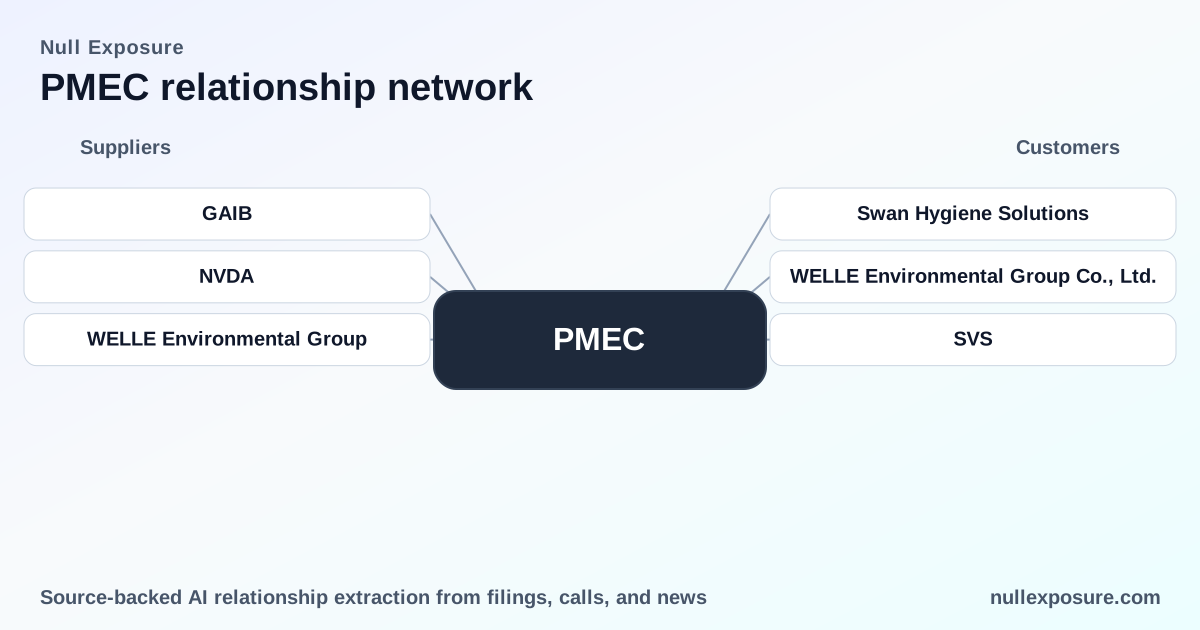
Swan Hygiene Solutions (Savills subsidiary)
Primech announced a 200‑unit fleet commitment for deployment across Hong Kong and Macau with Swan Hygiene Solutions, the Savills-affiliated distributor, positioning Hytron for rapid regional scale through an established facilities channel. This commitment was disclosed during Primech’s CES 2026 coverage and related press releases (GlobeNewswire / Primech press materials, Jan–Mar 2026).
Savills (SVS)
Savills is identified as the parent channel behind Swan Hygiene Solutions and is referenced in Primech’s commercial disclosures as the exclusive distributor for Hong Kong and Macau, illustrating a structured channel partnership that converts distribution reach into fleet commitments (QuiverQuant coverage of Primech CES 2026 disclosures, FY2025/FY2026).
CBM Pte Ltd (CBMB)
Primech AI executed a leasing agreement with CBM Pte Ltd designed to deploy Hytron units across CBM‑managed properties in Singapore to improve cleaning consistency and hygiene standards; the engagement is a leasing arrangement rather than pure sale, aligning revenue with recurring service economics (Primech press release via GlobeNewswire, Mar 12, 2026). Additional reporting references the same CBM engagement (intellectia.ai news feed, FY2026).
WELLE Environmental Group Co., Ltd.
Primech entered a strategic cooperation and received a $4.0 million strategic investment from WELLE, with planned commercial deployments across WELLE’s portfolio and joint market opportunities leveraging Primech’s robotics and O&M solutions (Primech–WELLE press release, Dec 12, 2025). This investor‑partner relationship functions both as capital and a commercial channel for deployments.
Singapore University (unnamed)
Public reporting lists a $33 million contract award linked to a Singapore university engagement attributed to Primech, indicating a material institutional contract in FY2026 that could substantively scale revenue if confirmed and executed (intellectia.ai news compilation, FY2026).
Dunman High School
Primech secured a 12‑month government collaboration to pilot Hytron at Dunman High School, deploying one Hytron unit as part of a broader government engagement for in‑school autonomous cleaning trials (Primech press release via GlobeNewswire, Apr 9, 2026). The pilot frames Primech’s route to public‑sector adoption.
Operating model signals and company-level constraints
No explicit customer constraints were recorded in the available relationship data; this absence is itself a company-level signal. From the relationship set and corporate disclosures, the operating model displays these characteristics:
- Contracting posture — channel and leasing oriented: Primech leans on leasing agreements and distributor relationships (Savills/Swan, CBM) rather than only one‑off product sales, which supports recurring revenue but requires ongoing service and fleet management capabilities.
- Concentration and criticality: Early revenues are driven by a small number of large pilot or fleet commitments; customer concentration is high, making each named relationship commercially material to near‑term performance.
- Maturity and commercial stage: The business is in early commercialization—multiple pilot programs and inaugural fleet deployments rather than broad, global rollout—implying that operational scaling and product robustness will determine conversion to sustained margins.
- Disclosure cadence: Multiple press releases and trade coverage show active PR-driven commercial announcements; however, formal financial analyst coverage remains sparse, which is consistent with small‑cap, early‑stage public companies.
Financial and execution risks investors must weigh
- Profitability pressure: Company financials show negative EBITDA and a small negative profit margin despite meaningful gross profit, indicating continuing operational investment to scale deployments.
- Concentration risk: Several large commitments (200‑unit fleet, institutional contracts) mean execution delays or cancellations would disproportionately impact short-term revenue.
- Channel dependency: Reliance on distributors and facilities-management partners accelerates market access but transfers execution risk in operations and after‑sales service to third parties.
- Capital intensity: Robotics deployments and leasing require working capital and maintenance commitments; strategic investments such as WELLE’s $4.0 million reduce but do not eliminate funding needs.
- Shareholder profile: Insider ownership is high, limiting institutional float and potentially amplifying share volatility as commercial announcements drive sentiment.
Conclusion — where this positions investors
Primech’s recent customer relationships demonstrate early but tangible commercial adoption of Hytron through a mix of distributor fleet deals, leasing with facilities managers and institutional pilots in Singapore and Hong Kong. The model leans toward recurring revenue via leases and channel distribution, but profitability and execution at scale remain open risks given negative operating margins and concentrated contracts. Investors tracking PMEC should prioritize verification of contract revenue recognition, deployment cadence, and partner service economics as the company scales.
For continued tracking of PMEC customer intelligence and market implications, visit NullExposure.