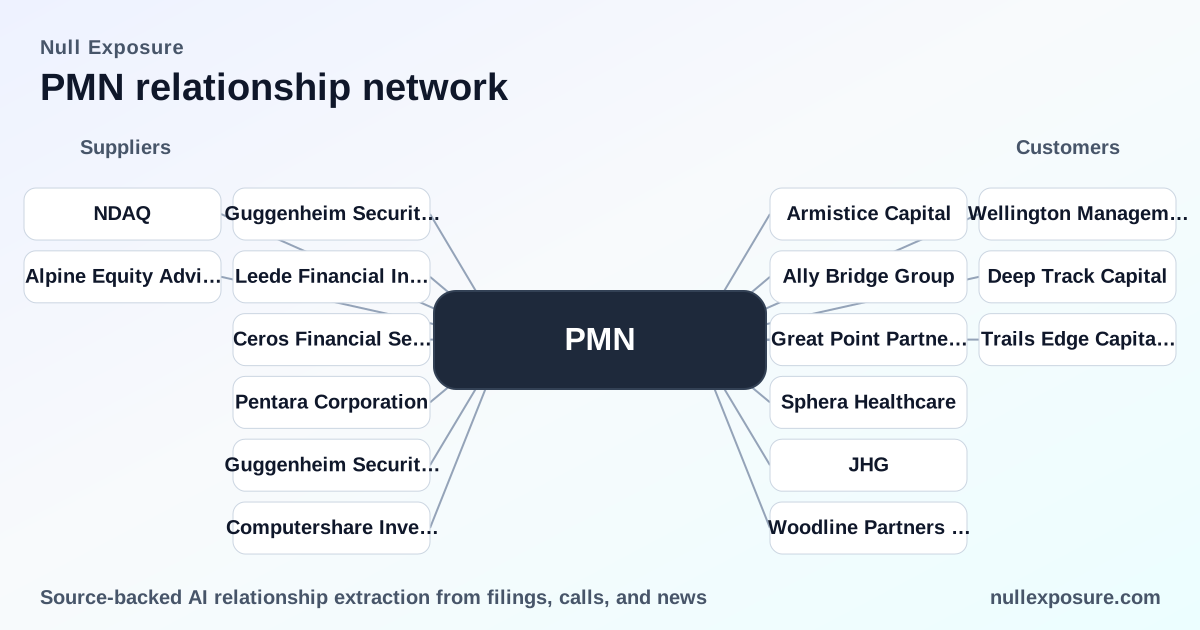
ProMIS Neurosciences (PMN): PIPE-backed runway and what the investor roster tells equity holders
ProMIS Neurosciences develops antibody therapeutics for neurodegenerative diseases by targeting misfolded proteins; the company presently monetizes through milestone-driven licensing potential and future product sales, while funding operations primarily through equity raises. PMN is a capital-intensive, clinical-stage biotech that relies on periodic private investment in public equity (PIPE) to finance R&D, so the composition of its investor base is a direct input into funding stability, dilution dynamics, and governance expectations. Visit https://nullexposure.com/ for an indexed view of these investor flows and related market signals.
Why the financing register matters more than a simple ownership table
PMN’s financials underline the business reality: minimal revenue (TTM revenue roughly $7.6k) and negative EBITDA (about -$13.3M), with a market capitalization near $99M. These are textbook indicators of a clinical-stage biotech whose short-term valuation and operational continuity depend on capital markets rather than product cash generation. The company’s contracting posture is transactional and finance-driven—PIPE placements and institutional rounds rather than long-term commercial contracts. Concentration is moderate: syndicates include both healthcare specialists and large institutional managers, which reduces single-investor dependency but keeps the company sensitive to shifts in institutional appetite for high-risk biotech. Criticality is binary and high: continued funding is mission-critical to advance trials; maturity is early—pre-revenue, development-stage—so investor support translates directly into program cadence and milestone risk.
What the recent syndicates communicate about investor sentiment
Across two published financings—one announced in July 2024 and a larger, co-led PIPE in January 2026—PMN attracted a mix of dedicated healthcare specialists and mainstream investment managers. The 2024 round shows specialist healthcare backers underwriting earlier-stage risk; the 2026 PIPE, co-led by Janus Henderson and Ally Bridge Group, signals access to larger pools of institutional capital and a step-up in fundraising scale. Taken together, the roster signals continued external confidence from specialized investors plus meaningful buy-in from mainstream asset managers.
Visit https://nullexposure.com/ for deeper analysis of each capital event and investor participation.
Relationship-by-relationship: the investor roster and what each connection signals
Below are concise, source-linked summaries for every named investor in the results set.
Ally Bridge Group
Ally Bridge Group participated in both the July 2024 PIPE and was a co-lead on the January 2026 PIPE, indicating persistent strategic interest and a leading role in syndication. According to a GlobeNewswire press release (July 26, 2024) and a GlobeNewswire release (Jan 30, 2026), Ally Bridge moved from participant to co-lead across these financings, highlighting an elevated commitment in FY2026.
Sphera Healthcare
Sphera Healthcare joined the July 2024 PIPE as a healthcare-specialist investor, reinforcing the round’s orientation toward sector-focused capital rather than generalist retail flows. This participation is documented in the GlobeNewswire announcement dated July 26, 2024 (FY2024).
Great Point Partners, LLC
Great Point Partners is listed as a participant in both the July 2024 financing and the January 2026 PIPE, signaling repeat institutional support across financing cycles. The July 26, 2024 GlobeNewswire release and the Jan 30, 2026 GlobeNewswire release both identify Great Point as part of the syndicate (FY2024 and FY2026).
Armistice Capital
Armistice Capital was a named participant in the July 2024 private placement, demonstrating involvement from value-oriented healthcare investors in that round. The GlobeNewswire press release on July 26, 2024 records Armistice’s FY2024 participation.
Janus Henderson (JHG)
Janus Henderson co-led the January 30, 2026 PIPE alongside Ally Bridge Group, marking a material institutional endorsement and providing scale to the FY2026 raise. This leadership role is disclosed in the GlobeNewswire release of Jan 30, 2026 and is reflected in related news syndication (FY2026).
Deep Track Capital
Deep Track Capital appears as a participating investor in the January 2026 PIPE, contributing to syndicate depth and suggesting interest from hedge/alternative managers in the FY2026 financing. SAHM Capital and GlobeNewswire coverage of the Jan 30, 2026 announcement list Deep Track Capital among participants (FY2026).
Trails Edge Capital Partners
Trails Edge Capital Partners is named as a participant in the January 2026 PIPE, adding to the roster of specialized and alternative investors backing PMN’s FY2026 capital plan. See the GlobeNewswire Jan 30, 2026 release and SAHM Capital coverage (FY2026).
Wellington Management
Wellington Management participated in the January 2026 PIPE, representing significant mainstream institutional support and suggesting top-tier manager due diligence on PMN’s prospects. The Jan 30, 2026 GlobeNewswire announcement and SAHM Capital notice include Wellington Management among the syndicate (FY2026).
Woodline Partners LP
Woodline Partners LP is listed among FY2026 participants, indicating interest from long/short equity and alternative fund managers in the PIPE. This participation is recorded in both the Jan 30, 2026 GlobeNewswire release and SAHM Capital’s Jan 30, 2026 coverage (FY2026).
What investors should read between the lines
- Funding dependence is acute. With negative operating metrics and near-zero revenue, PMN’s program timelines are directly tied to successful PIPEs and institutional support. The presence of Tier-1 managers like Wellington and Janus Henderson improves access to capital but does not eliminate dilution risk.
- Syndicate composition is balanced. Repeated participation from healthcare specialists (Great Point, Ally Bridge) alongside large managers (Janus Henderson, Wellington) is a constructive signal: specialists provide domain conviction; institutions supply scale and governance oversight.
- Operational implications are immediate. Because ProMIS is early-stage and R&D-heavy, investor behavior—whether continuing to fund at milestone points or pulling back—will determine trial cadence and partnership leverage.
- Governance and expectations will shift with co-leads. The 2026 co-lead structure implies more institutional oversight and likely clearer milestone expectations attached to future draws or licensing negotiations.
Bottom line for investors and operators
ProMIS is a clinically-focused, capital-dependent biotech whose investor relationships are the operational lifeline. The syndicate evolution from FY2024 to FY2026 demonstrates stronger institutional involvement and deeper pockets, but also signals an increased need to meet investor-driven milestones. For equity holders, monitor subsequent financing cadence, dilution mechanics, and any licensing arrangements that convert R&D progress into non-dilutive capital. For operators, preserving runway while sequencing value-creating clinical and partnering events is the top priority.
For ongoing tracking of PMN investor flows and financing events, see https://nullexposure.com/.