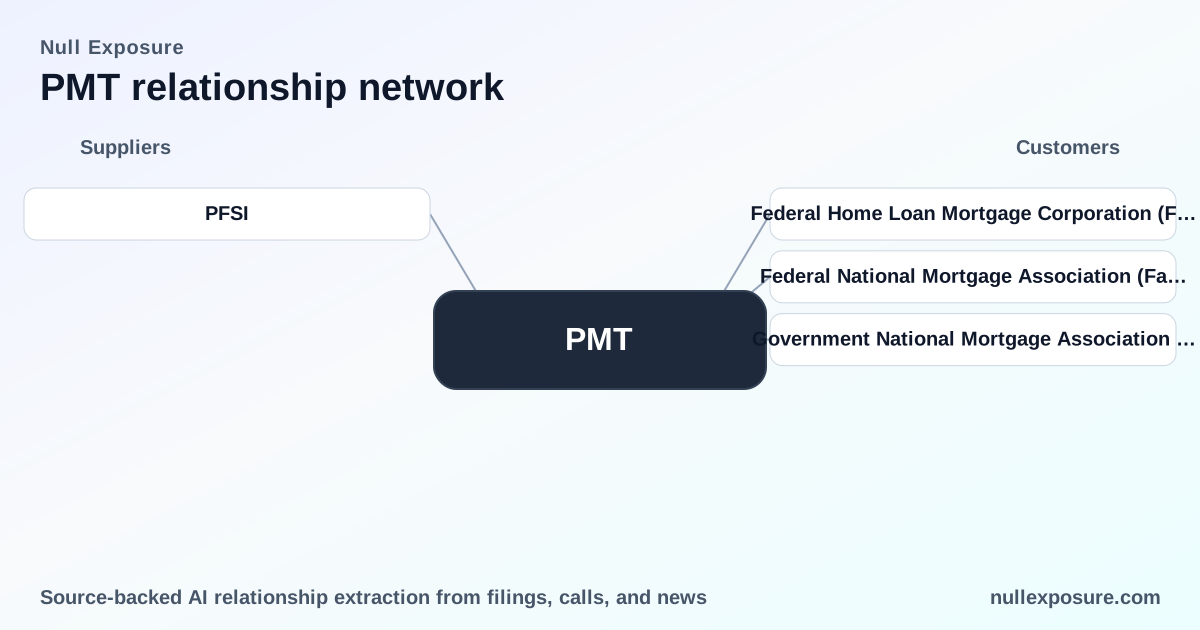
PMT’s customer map: how PennyMac sells loans into the agency pipeline
PennyMac Mortgage Investment Trust (PMT) acquires and originates mortgage assets and monetizes them primarily by selling correspondent loans into the secondary market and by earning servicing fees. The company operates as a seller/servicer and investor: it acquires loans through correspondent production, monetizes those loans through sale to government-sponsored enterprises (GSEs), placement into private-label securities (PLS) that are often guaranteed by Ginnie Mae, and collects servicing fees on MSRs it retains or services for others. For investors, the business model is a mix of transactional loan sales (volume-driven) and recurring servicing economics (fee accretion and ancillary income). Learn more about our coverage at https://nullexposure.com/.
The customer relationships that drive revenue today
PMT’s 2024 filing describes a small set of institutional buyers and guarantors that are central to its production channel. These are not retail customers; they are large market infrastructure players that determine eligibility, pricing, and ultimately PMT’s ability to convert loan production into cash. The 10‑K frames these counterparties as core demand drivers for PMT’s correspondent production and securitization strategies.
Federal National Mortgage Association (Fannie Mae)
PennyMac sells a portion of its correspondent-originated loans to Fannie Mae as part of its primary monetization channel. According to PMT’s 2024 Form 10‑K, these sales are routine and part of the company’s stated strategy to sell GSE-eligible loans. (Source: PMT 2024 Form 10‑K, FY2024).
Federal Home Loan Mortgage Corporation (Freddie Mac)
Freddie Mac is likewise a listed buyer for PMT’s correspondent production; PMT sells loans that meet Freddie Mac eligibility standards into that conduit. The 2024 10‑K explicitly names Freddie Mac alongside Fannie Mae as a primary purchaser of loans PMT acquires through correspondent activities. (Source: PMT 2024 Form 10‑K, FY2024).
Government National Mortgage Association (Ginnie Mae)
PMT also channels loans into securitizations guaranteed by Ginnie Mae via private-label securities (PLS) transactions when appropriate, particularly for loans that require government guarantees. The 10‑K notes that some conventional and government-insured loans are sold to PLS primarily for sale into securitizations guaranteed by Ginnie Mae or the GSEs. (Source: PMT 2024 Form 10‑K, FY2024).
How these relationships fit PMT’s operating model and constraints
PMT’s customer posture and operating constraints are shaped by the role these entities play.
-
Contracting posture and eligibility: PMT operates under formal eligibility regimes administered by the Federal Housing Finance Agency (FHFA) and must meet financial and operational tests to be an approved seller/servicer for Fannie Mae and Freddie Mac. The 10‑K discloses that the company, through its servicing platform PMC, is subject to these FHFA financial eligibility requirements. This elevates operational discipline and compliance as gating factors for access to GSE channels. (Company-level signal from PMT 2024 Form 10‑K.)
-
Counterparty type and criticality: The identified counterparties are government or quasi‑government entities (GSEs and Ginnie Mae), which represents a high criticality, low counterparty default risk environment but high policy and regulatory sensitivity. PMT’s revenue generation via loan sales depends materially on programs administered by those Agencies that facilitate issuance of mortgage‑backed securities. (Company-level signal from PMT 2024 Form 10‑K.)
-
Concentration and commercial posture: The business model is concentrated around a small set of agency channels—GSEs and Ginnie Mae-backed securitizations are core buyers—which makes PMT’s volume and pricing exposure tightly linked to agency eligibility rules and available capacity in agency and PLS markets. (Company-level signal drawn from the same FY2024 disclosure.)
-
Maturity and relationship stage: These relationships are active and core to PMT’s operations; the company reports ongoing sales to PLS during 2024 and planned continuation into 2025 to optimize capital use, indicating mature, operationally embedded channels rather than nascent pilots. (Company-level signal from PMT 2024 Form 10‑K.)
-
Revenue mix—products and services: PMT is monetizing both core product flows (loan sales to GSEs/PLS) and services (loan servicing fees and MSR income), which provides a structural hedge between transactional volatility and recurring fee income. (Company-level signal from PMT 2024 Form 10‑K.)
What investors should read into each named relationship
-
Fannie Mae: PMT regularly sells GSE‑eligible correspondent loans to Fannie Mae, making Fannie a routine demand outlet for conventional production; the GSE relationship requires PMT to maintain seller/servicer standards. (Source: PMT 2024 Form 10‑K, FY2024.)
-
Freddie Mac: Freddie Mac is another primary purchaser for PMT’s correspondent-originated loans, and access to Freddie’s purchase pipeline similarly depends on ongoing compliance with Freddie’s eligibility requirements and market pricing dynamics. (Source: PMT 2024 Form 10‑K, FY2024.)
-
Ginnie Mae: PMT places certain loans into PLS that are ultimately guaranteed by Ginnie Mae, enabling securitization of government-insured loans; this pathway complements GSE sales and supports capital-efficient offload of specific loan types. (Source: PMT 2024 Form 10‑K, FY2024.)
Investment implications — risks and upside, in plain terms
-
Upside: PMT’s dual monetization model—loan sales to GSEs/PLS plus servicing fee capture—creates both immediate cash generation and longer-term fee streams. When agency purchase flows are robust and spreads are favorable, PMT can scale correspondent volumes quickly and convert originations to cash. Servicing economics provide a stabilizer for earnings during lower origination cycles.
-
Key risks: Heavy reliance on a small set of agency channels concentrates policy and operational risk. Eligibility enforcement, FHFA rule changes, or contraction in agency purchase appetite would materially affect PMT’s ability to sell loans at attractive economics. Market volatility that constricts the PLS market could also raise funding costs or force wider spreads. Operational failures in servicing or a loss of seller/servicer status would be immediate and material. These are not theoretical—PMT’s own 10‑K links revenue generation to Agency programs and eligibility. (Source: PMT 2024 Form 10‑K, FY2024.)
-
Operational considerations: Maintaining FHFA‑mandated financial and operational thresholds is a continuous requirement and effectively a gating covenant for access to the most liquid buyers. Investors should monitor any disclosures around PMC’s servicing performance, capital adequacy, and regulatory findings. (Company-level signal from PMT 2024 Form 10‑K.)
If you want a concise, comparable view of PMT’s counterparty footprint and how it maps to its monetization levers, visit https://nullexposure.com/ for additional research and relationship visualizations.
Bottom line
PennyMac Mortgage Investment Trust runs a transaction + fee hybrid model that sells correspondent loans to Fannie Mae and Freddie Mac and places loans into Ginnie Mae‑guaranteed securitizations via PLS, while also collecting servicing fees on MSRs. That structure produces a clear revenue pathway but concentrates execution risk on agency eligibility, securitization market depth, and servicing operations. For investors evaluating PMT, the single most important monitorables are agency access, servicing performance, and PLS market capacity—each of which directly influences PMT’s ability to convert production into cash and recurring fees.