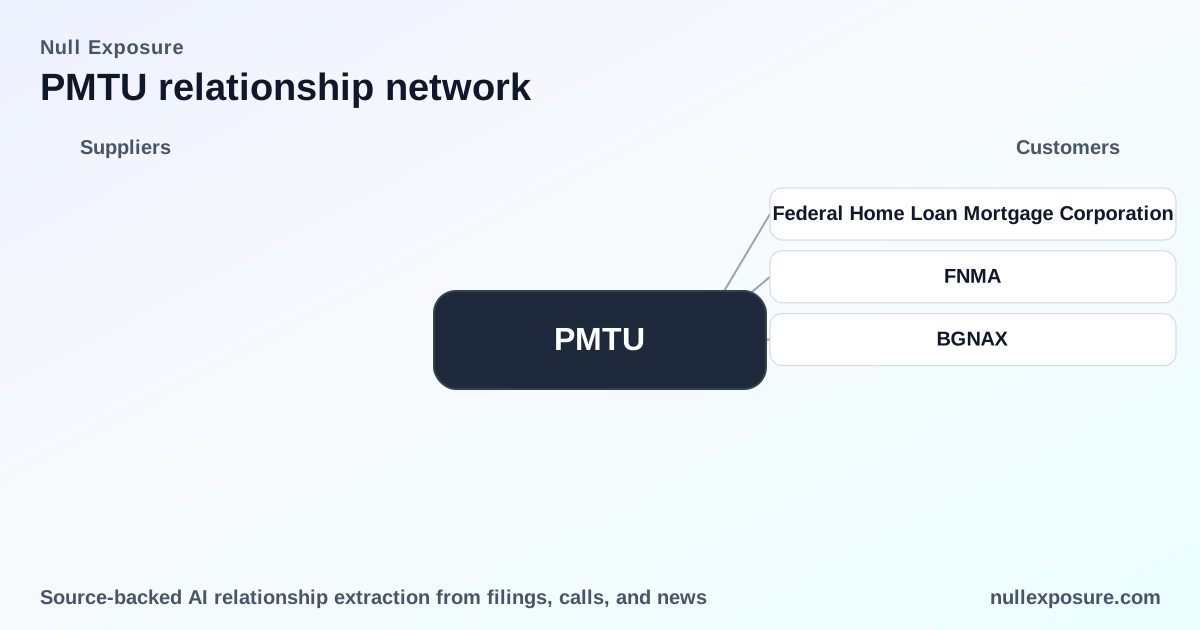
PMTU Customer Map: Who Actually Buys PennyMac Mortgage Investment Trust’s Paper
PennyMac Mortgage Investment Trust (PMTU) operates as a mortgage REIT that profits by acquiring, financing, securitizing and servicing residential mortgage loans and mortgage-related securities, then monetizing those assets through loan sales, MSR income and securitization proceeds. The firm’s correspondent-production model sources loans from originators, sells a material portion to government-sponsored entities (GSEs) and agency-guaranteed securitizations, and retains servicing rights where economically attractive—a structure that generates fee income and recurring servicing cash flows while exposing the business to concentrated counterparty and regulatory risk. For a practitioner view of these customer relationships, see https://nullexposure.com/.
How PMTU makes money — a concise investor view
PMTU’s core economics rest on three levers:
- Spread capture on acquired mortgage assets, where footprint and timing of purchases determine yield;
- Loan-sale and securitization economics, where correspondent production is converted into immediate cash via sales to GSEs, PLS and Ginnie Mae‑guaranteed pools; and
- Servicing and MSR cash flows, which produce recurring fee revenues and ancillary income.
The firm monetizes both by selling loans “as‑is” to institutional buyers and by packaging loans into agency/MBS structures, which produces liquidity and allows balance sheet rotation. This operational posture creates a concentrated relationship set with a small number of large government entities and specialist purchasers. For more on PMTU’s positioning and relationship-driven exposure, visit https://nullexposure.com/.
The counterparty roster that matters (documented in PMTU’s FY2024 10‑K)
Below are every relationship extracted from PMTU’s FY2024 filings and related excerpts, presented with a plain-English description and the cited source.
Federal Home Loan Mortgage Corporation (Freddie Mac)
PMTU sells loans acquired through its correspondent channels directly to Freddie Mac as a primary distribution outlet for conventionally underwritten loans. According to PMTU’s 2024 Form 10‑K, Freddie Mac is listed as a primary government-sponsored purchaser of the company’s correspondent production. (PMTU 2024 Form 10‑K, FY2024)
Federal National Mortgage Association (Fannie Mae)
Fannie Mae serves as a principal buyer for PMTU’s correspondent-originated loans, enabling rapid off‑balance-sheet conversion of newly originated prime loans into agency MBS. The 2024 Form 10‑K explicitly identifies Fannie Mae among the GSEs that purchase PMTU’s correspondent-originated loans. (PMTU 2024 Form 10‑K, FY2024)
FNMA (duplicate entry in results)
The filing repeats the Fannie Mae reference, reinforcing that sales to FNMA are a core and recurring channel for correspondent production. The duplicated mention in the FY2024 10‑K signals emphasis on FNMA as a stable buyer in PMTU’s distribution network. (PMTU 2024 Form 10‑K, FY2024)
BGNAX
The 10‑K references sales to PLS for securitizations guaranteed by Ginnie Mae or the GSEs, and one result maps an issuer symbol BGNAX in the extraction. In practice this line item reflects PMTU’s pathway of selling loans into PLS structures that ultimately feed Ginnie‑guaranteed or agency‑guaranteed MBS conduits. (PMTU 2024 Form 10‑K, FY2024)
Ginnie Mae (Government National Mortgage Association)
PMTU sells loans—often through private label structures—to be pooled into securitizations guaranteed by Ginnie Mae, providing an outlet for government‑insured or VA/USDA collateral. The FY2024 10‑K calls out sales into securitizations guaranteed by Ginnie Mae alongside GSE sales. (PMTU 2024 Form 10‑K, FY2024)
What the documented constraints tell investors about the operating model
PMTU’s 10‑K excerpts surface a clear set of structural constraints that shape revenue stability, counterparty risk and capital allocation.
- Concentration on government counterparties: PMTU is highly dependent on GSEs and government agencies as buyers and guarantors, which drives liquidity but creates concentrated counterparty and regulatory exposure. This is a company‑level signal drawn from multiple excerpts that consistently reference Fannie Mae, Freddie Mac and Ginnie Mae.
- U.S.-centric geography: PMTU files U.S. federal and state returns and relies on U.S. agency programs, anchoring its market and regulatory exposure to U.S. mortgage policy and Fed/regulatory actions.
- Dual buyer/seller posture: The firm acts both as a seller (originating and selling loans) and as a buyer/holder of loan and MBS positions, implying capital allocation tension between balance‑sheet accumulation and correspondent pipeline liquidity.
- Active commercial stage: The narrative in 2024 confirms continued sales to PLS and plans to adjust volumes with counterparties in 2025, indicating active and operationally engaged distribution relationships.
- Service provider dynamics: PMTU values and retains MSRs, serving loans for owners and collecting servicing fees—this creates recurring cash flow but also operational obligations and compliance exposure tied to servicing standards and agency eligibility rules.
- Core product focus: The correspondent production segment is the operational center, funneling newly originated loans into markets through sales and securitizations.
These constraints define both the upside (stable agency liquidity and fee income) and the downside (agency/regulatory concentration, program changes, and capital intensity).
Risk and reward — what investors should price in
- Revenue predictability is high when agency channels function normally, because GSEs and Ginnie Mae represent large, reliable buyers for conforming and insured product. This supports durable servicing and fee income streams.
- Regulatory or agency policy shifts are single‑event risks: changes to GSE eligibility, pricing, or capital requirements can materially affect PMTU’s ability to sell or service loans and therefore compress liquidity and margins.
- Operational execution matters: PMTU’s counterparty relationships are predicated on eligibility and servicing standards; noncompliance can directly curtail access to the GSE/agency distribution channels.
- Concentration requires active capital management: the firm’s dual role as seller and holder means capital allocation decisions (retain vs. sell) will determine balance‑sheet risk and return volatility.
Bottom line: PMTU runs a classic agency‑dependent correspondent REIT model—structured for stable fee generation while carrying outsized exposure to a small set of government counterparties. Investors should weigh the income profile against policy and counterparty concentration risks.
For a deeper mapping of PMTU’s counterparty exposures and to track any material changes to these relationships, visit https://nullexposure.com/.
Closing perspective
PMTU’s FY2024 disclosures leave no ambiguity: its customer ecosystem is dominated by Fannie Mae, Freddie Mac and Ginnie Mae‑backed securitizations (including PLS conduits), and the firm intentionally leverages these channels as the delivery mechanism for correspondent production. That structure produces predictable servicing cash flow and agency liquidity while concentrating regulatory and counterparty risk—precisely the trade investors should price into any valuation or credit assessment.