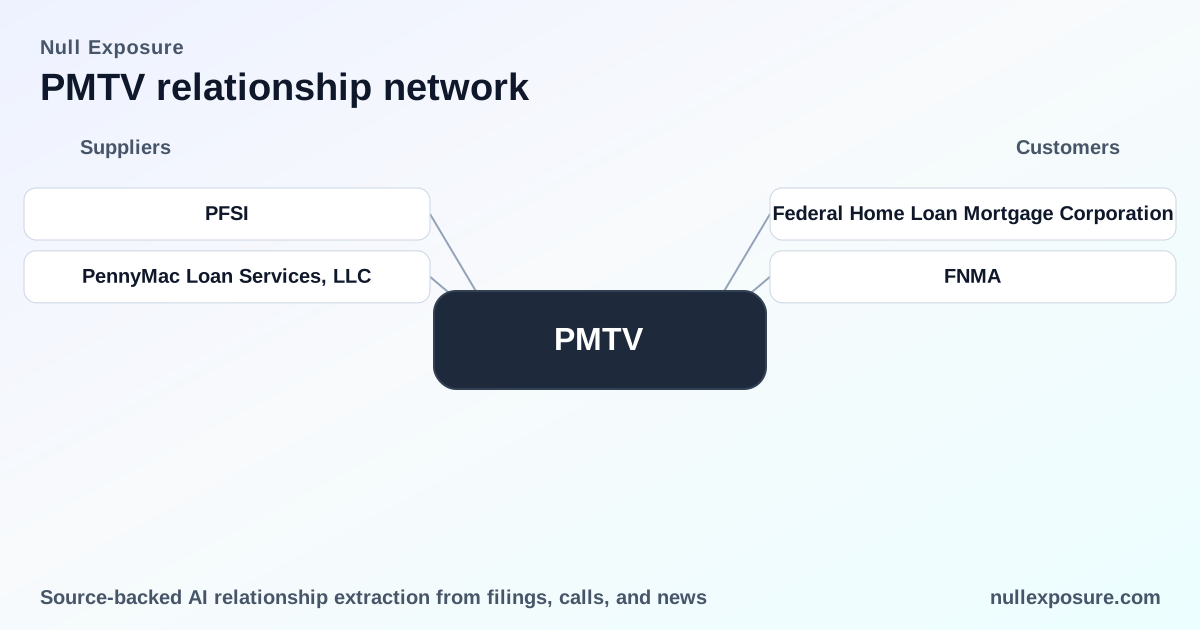
How PMTV Monetizes GSE Channels and What the customer map reveals
PennyMac Mortgage Investment Trust issues 9.00% senior notes due 2030 and operates as a mortgage REIT that acquires residential loans and mortgage-backed securities, then monetizes those assets through a combination of sales to government-sponsored entities (GSEs), private-label securitizations, and loan servicing. The firm extracts spread and fee income by originating or buying correspondent loans, selling a portion into GSE channels (Fannie Mae, Freddie Mac) or into PLS/Ginnie Mae securitizations, and retaining servicing rights where profitable — a model that converts mortgage inventory into predictable cash yield while funding through debt securities. For a quick reference on the company profile and coverage, see Null Exposure for PMTV analysis: https://nullexposure.com/.
Why the GSE relationships define the business model
PMTV’s operating model is built around three connected dynamics: origination and inventory management, GSE access and pricing, and securitization/servicing economics. Filings show the company deliberately routes a large share of correspondent-originated loans to Fannie Mae and Freddie Mac, or into PLS structures that can be guaranteed by Ginnie Mae. That routing simultaneously reduces warehouse finance costs, transfers certain credit risks off the balance sheet, and preserves servicing revenue streams.
From an investor perspective, several structural signals stand out:
- Counterparty profile: PMTV is materially dependent on government-sponsored enterprises and related agencies for disposition of originated loans, which creates both scale benefits and policy sensitivity. (Company 10‑K, FY2024.)
- Contracting posture: Evidence of long-term debt instruments in the capital structure (e.g., CRT Term Notes with multi-year maturities) signals an established funding posture rather than purely short-term wholesale financing. This supports predictable coupon servicing but also fixes leverage duration. (Company filing excerpts.)
- Concentration and criticality: The firm identifies its GSE relationships as material to liquidity and operations, so any structural changes at those counterparties would have immediate cash-flow consequences. (Company 10‑K, FY2024.)
- Geographic scope and regulatory reach: PMTV operates under state licensing across all U.S. jurisdictions, which embeds regulatory complexity into its correspondent and servicing rollouts. (Company 10‑K, FY2024.)
For additional background on the issuer and coverage, Null Exposure maintains a profile hub for PMTV: https://nullexposure.com/.
The customer relationships recorded in filings
PMTV’s FY2024 10‑K explicitly lists its customer and disposition channels. The filing entries in the relationship dataset are short but consequential; below I cover each recorded relationship exactly as it appears in the results.
Federal Home Loan Mortgage Corporation (Freddie Mac)
PMTV discloses that it primarily sells loans it acquires through correspondent production activities to Freddie Mac, using this channel to convert originated inventory into cash and to manage credit exposure. According to PMTV’s 2024 Form 10‑K, Freddie Mac is one of the GSEs named as a regular purchaser of correspondent-originated loans (FY2024 10‑K).
Federal National Mortgage Association (Fannie Mae)
The 10‑K states that Fannie Mae is a primary buyer for PMTV’s correspondent loan production, reflecting an operational reliance on Fannie for conventional mortgage disposition and liquidity management. PMTV’s FY2024 Form 10‑K lists Fannie Mae alongside Freddie Mac as routine counterparties for correspondent sales (FY2024 10‑K).
FNMA (duplicate listing)
A second entry repeats the same relationship with FNMA (Fannie Mae) as recorded in the dataset; the underlying disclosure reiterates that PMTV sells correspondent loans to FNMA as part of its standard distribution channels. The duplicate listing is sourced to the same FY2024 10‑K language identifying GSE purchasers of correspondent loans (FY2024 10‑K).
What the relationship map implies for investors: constraints and mechanics
The extracted constraints from the filings frame how these customer links operate in practice:
- Government counterparties and materiality: PMTV explicitly confirms its heavy dependence on GSEs and government agencies; this is a corporate-level signal that GSE pricing and regulatory decisions are central value drivers and risk vectors. (10‑K FY2024 excerpts.)
- Active, transactional relationships: The filing language describes current, ongoing sales flows to GSEs and PLS structures, signaling that these are active, operational channels rather than legacy or dormant contracts. Active status supports near-term cash conversion but increases sensitivity to pipeline disruptions. (10‑K FY2024 excerpts.)
- Role diversity — buyer, seller, servicer: Filings assign multiple commercial roles across PMTV’s activity set: PMTV sells loans to GSEs (seller), purchases or finances some production (buyer in other contexts), and earns loan servicing fees through PennyMac Financial Services, indicating vertical integration across production, sale and servicing lines. This verticality amplifies both margin capture and operational complexity. (10‑K FY2024 excerpts.)
- Long-term capital posture: The appearance of multi-year term notes in the capital schedule (CRT Term Notes with maturities into 2028) demonstrates a commitment to multi-year funding that underpins REIT coupon obligations and supports opportunistic duration management of the mortgage book. This is a company-level funding signal rather than a counterparty-specific covenant. (Filing excerpts.)
Investment implications: opportunities and headline risks
- Opportunity — predictable monetization path: PMTV benefits from established GSE channels to convert loans into cash and to capture servicing fees; this structure supports yield generation for fixed-income investors in the senior notes. GSE access is a durable monetization lever.
- Risk — policy and concentration: The single largest operational risk is GSE/regulatory change. Because the company is materially dependent on Fannie Mae and Freddie Mac purchase programs, changes in guarantee pricing, eligibility rules, or regulatory frameworks would have an outsized impact on liquidity and returns. The 10‑K explicitly warns that organizational or pricing changes at such entities would materially affect PMTV’s operations (FY2024 10‑K).
- Operational complexity: Holding servicing rights and performing nationwide licensing means PMTV’s cost base and compliance obligations are non-trivial; servicing fees are a meaningful revenue segment and operational competency for the group. (10‑K FY2024 excerpts.)
- Funding profile: Long-dated term notes signal funding stability, but also commit the company to fixed coupon costs that must be covered by spread income on the mortgage assets and securitizations.
Bottom line for investors evaluating PMTV customer risk
PMTV runs a GSE-centric disposition model that converts correspondent production into cash and fee income while retaining selective servicing economics. That model generates steady monetization so long as GSE channels and securitization markets remain accessible under current terms; conversely, policy shifts or GSE repricing represent clear concentration risk. For credit-focused investors in the 9.00% 2030 notes, the combination of active GSE relationships, demonstrated servicing revenue, and long-term funding instruments defines both the source of yield and the primary downside vector.
For detailed coverage and continual updates on PMTV’s counterparties and filings, visit Null Exposure: https://nullexposure.com/.