PNC’s customer footprint: loans, syndications and fee engines investors should watch
Thesis: PNC is a diversified regional bank that monetizes a national deposit franchise, commercial lending and capital markets origination—earning net interest income from loans and deposits and recurring fees from treasury management, servicing and underwriting. Its customer relationships show PNC operating across the credit stack as administrative agent, lead arranger, book‑runner and commercial bank, which supports stable fee income and predictable funding flows for the franchise. For a systematic view of PNC’s commercial counterparties and recent deal activity, see Null Exposure’s company customer briefs at https://nullexposure.com/.
Overview: Across recent filings and press reports PNC is active as lender and capital markets partner — syndicating credit facilities, leading bond offerings, monetizing tax credits and providing cash‑management and hedging services. These relationships reflect scale in corporate banking and capital markets and an operating model that blends long‑dated credit commitments with recurring fee services.
Key operating model signals for investors
- Contracting posture: relationships are a mix of long‑dated loans and syndicated facilities alongside ongoing treasury and servicing contracts; PNC’s role as administrative agent implies multi‑year documentation and operational involvement.
- Concentration and counterparty mix: evidence shows exposure across large enterprises, mid‑market firms, small businesses, governments and individual retail clients—reinforcing diversified revenue channels.
- Criticality and value drivers: PNC captures both interest margin and fee income (servicing, underwriting, tax‑credit monetization and cash management), increasing the strategic stickiness of customer relationships.
- Maturity and optionality: frequent amendments and refinancings in the data indicate active relationship management and the ability to reprice or re‑structure exposure over time.
Read on for a compact, source‑by‑source catalog of every relationship in the record and what each tells an investor.
Customer relationships, source by source
-
Cooper Companies (COO) — Cooper signed an amendment to a term‑loan agreement with PNC Bank that extends maturity and leaves a $950m tranche running to 2031; PNC acted as administrative agent. Source: TradingView press item on the Feb 3, 2026 amendment (TradingView, Mar 2026) — https://www.tradingview.com/news/tradingview:02f7f24d2f8e4:0-cooper-companies-updates-multiple-financing-agreements-with-pnc-bank/.
-
Babcock & Wilcox Enterprises (BW) — The company discharged obligations and terminated a prior credit agreement with PNC Bank N.A., indicating payoff and agreement termination. Source: Babcock corporate release (FY2024) — https://www.babcock.com/home/about/corporate/news/babcock-and-wilcox-enterprises-announces-new-150-million-senior-secured-credit-facility-reaffirmed-credit-rating-of-bb-.
-
Kearny Financial / MSB (KRNY) — PNC FIG Advisory served as financial advisor to Kearny in its merger activity, reflecting PNC’s advisory footprint in M&A for regional banks. Source: NJB Magazine (FY2019) — https://njbmagazine.com/njb-news-now/kearny-financial-corp-announces-merger-with-msb-financial-corp/.
-
Hallador Energy (HNRG) — Hallador’s refinancing activity lists PNC Bank as a counterparty, then later reports show Hallador terminated a prior credit agreement with PNC effective March 5, 2026. Source: TradingView (Mar 2026) and QuiverQuant/Investing.com coverage (May 2026) — https://www.tradingview.com/news/tradingview:4c2a3d38a4397:0-hallador-energy-secures-120-million-senior-credit-facilities-led-by-texas-capital-bank-due-2029/; https://quiverquant.com/news/Hallador+Energy+Company+Closes+%24120+Million+Senior+Secured+Credit+Agreement+to+Enhance+Liquidity+and+Support+Growth+Initiatives.
-
ACRES Commercial Realty / Mavrek (ACR‑P‑C / ACR) — PNC monetized more than $17m in Federal and Illinois historic tax credits for a Chicago conversion project and participated in the financing close for 65 E Wacker Place. Source: Urbanize Chicago and REBusinessOnline (FY2025) — https://chicago.urbanize.city/post/developers-secure-funding-and-permit-office-residential-conversion-65-e-wacker; https://rebusinessonline.com/mavrek-acres-receive-financing-for-conversion-of-chicago-office-building-into-252-apartment-units/.
-
RLJ Lodging Trust (RLJ) — RLJ refinanced roughly $154.8m of mortgages with PNC to extend maturities to 2029, highlighting PNC’s role in commercial real estate mortgage refinancings. Source: TradingView (Mar 2026) — https://www.tradingview.com/news/tradingview:b17ef34cece2e:0-rlj-lodging-trust-extends-credit-facilities-adds-569m-a-1-and-150m-term-loans-to-refinance-2026-notes/.
-
Kearny Financial (KRNY) — Earlier press confirms PNC FIG Advisory served as Kearny’s financial advisor on acquisitions, underlining a repeated advisory relationship. Source: GlobeNewswire (2020) — https://www.globenewswire.com/news-release/2020/07/13/2061219/0/en/Kearny-Financial-Corp-Completes-Acquisition-of-MSB-Financial-Corp.html.
-
CTO Realty Growth (CTO) — PNC Bank was a co‑syndication agent on a financing, demonstrating participation in larger loan syndicates with peers. Source: Yahoo Finance release (FY2025) — https://finance.yahoo.com/news/cto-realty-growth-strengthens-balance-200500661.html.
-
Healthpeak Properties (DOC) — PNC Capital Markets LLC acted as a joint book‑running manager on a $500m offering, showing PNC’s underwriting and distribution capability. Source: Yahoo Finance and FinancialContent (FY2025) — https://finance.yahoo.com/news/healthpeak-prices-offering-500-million-212700401.html; https://markets.financialcontent.com/wedbush/article/bizwire-2025-8-5-healthpeak-prices-offering-of-500-million-of-4750-senior-unsecured-notes-due-2033.
-
Walker & Dunlop (WD) — Coverage notes an extensive relationship with PNC encompassing lending, cash management and derivatives for hedging, and amendments to warehousing facilities. Source: Ad‑Hoc News and SimplyWallSt (FY2026) — https://www.ad-hoc-news.de/boerse/news/ueberblick/walker-and-dunlop-secures-more-favorable-credit-terms/68548403; https://simplywall.st/stocks/us/diversified-financials/nyse-wd/walker-dunlop/news/350-million-self-storage-financing-might-change-the-case-for.
-
Embraer (EMBJ) — Embraer’s $1bn syndicated credit line was led by PNC Bank among other global banks, indicating PNC’s participation in cross‑border syndicated facilities. Source: AviTrader (FY2024) — https://avitrader.com/2024/08/07/embraer-signs-us1-billion-syndicated-credit-agreement/.
-
Trupanion (TRUP) — Trupanion announced a new debt facility with PNC providing a $100m term loan and $20m revolver, replacing prior facilities. Source: InsiderMonkey and TradingView (FY2026) — https://www.insidermonkey.com/blog/trupanion-inc-nasdaqtrup-q4-2025-earnings-call-transcript-1695370/; https://www.tradingview.com/news/tradingview:60479f86bfcd7:0-trupanion-inc-sec-10-k-report/.
-
Horace Mann (HMN) — PNC Capital Markets served as a joint book‑running manager on a $300m note offering, reflecting municipal/insurance sector underwriting activity. Source: Investing.com (FY2025) — https://www.investing.com/news/company-news/horace-mann-prices-300-million-in-senior-notes-due-2030-93CH-4252077.
-
LSI Industries / LYTS (LYTS) — LSI funded an acquisition partially with a credit facility and PNC Capital Markets participation, and secured a $350m senior secured facility led by PNC. Source: MarketScreener, TradingView and Globe and Mail (FY2026) — https://www.marketscreener.com/news/lsi-industries-inc-completed-the-acquisition-of-srr-holdings-inc-from-industrial-opportunity-part-ce7e5ed3d881f326; https://www.tradingview.com/news/tradingview:b3acc06040419:0-lsi-industries-secures-350-million-senior-secured-credit-facility-led-by-pnc/; https://www.theglobeandmail.com/investing/markets/stocks/LYTS/pressreleases/546298/lsi-industries-prices-equity-offering-to-fund-growth/.
-
SiteOne Landscape Supply (SITE) — PNC is listed as a participating lender in a multi‑bank amendment to SiteOne’s credit agreement, indicative of syndicate participation on large corporate revolvers. Source: MiniChart (FY2026) — https://www.minichart.com.sg/2026/04/27/siteone-landscape-supply-inc-and-subsidiaries-enter-first-amendment-to-amended-and-restated-credit-agreement-with-jpmorgan-chase-and-other-lenders/.
-
Lumexa Imaging (LMRI) — PNC Capital Markets acted as a co‑manager on Lumexa’s IPO, underlining the bank’s activity in equity capital markets for small‑cap issuers. Source: PR Newswire (FY2025) — https://www.prnewswire.com/news-releases/lumexa-imaging-announces-pricing-of-initial-public-offering-302638582.html.
-
Integral Ad Science (IAS) — IAS entered into an amendment with a PNC‑led syndicate as joint lead arranger and later terminated a prior PNC‑led agreement, showing lifecycle of underwriting and replacement. Source: QuantiSnow/TradingView (FY2026/FY2025) — https://www.quantisnow.com/insight/ias-announces-completion-of-expanded-credit-facility-6091143; https://www.tradingview.com/news/tradingview:2f34fa7db34a2:0-integral-ad-science-signs-credit-agreement-with-royal-bank-of-canada/.
-
Walker & Dunlop (WD) — warehousing amendment — The Seventeenth Amendment to WD’s warehousing facility involved PNC, reinforcing PNC’s role in short‑term warehouse finance. Source: SimplyWallSt (FY2026) — https://simplywall.st/stocks/us/diversified-financials/nyse-wd/walker-dunlop/news/350-million-self-storage-financing-might-change-the-case-for.
-
TRTN loan facility (TRTN‑P‑C / TRTN‑P‑A) — PNC Capital Markets has appeared as joint lead arranger and PNC Bank as lender/administrative agent on past Triton facilities, showing cross‑border arrangement participation. Source: Royal Gazette and SEC filing (FY2018/FY2023) — https://www.royalgazette.com/international-business/business/article/20181206/triton-enters-into-new-1bn-loan-facility/; https://www.sec.gov/Archives/edgar/data/1660734/000166073423000033/trtn-20221231.htm.
-
Zumiez (ZUMZ) — Zumiez amended its credit agreement with PNC to extend its secured revolver, demonstrating PNC’s involvement in retail revolving facilities. Source: TradingView (FY2025) — https://www.tradingview.com/news/tradingview:0f71478b6d769:0-zumiez-signs-credit-agreement-amendment-with-pnc-bank/.
-
Vontier (VNT) — Vontier secured a 364‑day unsecured term loan with PNC as administrative agent, reflecting short‑dated corporate liquidity solutions. Source: TradingView (FY2026) — https://www.tradingview.com/news/tradingview:15cb7d501019f:0-vontier-secures-300-million-364-day-unsecured-term-loan-with-pnc-bank/.
-
Build‑A‑Bear Workshop (BBW) — Build‑A‑Bear entered into a third amendment of its revolving credit with PNC and participating lenders, illustrating PNC’s role in retail covenant management. Source: TradingView (FY2026) — https://www.tradingview.com/news/tradingview:1d685fdf62ea7:0-build-a-bear-workshop-signs-revolving-credit-agreement-amendment-with-pnc-bank/.
-
Advanced Drainage Systems (WMS) — PNC served as revolver agent on an expanded facility while Bank of America handled term agent duties, showing agent splits across product types. Source: TradingView (FY2026) — https://www.tradingview.com/news/tradingview:92390ada862d6:0-advanced-drainage-systems-prices-500-million-2034-notes-and-expands-credit-facilities/.
-
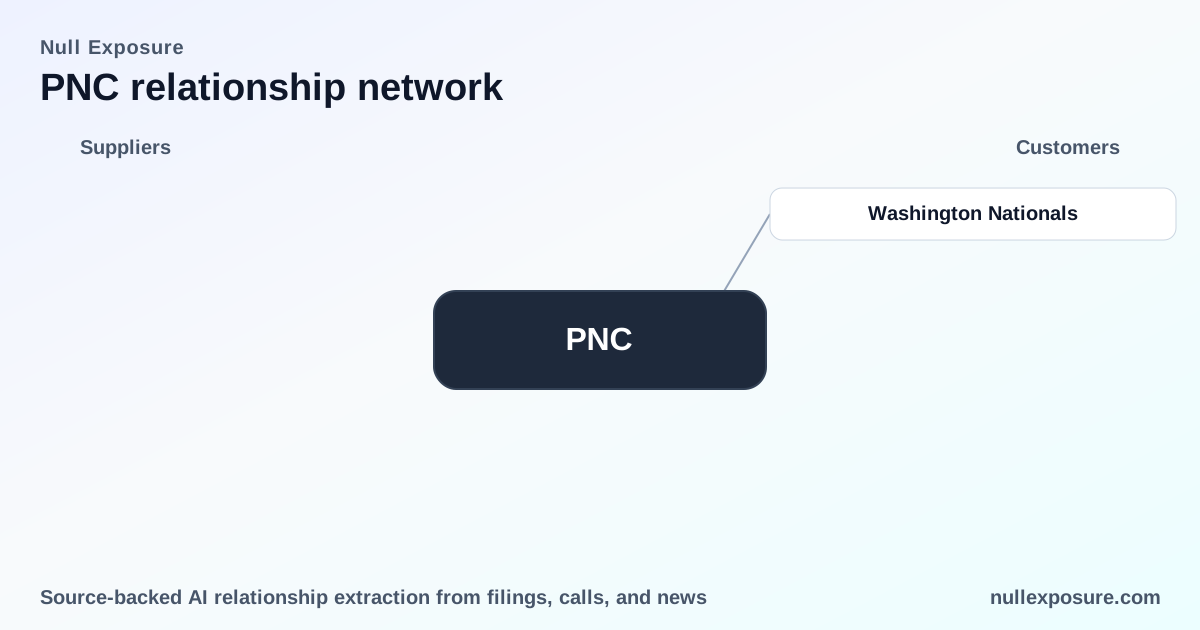
PNC & Washington Nationals (sponsorship) — PNC entered a multi‑year exclusive agreement as the official bank of the Washington Nationals, extending PNC’s consumer brand reach. Source: PNC Media Room release (FY2026) — https://pnc.mediaroom.com/news-releases?item=73816.
-
Triumph Group (TGI) — Administration of a facility transitioned away from PNC to MUFG Bank, indicating occasional syndicate role exits or transfers. Source: Investing.com (FY2025) — https://www.investing.com/news/company-news/triumph-group-stock-hits-52week-high-at-2598-usd-93CH-4151021.
-
Agree Realty (ADC) — PNC Bank served as administrative agent on a $350m term loan, with PNC Capital Markets among joint lead arrangers, demonstrating PNC’s REIT financing capabilities. Source: StockTitan (FY2023) — https://www.stocktitan.net/news/ADC/agree-realty-announces-350-million-5-5-year-term-lx43h3pajvh9.html.
-
Kewaunee Scientific (KEQU) — Kewaunee amended a loan with PNC to facilitate an early repayment and previously used PNC financing for acquisitions, showing repeat transactional lending. Source: Investing.com and BusinessNC (FY2026/FY2024) — https://m.za.investing.com/news/insider-trading-news/kewaunee-scientific-ceo-hull-sells-81k-in-stock-93CH-4053643; https://businessnc.com/kewaunee-acquires-nuaire-for-55-million/.
-
AppFolio (APPF) — AppFolio entered a $150m senior secured revolver with PNC that includes tight covenants limiting additional borrowings and capital returns, signaling PNC’s covenant enforcement posture. Source: SahmCapital (FY2026) — https://www.sahmcapital.com/news/content/how-appfolios-new-tightly-covenanted-credit-facility-appf-has-changed-its-investment-story-2026-02-27.
-
RLI Corp (RLI) — RLI repaid long‑term debt and upsized its revolver with PNC, underlining PNC’s role as a working‑capital liquidity provider. Source: Investing.com transcript (FY2026) — https://m.investing.com/news/transcripts/earnings-call-transcript-rli-corp-q1-2026-earnings-beat-eps-expectations-93CH-4633660?ampMode=1.
-
Pebblebrook Hotel Trust (PEB‑P‑E) — PNC is one of multiple documentation agents on a refinancing, illustrating PNC’s participation in hotel/RE financing syndicates. Source: CityBiz (FY2026) — https://www.citybiz.co/article/805748/pebblebrook-hotel-trust-refinances-near-term-debt-secures-450m-term-loan/?abkw=citybizbaltimore.
-
Stoneridge (SRI) — Stoneridge amended its credit facility with PNC as administrative agent, extending tenor and easing covenants; a typical mid‑market manufacturer engagement. Source: TradingView (FY2026) — https://www.tradingview.com/news/tradingview:2aad70bfb2a61:0-stoneridge-amends-credit-facility-with-pnc-extends-to-2027-and-eases-covenants/.
-
Richardson Electronics (RELL) — RELL reports no outstanding debt on its PNC revolver during fiscal 2026, indicating conservative draw patterns or alternative liquidity. Source: TradingView and GlobeNewswire (FY2026) — https://www.tradingview.com/news/tradingview:0af13c4b24839:0-richardson-electronics-reports-q2-fy26-results/; https://www.globenewswire.com/news-release/2026/01/07/3214928/0/en/Richardson-Electronics-Reports-Second-Quarter-Results-Declares-Quarterly-Cash-Dividend.html.
-
Gladstone Commercial (GOODO) — PNC joined as a lender alongside Webster Bank in a facility, demonstrating PNC’s participation in REIT lending consortia. Source: InsiderMonkey (FY2026) — https://www.insidermonkey.com/blog/gladstone-commercial-corporation-nasdaqgood-q4-2025-earnings-call-transcript-1699617/.
-
Quest Resource / QRHC (QRHC) — Quest refinanced its ABL away from PNC to Texas Capital Bank, showing client movement between commercial lenders. Source: The Globe and Mail transcript (FY2026) — https://www.theglobeandmail.com/investing/markets/markets-news/motley/725336/quest-resource-qrhc-q4-2025-earnings-transcript/.
-
Kinetik Holdings (KNTK) — An amendment to a Receivables Purchase Agreement lists PNC as administrative agent, highlighting PNC’s role in receivables financing structures. Source: Investing.com (FY2026) — https://m.investing.com/news/insider-trading-news/kinetik-holdings-isqaffiliated-entities-sell-1845m-in-shares-93CH-4647516?ampMode=1; https://ng.investing.com/news/insider-trading-news/kinetik-holdings-i-squared-capitallinked-entities-sell-77m-stock-93CH-2461705.
-
Evercore (EVR) — Evercore maintained a revolver with PNC that was expanded to $225m to ensure working‑capital liquidity, showing PNC’s use as a corporate backstop. Source: TradingView (FY2026) — https://www.tradingview.com/news/tradingview:e493007a21ade:0-evercore-inc-sec-10-k-report/.
-
Phreesia / AccessOne (PHR) — Phreesia’s funded model is offered through AccessOne’s relationship with PNC Bank, indicating PNC’s role in third‑party financing programs. Source: InsiderMonkey transcript (FY2025) — https://www.insidermonkey.com/blog/phreesia-inc-nysephr-q3-2026-earnings-call-transcript-1657179/.
Closing note and next steps PNC’s customer roster across these items demonstrates breadth—retail, mid‑market, large corporates and capital markets clients—and depth—agent, arranger, underwriter and servicer roles. For investors, the combination of fee‑based capital markets activity and core lending relationships supports predictable income while requiring active credit and covenant oversight.
If you want the relationships translated into exposure maps, concentration indicators and formatted counterparty reports, explore a sample brief at Null Exposure: https://nullexposure.com/ — or request a tailored customer‑relationship extract for PNC through our site.