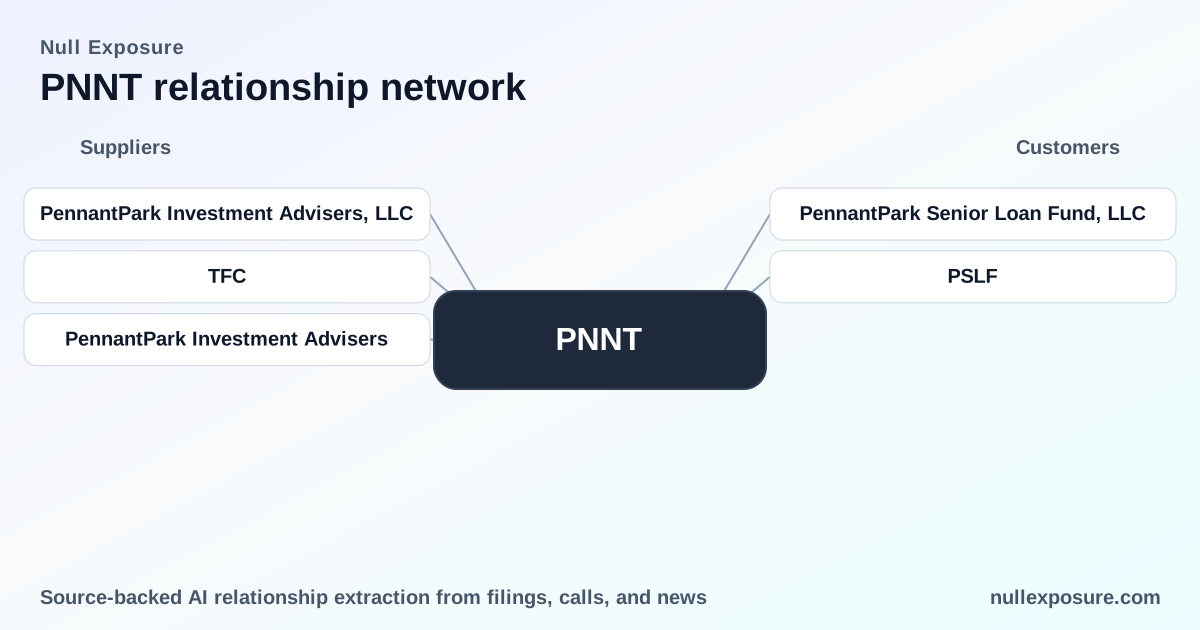
PennantPark Investment Corporation (PNNT): Customer relationships that move the credit needle
PennantPark Investment Corporation operates as a publicly traded business development company that monetizes by originating and managing private credit and equity investments for middle‑market companies, generating income through interest, fees, and realized gains while distributing steady dividends to shareholders. Its commercial relationships—joint ventures, affiliated loan funds, strategic portfolio exits, and passive institutional holders—shape leverage capacity, liquidity runway, and dividend sustainability. For relationship-level intelligence and the underlying source documents that inform these findings, visit https://nullexposure.com/.
Quick take: why the customer map matters for investors
PNNT’s economic model depends on two operational realities: asset monetization (interest and realized gains) and balance sheet flexibility (leverage targets and JV funding). The company’s counterparties—most importantly its PennantPark Senior Loan Fund joint vehicle and a handful of institutional ETF holders—directly affect how quickly PNNT can offload assets, reduce leverage, and redeploy capital. These relationships therefore translate to immediate portfolio and dividend implications for investors.
The operating model in plain terms
PNNT runs through a single reporting segment focused on debt and equity investments, which concentrates commercial exposure into the firm’s investment platform and its affiliated vehicles. That single-segment posture signals operational simplicity but higher counterparty concentration, meaning partner actions (JV purchases, significant ETF flows) produce outsized effects on PNNT’s leverage, liquidity, and realized income. The firm’s contracting posture shows active asset transfers to affiliated funds to manage leverage; maturity of relationships ranges from ongoing JV arrangements to one‑off realized exits. This combination creates high criticality of a few relationships and moderate maturity across its partner network.
Relationship inventory: every customer-level signal from the sources
PennantPark Senior Loan Fund, LLC — big intra‑group flows
During FY2026 PNNT sold a material portion of new lending into PennantPark Senior Loan Fund, LLC, with PSLF investing $129.5 million in the quarter — including $128.9 million purchased from PNNT — at a weighted average yield of 9.2% on interest‑bearing debt, according to a company press release reported via Manila Times/GlobeNewswire (FY2026). This confirms active portfolio transfers to the senior loan vehicle as a structural liquidity channel.
PSLF — JV asset purchase under active evaluation
PNNT’s PSLF joint venture was evaluating a purchase of $120–$140 million of assets from PNNT to drive PNNT’s leverage down to roughly 1.25–1.3x, per the company’s Q4 2025 earnings call transcript published on InsiderMonkey (FY2025). The discussion confirms the JV functions as a deliberate deleveraging tool that materially affects PNNT’s balance sheet metrics.
PSLF JV — strategic lever for capital structure management
The PSLF JV label in the same Q4 2025 transcript reiterates the asset‑purchase plan tied to PNNT’s targeted leverage band (1.25–1.3x), highlighting that the joint vehicle is an explicit counterparty for offloading loans and managing regulatory/market leverage thresholds, per InsiderMonkey (FY2025). This repeats and reinforces the previous point about the JV’s operational importance.
JF Holdings — realized equity exit and large realized gain
PNNT completed a full exit of its equity stake in JF Holdings in FY2026, generating $68 million of proceeds and a $63 million realized gain, according to the Q1 2026 earnings call transcript on InsiderMonkey (FY2026). This single transaction materially bolstered PNNT’s reported realized income for the quarter and demonstrates the company’s ability to crystallize substantial gains from equity dispositions.
BlackRock, Inc. — passive ETF ownership signal
BlackRock appears as a holder of PNNT shares through funds listed on ETF aggregation pages, indicating institutional passive exposure; TradingView’s ETF listings (FY2026/May 2026) show BlackRock funds among holders of PNNT. Large passive asset managers provide a steady liquidity pool for PNNT stock, but their flows are functionally tied to ETF demand dynamics rather than direct corporate interaction.
Invesco Ltd. — distributor-driven passive demand
Invesco shows up on ETF holding lists (TradingView, FY2026/May 2026), principally via financial‑sector, high‑dividend ETFs that include PNNT. Invesco’s inclusion signals ongoing passive demand from income‑seeking ETF wrappers, supporting secondary market liquidity and dividend valuation.
Virtus Investment Partners, Inc. — private credit ETF interest
Virtus appears on the ETF holding roster (TradingView, FY2026/May 2026) through products that target private credit outcomes and include PNNT. Virtus’s position reflects thematic investor demand for private credit exposure and acts as a channel linking PNNT to dedicated credit ETF investor flows.
Power Corp of Canada — international ETF exposure
Power Corp of Canada appears within ETF holdings that include PNNT per TradingView (FY2026/May 2026), reflecting cross‑border passive interest via Canadian ETF issuers. This broadens the investor base beyond domestic passive funds and provides incremental liquidity depth.
Empirical Finance LLC — niche ETF participation
Empirical Finance LLC is listed among funds that hold PNNT on the same ETF aggregation page (TradingView, FY2026/May 2026), representing narrower, specialty ETF exposure to PNNT shares. Such holders contribute marginal volume but validate demand from targeted product suites focused on private equity or dividend strategies.
What investors should read into these relationships
- Affiliated JV flows are the most consequential relationships. The PSLF/PSLF JV transactions directly adjust PNNT’s leverage and liquidity and therefore influence dividend policy and capital deployment. Repeated public references to JV purchases indicate a deliberate, contractually available mechanism to move assets off PNNT’s balance sheet.
- Realized exits such as JF Holdings create episodic upside to distributable earnings; the $63 million realized gain in FY2026 materially improved reported income for that quarter. Expect realized gains to be lumpy but meaningful when they occur.
- Passive institutional holders (BlackRock, Invesco, Virtus, Power Corp, Empirical) underpin market liquidity and valuation multiples through ETF inclusion, but they do not substitute for active JV counterparty actions that affect PNNT’s operational liquidity.
Risk and concentration considerations
PNNT’s single‑segment reporting and reliance on a few high‑impact relationships produce concentration risk: JV activity or withdrawal, failed asset sales, or major ETF redemptions could rapidly change leverage ratios and dividend coverage. Conversely, the existence of structured JV channels and active realized exits is a deleveraging and value‑realization mechanism that supports the firm’s dividend profile when executed.
If you evaluate PNNT for portfolio inclusion or credit exposure, focus on: (1) cadence and terms of PSLF/PSLF JV purchases; (2) cadence of large realized exits; and (3) trends in passive ETF holdings that influence stock liquidity and valuation multiples. For a broader map of how these relationships map to other issuers and counterparties, see our detailed relationship intelligence offering at https://nullexposure.com/.
Bottom line
PennantPark’s customer landscape is dominated by an affiliated senior loan fund that functions as an operational lever, episodic equity exits that meaningfully affect distributable earnings, and a base of passive ETF holders that support public market liquidity. These relationships jointly determine PNNT’s balance‑sheet flexibility and the sustainability of its dividend profile. Investors should monitor JV purchase execution and realized‑gain frequency as primary drivers of near‑term performance.