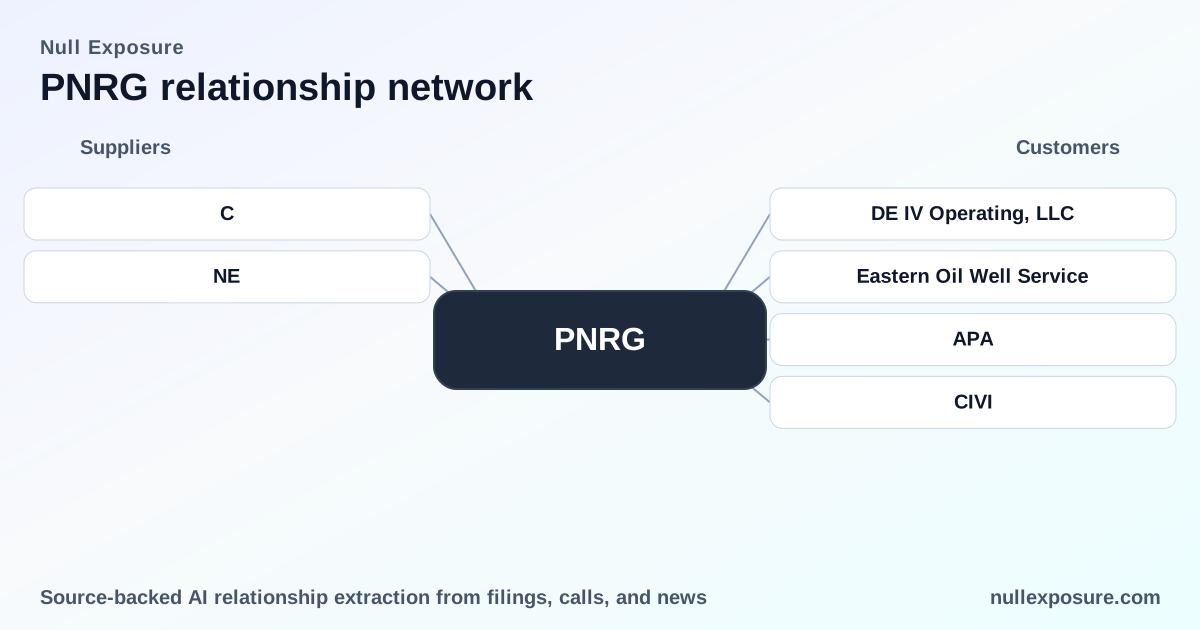
PrimeEnergy (PNRG) — Customer Map and Commercial Constraints that Drive Cash Flow
PrimeEnergy Resources Corporation is an independent U.S. oil and gas producer that monetizes upstream output by selling oil, natural gas and NGLs into the spot market and by providing field services. The company generates the bulk of revenue from commodity sales to a small set of large purchasers and supplements cash flow through well-servicing and site-preparation work; these relationships and the company’s contracting posture create a concentrated, price-exposed cash flow profile. For an operational due diligence lens and quick access to relationship intelligence, see Null Exposure’s research hub: https://nullexposure.com/.
Why customers determine PrimeEnergy’s valuation trajectory
PrimeEnergy’s revenue growth and margin stability are directly linked to two fundamentals: who buys the production and how that production is priced and contracted. The company sells the majority of its production at spot market prices, which makes realized revenue highly correlated with short-term commodity cycles. At the same time, several single purchasers account for double-digit shares of annual oil and gas sales, creating concentration risk that amplifies commodity-driven volatility.
- Concentration: Multiple customers each represent more than 10% of annual sales, making the loss or contract change of any major purchaser materially impactful to near-term cash flow.
- Contracting posture: The firm sells largely on spot terms and has no long-term purchasing agreements; the company treats purchasers as replaceable but dependent for current revenue.
- Service business: PrimeEnergy runs a field-service operation that generates ancillary revenue and can be a tactical buffer against commodity swings, although the firm executed at least one asset sale in this area during FY2024.
For quick navigation to PrimeEnergy relationship data, visit Null Exposure: https://nullexposure.com/.
Customer roster: who buys PrimeEnergy production (line‑by‑line)
Below are the relationships reported in PrimeEnergy’s FY2024 10‑K. Each entry is a concise operational takeaway with its source.
DE IV Operating, LLC
DE IV Operating, LLC purchased 29.77% of gas and 44.09% of oil sold by PrimeEnergy in FY2024, making it the company's largest single purchaser of oil and a primary counterparty for gas. According to PrimeEnergy’s FY2024 Form 10‑K, these shares represent material and concentrated revenue sources for the year.
Eastern Oil Well Service
Eastern Oil Well Service, formerly part of PrimeEnergy’s field services footprint, was sold in 2024 for proceeds of $2.8 million, reducing the company’s direct exposure to that specific service asset. PrimeEnergy disclosed the sale in its FY2024 10‑K as a completed divestiture of a South Texas oil field services business.
APA (APA Corporation)
APA Corporation accounted for 18.64% of gas purchases and 11.90% of oil purchases from PrimeEnergy in FY2024, positioning APA as a top-three counterparty by volume. The FY2024 10‑K lists APA’s purchase percentages, underscoring its role as a material buyer of PrimeEnergy production.
APA Corporation (duplicate listing)
The company’s filings list APA Corporation again with the same purchase percentages (18.64% gas; 11.90% oil) in FY2024, confirming APA’s consistent prominence among PrimeEnergy’s buyers as reported in the FY2024 Form 10‑K.
CIVI (Civitas Resources Inc)
Civitas Resources (CIVI) purchased 21.79% of gas and approximately 19.57% of oil sold by PrimeEnergy in FY2024, making Civitas another large and material purchaser for both commodity streams. These percentages are reported in PrimeEnergy’s FY2024 10‑K and signify high dependency on a handful of integrated producers.
Civitas Resources Inc (duplicate listing)
Civitas Resources Inc is listed again in the FY2024 filing with the same purchase proportions (21.79% gas; ~19.57% oil), reinforcing its status as a core buyer for PrimeEnergy during the reporting year.
Operating constraints and what they imply for commercial risk
PrimeEnergy’s 10‑K disclosures convey a consistent set of operating constraints that shape the firm’s commercial profile:
- Spot pricing is the norm. The company sells the majority of its production at spot market prices, meaning revenue is highly sensitive to short‑term commodity moves rather than protected by fixed-price contracts.
- Geography is concentrated in the U.S. All oil and gas properties are located in the United States, so PrimeEnergy’s operational and regulatory exposure is concentrated within a single national jurisdiction.
- Customer concentration is material. The company explicitly lists purchasers that each represent more than 10% of sales in 2024, flagging single‑counterparty risk as a persistent valuation lever.
- Role diversity: PrimeEnergy is primarily a seller of commodities (buyer relationship in filing language) but also operates service activities (well servicing and site preparation) that provide incremental revenue and operational flexibility.
- Active but short‑term relationships: There are no long‑term purchasing agreements; relationships are active and expected to continue, but are contractually short‑term and thus replaceable yet critical for current cash flow.
- Business segments: The company’s cash flow is driven by core product sales (oil, gas, NGLs), with a smaller services segment that historically operated and, in part, was divested (Eastern sale).
These constraints translate into a business model that is highly levered to commodity price cycles, vulnerable to counterparty concentration, and operationally compact within U.S. onshore basins.
Investment implications and where to focus your diligence
For investors and operators evaluating PrimeEnergy, the practical implications are clear:
- Concentration is the primary operational risk. DE IV, Civitas and APA together account for a substantial share of FY2024 commodity receipts; any shift in their sourcing behavior would have an outsized near‑term impact on revenue.
- Price exposure is explicit and structural. Because the company sells primarily on spot terms, macro energy price forecasts and near‑term production hedging policy are decisive drivers of cash‑flow projections.
- Services are a secondary lever. Field services provide operational depth and incremental revenue but are not material to the firm’s core earnings; the FY2024 sale of Eastern Oil Well Service for $2.8 million reduced service asset exposure.
- Operational geography simplifies some risk vectors and concentrates others. Single‑country operations limit geopolitical complexity but amplify U.S. regulatory and basin‑level risks.
Key takeaway: PrimeEnergy is a compact, U.S.-focused upstream operator with material customer concentration and explicit spot-market dependence; investors should prioritize counterparty continuity, commodity price scenarios, and management’s approach to diversifying purchaser mix or introducing hedges.
For structured access to all relationship disclosures and company constraints, visit Null Exposure’s research platform: https://nullexposure.com/.