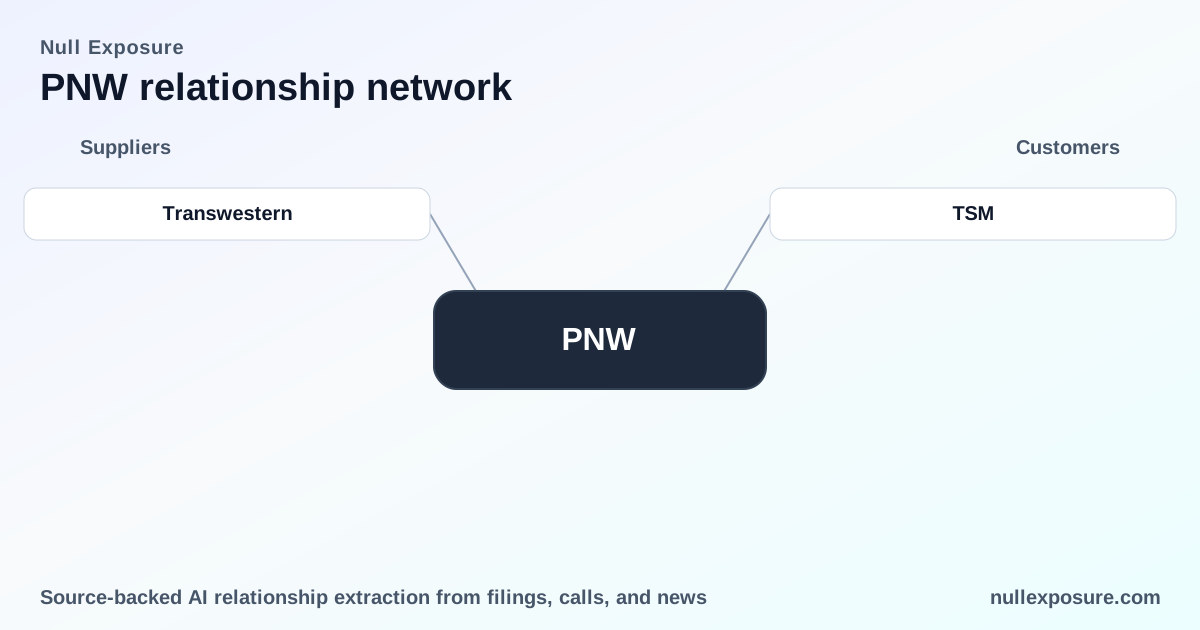
Pinnacle West (PNW) — What customers tell investors about growth runway and risk
Pinnacle West Capital (PNW) operates as a regulated utility holding company through Arizona Public Service (APS) and Bright Canyon Energy, monetizing primarily by selling electricity to retail and wholesale customers and by capturing long-term commercial & industrial (C&I) demand through infrastructure investments and regulated rates. Revenue derives from usage-based retail billing, regulated tariffs, and the incremental economics of serving large, high-load-factor customers such as semiconductor manufacturers that drive transmission and generation expansion. For investors, the question is not simply customer identity but the durability and scale of commitments that justify multi-year grid upgrades and capital deployment.
If you want a concise tracking view of PNW’s customer relationships and associated risk signals, visit https://nullexposure.com/ for our relationship analysis and coverage.
The TSMC relationship: strategic, capital-intensive, and visible in filings
PNW’s customer disclosures and management commentary repeatedly highlight TSMC (TSM) as a strategic, high-load customer whose Arizona expansion is directly driving grid investment. Management described TSMC’s footprint expansion — multiple fabs, an advanced packaging facility, and 900 additional acres for future growth — and explicitly linked those projects to planned transmission and generation capacity needed to support the new demand. According to the company’s Q4 2025 earnings call, TSMC’s second fab moves to full production in 2027 while additional fabs and packaging facilities are already in early development, and APS will expand grid infrastructure to support that growth (PNW Q4 2025 earnings call, March 2026).
A MarketBeat earnings alert reiterates the macro picture: PNW reports roughly 4.5 GW of committed high‑load‑factor C&I demand and an ~20 GW uncommitted pipeline, with TSMC expansion included; the company will file an updated 15‑year Integrated Resource Plan (IRP) mid‑year to map committed demand and required generation/transmission (MarketBeat, Feb–Mar 2026).
Line-item coverage of every reported customer relationship
Below are each of the reported relationship entries from public commentary and earnings material. Each entry is presented on its own terms with a concise investor-facing takeaway and the original source.
-
InsiderMonkey (news write-up of the Q4 2025 earnings call) notes that “TSMC is a very important customer, obviously, with a substantial build-out ongoing.” This framing emphasizes the strategic weight of TSMC for local demand growth. Source: InsiderMonkey blog covering PNW Q4 2025 earnings call (Mar 10, 2026) — https://www.insidermonkey.com/blog/pinnacle-west-capital-corporation-nysepnw-q4-2025-earnings-call-transcript-1704058/
-
The same InsiderMonkey reference repeats the same point in its coverage: TSMC’s build-out is material to APS’s near‑term growth assumptions. Source: InsiderMonkey blog (duplicate entry noted in public coverage) (Mar 10, 2026) — https://www.insidermonkey.com/blog/pinnacle-west-capital-corporation-nysepnw-q4-2025-earnings-call-transcript-1704058/
-
In the official Q4 2025 earnings call transcript, management explicitly details the TSMC pipeline: second fab to full production in 2027, third fab under construction, fourth fab and advanced packaging in early development, and 900 acres acquired for future expansion — all requiring grid enhancements. This is a direct operational linkage between a single large customer expansion program and PNW’s capital plan (PNW Q4 2025 earnings call transcript, Mar 7, 2026).
-
The earnings call record appears a second time in coverage feeds with the same excerpt describing TSMC’s staged expansion and the company’s role in expanding transmission and generation to meet that demand. This duplicate confirms consistent messaging across channels. Source: PNW Q4 2025 earnings call transcript (Mar 7, 2026).
-
A MarketBeat instant alert on PNW’s earnings highlights portfolio composition: ~4.5 GW of committed high‑load-factor C&I demand and an ~20 GW uncommitted pipeline (including ongoing TSMC expansion), and it notes the upcoming IRP update to map committed demand and required infrastructure (MarketBeat, Feb 25–Mar 10, 2026) — https://www.marketbeat.com/instant-alerts/pinnacle-west-capital-nysepnw-issues-earnings-results-beats-expectations-by-012-eps-2026-02-25/
-
That MarketBeat note recurs in syndicated coverage, restating the same capacity figures and the linkage to TSMC expansion; the repetition underscores market attention to PNW’s long-range planning around large C&I customers (MarketBeat, Feb–Mar 2026) — https://www.marketbeat.com/instant-alerts/pinnacle-west-capital-nysepnw-issues-earnings-results-beats-expectations-by-012-eps-2026-02-25/
Investor takeaway on these entries: All reported items point to a single, coherent narrative — TSMC is an anchor commercial customer whose staged investments are a primary driver of incremental APS capital spending and IRP assumptions. Management messaging is consistent across the earnings call and secondary reporting outlets.
If you want ongoing alerts and deeper relationship maps for PNW and peer utilities, check our coverage at https://nullexposure.com/.
How these customer signals map to Pinnacle West’s operating model and constraints
Several company-level signals emerge from the public excerpts that are material for valuation and operational risk:
-
Contracting posture: usage-based retail billing and regulated tariffs. PNW bills customers based on meter readings and recovers costs through regulated frameworks, which stabilizes revenue per unit but requires regulatory approval for major rate base additions.
-
Concentration: low single-customer revenue concentration historically. Management disclosed that in 2024 no single purchaser accounted for more than 1.4% of electric revenues, which signals a broadly diversified retail revenue base even as a few large C&I accounts drive incremental capital needs.
-
Criticality: high operational criticality for grid infrastructure. Serving large semiconductor fabs is operationally critical — these customers are high-load-factor and require reliable, high-capacity transmission and generation, raising the stakes for project execution and permitting.
-
Maturity and segment focus: regulated infrastructure and service delivery. Pinnacle West’s reportable business is principally regulated electricity generation, transmission and distribution, with APS providing service to approximately 1.4 million retail customers across Arizona; that established, vertically integrated model favors predictable cash flows but constrains upside to regulated rate proceedings.
-
Customer type mix: retail mass-market plus large C&I commitments. The evidence distinguishes standard residential/individual retail billing from committed C&I demand that drives discrete capital projects and mid‑to‑long-term planning (IRP).
Risk / reward synthesis for investors
-
Upside: Secured and prospective C&I commitments — particularly TSMC’s multi‑fab build-out — create a clear growth vector for regulated rate base and long-term cash flow through capital spending recoverable in rates. The existence of a large uncommitted pipeline (~20 GW) signals optionality for further scalability.
-
Downside: Large project pipelines concentrate execution and regulatory risk: transmission and generation additions require capital, permitting, and favorable regulatory treatment; any delay or ratemaking outcome that disallows cost recovery would compress returns. Historical low single‑customer concentration reduces counterparty risk today, but the economic importance of a few large customers to incremental capital makes project-level outcomes material.
-
Structural balance: The regulated business model and usage-based billing provide revenue stability, while the growth opportunity from high-load customers provides capital deployment visibility that underwrites future rate base expansion — provided regulatory processes and project execution remain on plan.
Closing view
PNW’s public commentary and syndicated market coverage converge on a single investor narrative: TSMC is the principal strategic customer driving near-term capital programs and IRP planning, while PNW’s regulated structure and broad residential base keep overall revenue concentration low. Investors should monitor IRP filings, regulatory case outcomes, and execution milestones on TSMC-related infrastructure projects to assess the realization of rate base value and downside exposure.
For continuous tracking of customer relationships and their materiality to regulated utilities like PNW, see full relationship maps and signal tracking at https://nullexposure.com/.