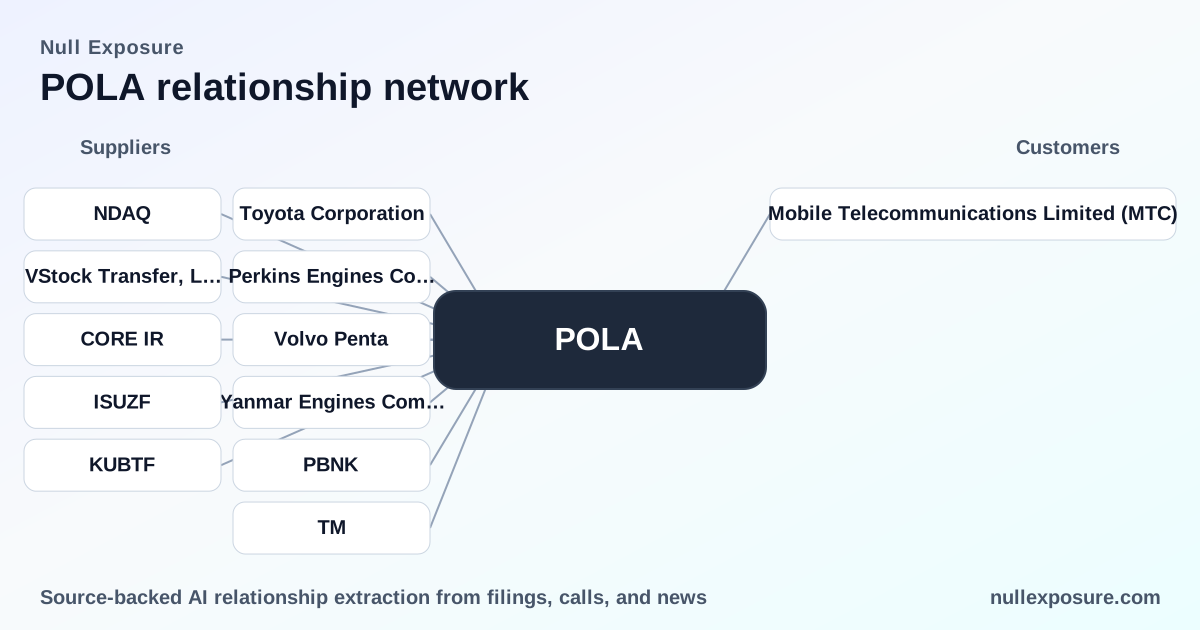
Polar Power (POLA) — customer relationships and what they mean for investors
Polar Power designs, manufactures and sells DC power generators, renewable-energy and cooling systems, and monetizes primarily through product sales to large telecommunications operators, complemented by parts and services. The company’s economics are driven by hardware margins, concentrated contract relationships with Tier‑1 telecoms and a modest stream of government/military orders that provide longer-duration revenue. For investors assessing customer risk and runway, focus on concentration, contract tenor and geographic exposure. For a deeper lens on customer-level signals, visit https://nullexposure.com/.
How Polar Power’s customer model actually operates
Polar Power is a seller of capital equipment and related services: revenue is overwhelmingly product-based, with parts and services a secondary revenue line. Company filings and disclosures describe sales to Tier‑1 telecommunications customers as the dominant revenue source, and military/government sales as a strategic complement because they are long‑term and development‑supportive. These characteristics create an operating posture where Polar Power’s manufacturing and delivery cadence is dictated by a small number of large contracts rather than broad transactional distribution.
Key operating signals drawn from company disclosures:
- Concentration: Two customers represented 48% and 14% of 2024 net sales, indicating a high concentration that makes revenue and negotiating leverage customer‑dependent (company filing for year ended Dec 31, 2024).
- Contract tenor and criticality: Military sales are described as long‑term contracts that subsidize product development; top telecom customers are critical, producing nearly half of sales in 2024 (company disclosures).
- Geographic skew: The U.S. is the primary market — filings show U.S. sales accounted for 87% of total net sales in 2024 — while international telecom projects exist in APAC and the South Pacific (company filing).
- Product and delivery posture: Polar Power is a manufacturer of hardware (DC power systems) and recognizes revenue on product shipment, with an active backlog (reported backlog of $1,306, with 53% attributable to the largest U.S. telecom customer) that management expects to ship within 6–12 months (company filing).
- Scale and financials: Recent financial metrics show Revenue TTM $6,304,000, EBITDA -$7,901,000 and Market Cap ~$6.95M, underscoring operational leverage and margin pressure (company financials).
These signals collectively frame a business that is manufacturer‑led, customer‑concentrated, and dependent on a handful of long-duration telecom and government contracts. That combination supports predictable near-term revenue when orders are active but introduces downside risk if a major customer reduces orders.
Complete relationship rundown: the named customers in recent reporting
Mobile Telecommunications Limited (MTC) — Namibia (FY2018)
Polar Power’s Africa subsidiary secured a telecom tower site purchase order from Mobile Telecommunications Limited (MTC), the largest mobile operator in Namibia, in connection with MTC’s 081 Every1 project. This represents Polar Power’s entry into African wireless infrastructure sales and a rollout use case for its telecom DC power systems (Construction Review Online, March 2026).
Vatajankowski power plant — Western Finland (FY2025)
Polar Night Energy installed the world’s first commercial sand‑based heat storage battery device at the Vatajankowski power plant; the press mention ties Polar Night Energy’s technology to utility‑scale thermal storage in Finland and highlights broader electrification and storage partnerships in the region (AZoCleantech, May 2026).
What these relationships imply for POLA’s commercial trajectory
The MTC order is consistent with Polar Power’s telecom growth strategy: sell engineered DC power systems to carriers and tower operators in emerging markets where grid reliability is limited. The Vatajankowski mention is less directly a Polar Power customer event and more an indicator of adjacent industry activity in renewable thermal storage; it signals regional utility and industrial adoption of new storage tech that could influence long‑term demand patterns for off‑grid power solutions.
From an investor perspective, the MTC engagement confirms the company’s ability to win international telecom contracts, supporting the stated APAC/south Pacific footprint. The Vatajankowski reference is an industry data point that should be monitored for partnership or product integration opportunities, but it is not a direct revenue driver identified in Polar Power’s financials.
Risks, constraints and what to watch next
Polar Power’s customer profile introduces concentrated upside and meaningful downside risk. Key risk/catalyst items for investors:
- Customer concentration risk: Nearly half of revenue in 2024 came from one customer; contract non‑renewal or slowed orders will materially impact top-line and backlog (company filings).
- Contract quality and tenor: Military sales offer long‑term stability, but they represent a minority share (8% in 2024 and 3% in 2023), so their stabilizing effect is limited (company filing).
- Geographic concentration: Heavy U.S. exposure (87% of sales in 2024) reduces currency and international project risks but limits diversification; international wins like MTC are important proof points for expansion (company filing; Construction Review Online).
- Execution and manufacturing risk: As a hardware manufacturer, Polar Power’s margins and cash flow depend on production efficiency and inventory/delivery execution against backlog.
- Scale and balance sheet constraints: Negative EBITDA and small market capitalization imply limited capital resources for scaling or absorbing prolonged order slowdown (company financials).
Catalysts that would materially re‑rate the stock:
- Winning additional Tier‑1 telecom contracts outside the current top customers to reduce concentration.
- Expanding government or military programs where long-term contracts and higher margins underpin R&D recovery.
- Any strategic partnership or order flow tied to new storage or renewable projects that leverages Polar Power’s DC expertise.
Bottom line and investor action
Polar Power is a hardware‑centric firm whose near‑term revenue profile is highly concentrated and contract‑driven. The MTC order validates international telecom market traction; the Vatajankowski mention is an adjacent energy‑storage development to watch for future partnerships. Investors evaluating POLA should weight customer concentration and execution risk heavily while monitoring backlog conversion, new Tier‑1 wins and any expansion of government contracts that lengthen revenue visibility.
For a structured, customer‑level view and ongoing updates on POLA’s counterparties and contract signals, visit https://nullexposure.com/.