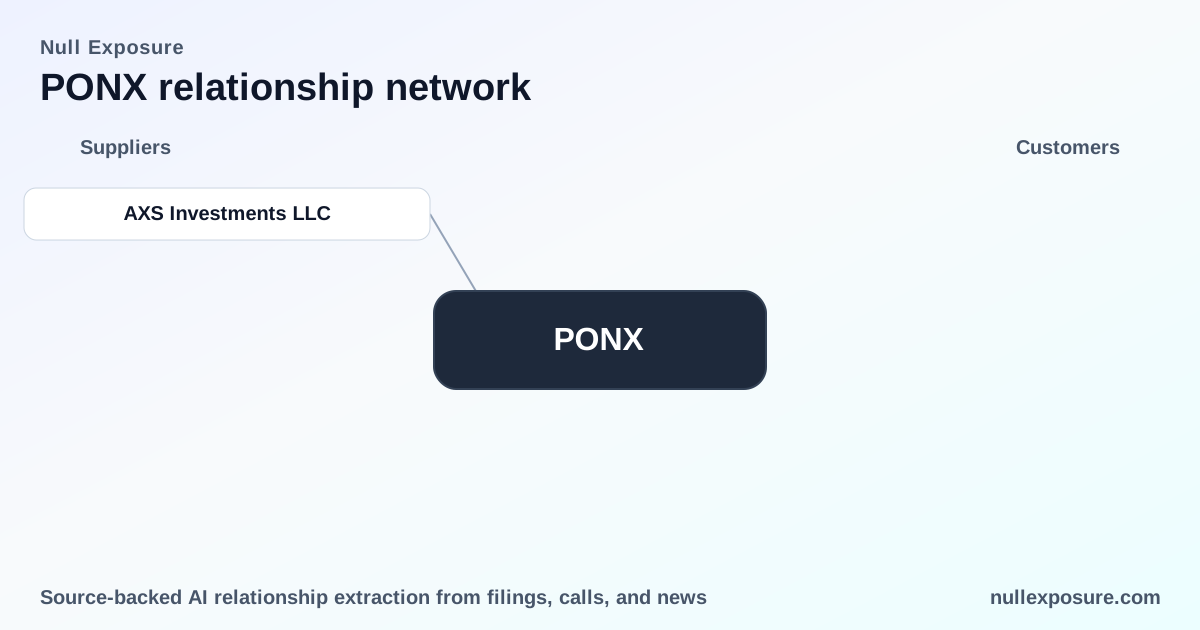
PONX customer relationships: what one visible client tells investors
PONX operates as a business-to-business provider that sells services to institutional financial customers and monetizes through contractual commercial relationships and licensing or service fees tied to those engagements. The publicly visible customer footprint is currently narrow, with revenue dependency and contract concentration likely to be material drivers of investor returns and downside risk. For direct access to the underlying relationship feeds and ongoing monitoring, visit https://nullexposure.com/.
What the customer list reveals about how PONX runs its business
The set of recorded customer ties for PONX is small and skewed toward institutional financial entities. That signal reflects a vendor model focused on a handful of professional clients, not a broad retail channel. For investors, this implies several operating model characteristics:
- Contracting posture: The company operates under direct commercial contracts with institutional counterparties rather than through large-scale distribution partnerships. This posture makes individual contract terms and renewal cadence highly consequential to revenue trajectories.
- Concentration: With only one visible relationship in the current feed, there is elevated concentration risk in publicly observed customer relationships. Concentration raises both revenue volatility and negotiating leverage risk if a named client shifts providers or internalizes the service.
- Criticality: When customers are institutional financial products such as ETFs, the service can be either critical (if embedded in product operations) or peripheral (if used for ancillary functions). The single recorded relationship does not confirm critical operational dependency, but it does mean each client carries outsized importance for near-term revenue visibility.
- Maturity: The narrow list suggests PONX is either in an early commercial stage of scaling B2B sales, or that most client relationships are not surfaced publicly. Either scenario drives the same investor action: prioritize verification of contract terms, duration, and revenue contribution.
No explicit contractual constraints or governance red flags were recorded in the available relationship feed. That absence itself is a company-level signal: there are no documented constraints captured in this review that would alter the operating assessment.
A single customer, clearly identified: LEUX
LEUX — Investment Managers Series Trust II - Tradr 2X Long LEU Daily ETF
PONX's identified customer relationship in the reviewed feed is with LEUX, an exchange-traded fund listed as "Investment Managers Series Trust II - Tradr 2X Long LEU Daily ETF." This entry was captured in FY2026 and is recorded via a market listing for the ETF. A listing on Investing.com for LEUX documents the ETF name and listing details (first observed 2026-03-10).
Source: Investing.com ETF listing for LEUX, captured FY2026 (first seen 2026-03-10).
How each relationship drives investor risk and upside
With only LEUX visible, the implications are straightforward and consequential:
- Revenue concentration risk: If LEUX accounts for a meaningful portion of PONX top-line, any change in that ETF's provider needs, asset base, or operational footprint would materially affect PONX revenues. Investors should treat current revenue visibility as highly sensitive to single-client dynamics.
- Commercial negotiation leverage: Institutional clients can command contract terms, service-level obligations, and pricing concessions. A concentrated client base reduces PONX's leverage and increases the probability of adverse renegotiation outcomes.
- Reference value and growth signaling: Having an ETF as a named client is a positive credential for business development—it demonstrates a capability to serve regulated financial products. However, one such reference is insufficient evidence of scalable go-to-market success without a broader roster.
What investors should verify now
Given the footprint revealed, active diligence should focus on contractual proof points and revenue quality. Investors should request or verify the following items directly:
- Contract length, renewal schedules, and termination rights for any agreement with LEUX or related entities.
- Revenue contribution from the LEUX relationship for the last four fiscal quarters and any forward-looking booking schedules.
- Service-level obligations and indemnities that could lead to disproportionate operational or legal exposure.
- Customer concentration metrics across all clients (top-10 revenue share) and references for other institutional customers that are not surfaced in the public feed.
- Evidence of recurring revenue vs. one-off project fees; recurring revenue improves predictability and valuation multiple justification.
For ongoing tracking and to view updated relationship signals, visit https://nullexposure.com/ for subscription options and live feeds.
Portfolio-level implications and valuation outlook
For investors evaluating PONX as an operating equity or strategic vendor, the customer signal implies a binary risk profile:
- Upside is concentrated in the company's ability to convert the LEUX reference into multiple comparable institutional engagements, thereby diluting concentration and increasing revenue predictability.
- Downside is driven by the loss or non-renewal of the LEUX tie or by contract renegotiation that compresses margins or shifts cost exposure onto PONX.
Valuation should therefore apply a premium to predictable recurring revenue streams and a discount for client concentration until additional independent customer relationships are documented and contractually durable.
Final read: what to watch next
- Quarterly filings and management commentaries that disclose customer concentration and contract duration will materially alter the investment thesis.
- Any press release or third-party confirmation of additional institutional clients will reduce concentration risk and support higher revenue multiple assumptions.
- Legal filings, regulatory disclosures, or material adverse events tied to the LEUX ETF should be monitored for indirect exposure.
In sum, PONX currently shows a narrow, institutionally-oriented customer footprint with one publicly recorded relationship to LEUX, producing both a credible business reference and a concentration-driven risk profile that investors must interrogate before assigning material valuation upside. For regular monitoring of customer relationships and evolving signals, check https://nullexposure.com/.