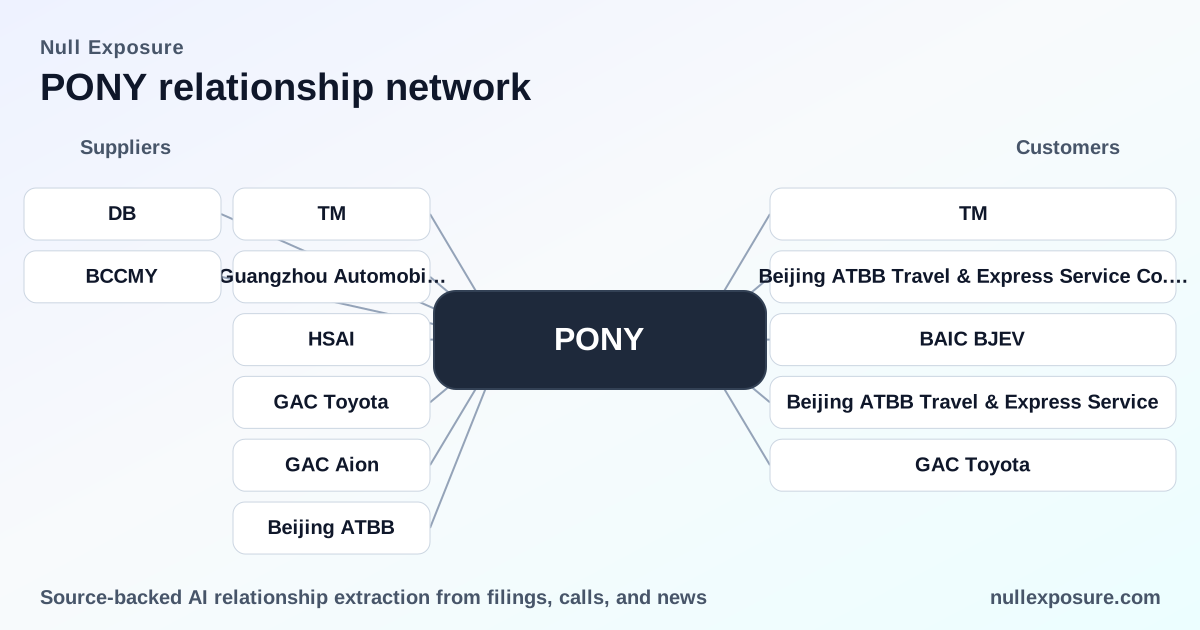
Pony AI: How customer relationships are driving early robotaxi commercialization
Pony AI supplies an integrated autonomous driving stack and operational know‑how to automakers, fleet owners and mobility platforms, and it monetizes through vehicle production partnerships, fleet deployments and platform integrations that convert technology into recurring ride and service revenue. The company operates as a technology supplier and co‑developer rather than a standalone taxi operator, leveraging OEM manufacturing partners and local fleet operators to scale more quickly and limit direct capital exposure. For deeper diligence, visit https://nullexposure.com/.
Partnerships as the revenue engine — what the relationships reveal about the model
Pony AI’s go‑to‑market is partnership‑centric: the company sells software and system integration, co‑produces vehicles with OEMs, and hands off local operations to fleet partners or platform integrators. That contracting posture produces three visible characteristics for investors:
- Concentration through strategic OEM tie‑ups. Pony’s commercialization path depends on a small set of high‑quality manufacturing and mobility partners for scale and credibility.
- Operational criticality to partners. Pony supplies the autonomous stack and operational expertise that are critical to partners’ robotaxi offerings, giving it leverage in commercial terms but also exposure if partners reassess investments.
- Commercial maturity in early stages. Deliveries and limited commercial launches show progress from R&D to revenue generation, but financials remain loss‑making and revenue is still modest relative to market value (Revenue TTM ~$90m; negative operating margin).
These are company‑level signals drawn from public deployments and OEM programs rather than from a single customer excerpt. Use those vectors to judge concentration risk and upside from scale.
Explore more customer intelligence at https://nullexposure.com/.
The customer map — every relationship in the public record
Uber — platform integration for European robotaxi rollouts
Pony.ai deployed its first commercial robotaxi service in Croatia under a joint arrangement where Uber handles ride bookings and platform integration while Pony.ai supplies the autonomous driving system and operations expertise. Automotive World reported the deployment in May 2026, noting bookings will be integrated into the Uber app (Automotive World, May 3, 2026).
Verne — local fleet owner and operator in Europe
Verne is the local fleet owner and operator for the Croatia deployment; the company owns vehicles, conducts regulatory work and provides customer payments through its app, while Pony.ai supplies the driving platform. This arrangement was described in the Automotive World coverage and in deployment reports tied to the same rollout (Automotive World, May 3, 2026; InsiderMonkey, May 2026).
Guangzhou Chenqi Mobility Technology — bulk vehicle delivery for Chinese service
Pony.ai delivered more than 100 of its seventh‑generation robotaxis built on the GAC AION V to Guangzhou Chenqi Mobility Technology for commercial use on the OnTime Mobility platform, marking a material fleet shipment into a Chinese mobility operator (InsiderMonkey, March 19, 2026).
Toyota Motor (TM) — joint development and production partner for bZ4X Robotaxi
Pony.ai co‑developed the bZ4X Robotaxi with Toyota Motor China and GAC Toyota, and joint production is handled at a Toyota global model plant; the production model uses Pony.ai’s Gen‑7 autonomous driving system with automotive‑grade components (StockTwits news summary, March 10, 2026).
Toyota Motor China — regional OEM collaboration for production readiness
Toyota Motor China is named alongside Pony.ai and GAC Toyota in the bZ4X Robotaxi program, reflecting Pony’s strategy to partner directly with China‑based OEM subsidiaries to ship production‑grade robotaxis (StockTwits, March 10, 2026).
GAC Toyota — production partner executing vehicle builds
GAC Toyota is the manufacturing partner on the bZ4X Robotaxi program and co‑produces units with Pony.ai at a Toyota plant, underscoring Pony’s reliance on established assembly capacity to scale units without building its own factories (StockTwits, March 10, 2026).
Beijing ATBB Travel & Express Service Co., Ltd. — commercial scale partner in China
Pony.ai announced a strategic collaboration with Beijing ATBB Travel & Express Service to accelerate robotaxi commercialization in China, positioning ATBB as a premium mobility operator for rollout and market uptake (Yahoo Finance coverage of the announcement, Jan 28, 2026).
BAIC BJEV — high‑volume ARCFOX production relationship
Pony.ai and BAIC BJEV have produced more than 600 ARCFOX Alpha T5 robotaxis using Pony.ai’s Gen‑7 platform, and the companies expanded their partnership to focus on joint robotaxi development and ecosystem integration—evidence of an established production pipeline (Finviz / InsiderMonkey reporting, Jan 10–Mar 2026).
GAC Commercial Vehicle — strategic cooperation on robotruck deployments
Pony.ai (PONY‑W) signed a cooperation agreement with GAC Commercial Vehicle to advance large‑scale Robotruck deployment across logistics scenarios in the Greater Bay Area and nationwide, indicating Pony’s enterprise mobility ambitions beyond passenger robotaxis (AAStocks report, May 16, 2026).
Nasdaq Global Select Market (NDAQ) — public market listing and investor access
Pony.ai’s American Depositary Shares trade on the Nasdaq Global Select Market under the ticker PONY, providing U.S. investor access to the company’s equity and public‑reporting obligations, as noted in a company filing discussed in market commentary (TipRanks reporting on 2025 Form 20‑F filing).
What these relationships imply for investors
- High strategic leverage but concentrated counterparty exposure. Pony’s revenue upside scales with a small number of OEM and fleet partners; successful rollouts with Toyota, BAIC and local fleets materially de‑risk commercialization but create concentration risk if any partner changes course.
- Capital light scaling through partnerships. Using OEM manufacturing and third‑party fleet operators reduces Pony’s capital intensity and speeds market entry, converting technology into recurring commercial opportunities without heavy CAPEX on Pony’s balance sheet.
- Transition from pilots to commercial operations is underway. Deliveries (100+ units to Chenqi, 600+ with BAIC) and the Croatia robotaxi launch mark clear commercial milestones that drive near‑term revenue growth potential while the company continues to absorb development and operational costs.
Investment risks and closing view
Risks are tangible: Pony is still operating at a loss with limited revenue relative to market capitalization, and its model concentrates execution risk in partner relationships that are critical to scaling. Regulatory acceptance, vehicle production quality, and local operations execution are the three levers that will govern whether the company converts technology leadership into profitable scale.
Bottom line: Pony.ai’s customer relationships are its growth engine—OEM manufacturing agreements and fleet/operator integrations convert its autonomous stack into real revenue, but investors must weigh the company’s early‑stage financials and partner concentration before ascribing a premium. For ongoing monitoring of customer signals and deployment milestones, see https://nullexposure.com/.