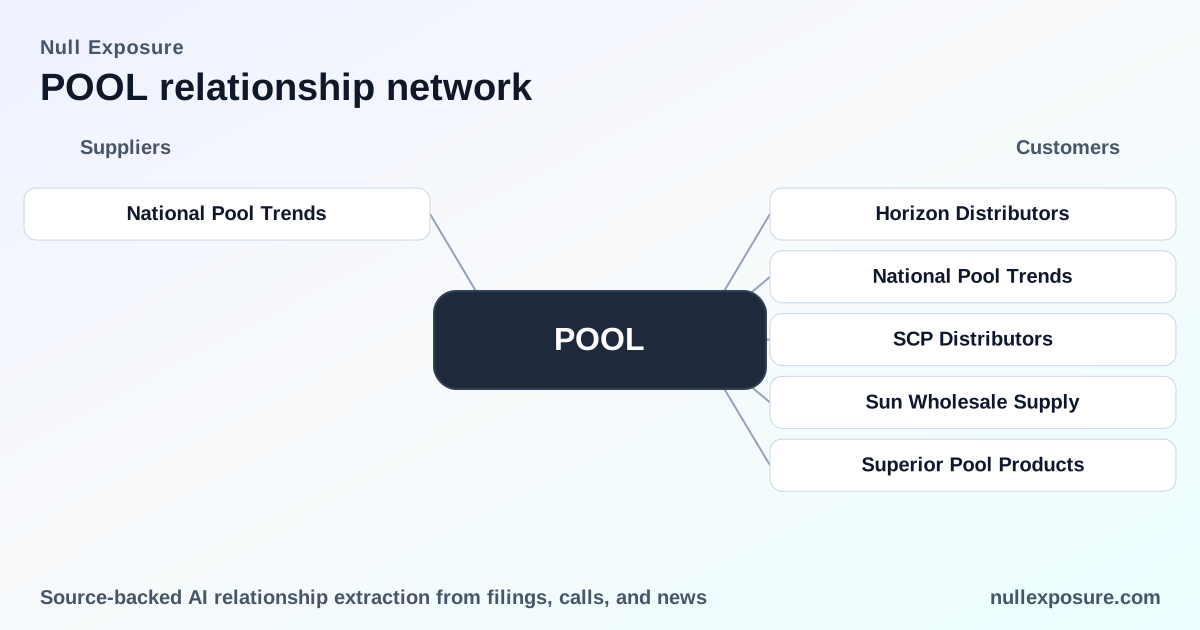
Pool Corporation (POOL) — customer relationships and distribution footprint
Pool Corporation operates as the leading distributor of swimming pool supplies, equipment, and related outdoor products, monetizing through wholesale distribution, localized sales centers, franchise support, and a growing digital services suite (POOL360). Revenue is driven by high-volume product distribution through five principal networks and large numbers of small, service-oriented customers, with seasonal pre-buy programs and occasional extended short-term payment arrangements. For a deeper view into POOL’s customer architecture and how it shapes revenue durability, visit https://nullexposure.com/ for primary research and model inputs.
The thesis up front
POOL runs a volume-focused, market-based distribution business that sells to roughly 125,000 mostly small, family-owned businesses through a network of sales centers and partner distributors. The company’s moat is scale in inventory, logistics, and localized sales relationships plus incremental margin from services and software (POOL360). Profitability depends on steady retail/service demand, effective inventory turns, and control of seasonality via pre-season programs.
How the customer network actually functions
POOL sells finished goods and services out of a large, geographically concentrated sales-center footprint. Company filings indicate 448 sales centers across North America, Europe, and Australia, and management discloses that roughly 96% of sales come from North America, with small percentages in Europe and Australia (2024). The commercial posture is predominantly spot and short-term: sales are recognized on pick-up, delivery, or presentation to a carrier, and the firm offers limited, seasonal extended payment terms tied to pre-season early-buy programs. Source: Pool Corp SEC disclosures and fiscal reporting (2024 / FY2026 filings).
- Contracting posture: Primarily spot sales with short-term financing for qualified customers during early-buy programs.
- Counterparty profile: High-volume of small-business customers (≈125,000), implying credit and working-capital sensitivity at the customer base level.
- Geographic concentration: North America-dominant revenue mix, with EMEA/APAC operations small and historically immaterial to consolidated results.
- Segments beyond distribution: POOL operates distribution, services (training, marketing support), and a digital software ecosystem (POOL360) aimed at professional customers.
For model inputs and customer-concentration analysis, see additional notes at https://nullexposure.com/.
Relationship roll-call: who POOL buys to and sells through
Below I cover every customer relationship found in the available results and the source backing each mention.
Pinch A Penny — franchise channel growth
Pinch A Penny is referenced as a franchise network whose franchisee sales grew 4% in the quarter, and franchisees opened seven new independently owned locations, indicating POOL’s exposure to franchise-driven retail volumes in Q1 FY2026. Source: Q1 FY2026 earnings call transcript referenced on InsiderMonkey (May 3, 2026), https://www.insidermonkey.com/blog/pool-corporation-nasdaqpool-q1-2026-earnings-call-transcript-1745797/.
Horizon Distributors — a named distribution network
Horizon Distributors is listed among POOL’s five distribution networks used to route products to market, reflecting a wholesale/distributor channel within the firm’s multi-network distribution model. Source: TradingView summary of Pool Corp’s SEC 10-K (March 10, 2026), https://www.tradingview.com/news/tradingview:1933fe4e032db:0-pool-corp-sec-10-k-report/.
National Pool Trends — network-level distribution partner
National Pool Trends appears in the company’s network list as a primary conduit for product distribution, indicating POOL’s strategy of market-based networks to reach dealers and local retailers. Source: TradingView summary of Pool Corp’s SEC 10-K (March 10, 2026), https://www.tradingview.com/news/tradingview:1933fe4e032db:0-pool-corp-sec-10-k-report/.
SCP Distributors — core wholesale channel
SCP Distributors is identified as one of the five main distribution networks through which POOL sells inventory, highlighting the firm’s reliance on multiple regional wholesale partners to cover market geographies. Source: TradingView summary of Pool Corp’s SEC 10-K (March 10, 2026), https://www.tradingview.com/news/tradingview:1933fe4e032db:0-pool-corp-sec-10-k-report/.
Sun Wholesale Supply — wholesale supply channel
Sun Wholesale Supply is named alongside the other networks, confirming POOL’s channel diversification within wholesale distribution and local market penetration. Source: TradingView summary of Pool Corp’s SEC 10-K (March 10, 2026), https://www.tradingview.com/news/tradingview:1933fe4e032db:0-pool-corp-sec-10-k-report/.
Superior Pool Products — regional distribution network
Superior Pool Products completes the five-network list, representing another regional wholesale route through which POOL moves inventory to retailers, service companies, and pool builders. Source: TradingView summary of Pool Corp’s SEC 10-K (March 10, 2026), https://www.tradingview.com/news/tradingview:1933fe4e032db:0-pool-corp-sec-10-k-report/.
What these relationships imply for investors
The relationship map demonstrates scale distribution paired with exposure to many small operators, which creates a predictable but seasonally variable revenue stream. Key implications:
- Concentration risk is low at the customer level because POOL serves ~125,000 customers, but credit risk is concentrated at the SME segment, which is more sensitive to local economic cycles and working-capital variation (company filing, 2024).
- Contract maturity/criticality: Revenue is mostly realized on spot delivery; the business does not depend on long-term take-or-pay contracts, which lowers locking-in risk but increases sensitivity to short-term demand swings and inventory turns.
- Geographic risk: With ~96% sales in North America (2024), currency exposure and international revenue are currently immaterial to consolidated results, but any material expansion internationally would change that profile (company disclosure, 2024).
- Service and software upsell potential: POOL360 introduces higher-margin recurring revenue and customer stickiness through digital tools and professional services, improving long-term gross margin profile if adoption scales.
- Seasonality and working capital: Pre-season early-buy programs create short-term receivable seasonality and require careful working-capital management; management offers limited extended payment terms tied to these programs (company disclosures).
Bottom line: POOL’s customer relationships deliver steady, scalable wholesale throughput with moderate margin upside from services and software, but the model carries SME credit exposure and meaningful seasonality. For diligence on network-level exposure and to integrate these relationship signals into financial models, consult the company filing links above and our collection at https://nullexposure.com/.
Conclusion
Pool Corporation’s distribution-first model is operationally simple and financially effective: broad customer reach, multiple regional networks, and an emerging services/software layer that elevates long-term revenue quality. Investors should underwrite the business as a scale-dependent distributor with concentrated geographic exposure to North America, SME counterparty risk, and seasonally concentrated cash flows. For more context and to access structured relationship analytics, visit https://nullexposure.com/.