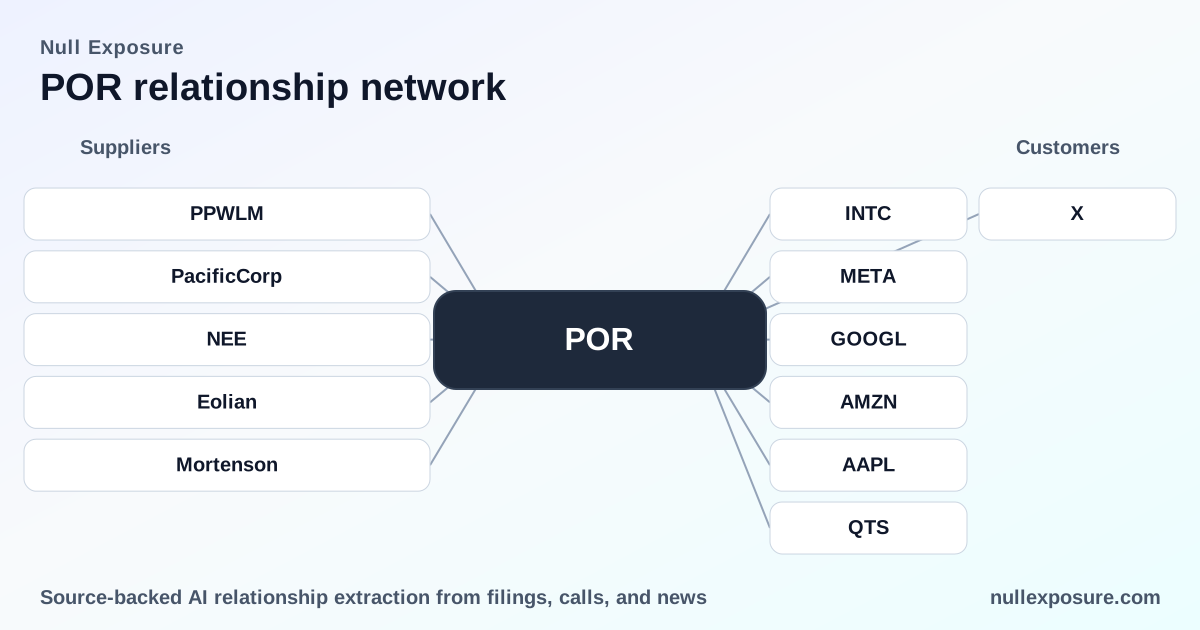
Portland General Electric (POR): customer footprint, demand concentration, and contract posture
Portland General Electric (POR) is a vertically integrated, regulated electric utility that monetizes by selling and delivering electricity across a state‑contained service territory in Oregon. Revenue and cash flow derive from generation, wholesale purchases and sales, transmission and distribution, and retail electricity contracts; the company’s regulated status and customer mix produce predictable cash flows while leaving operational exposure to localized demand shocks such as large data‑center buildouts. For quick access to the underlying customer signals and relationship intelligence, visit Null Exposure: https://nullexposure.com/.
Investor thesis — predictable utility economics, localized demand risk
POR’s core investment thesis is stability: regulated margins, visible rate base, and recurring retail volumes drive earnings durability. Offsetting this, concentrated geographic exposure to Oregon and accelerating consumption by hyperscale data centers create a distinct demand‑profile risk that influences capital planning, rate cases, and the timing of system upgrades. The company’s financials (trailing revenue roughly $3.53bn, market cap near $5.68bn) reflect a mature utility with modest growth, where customer composition and contract structure materially shape capital allocation.
How POR contracts with customers and what that implies
POR offers a mix of contracting options that create both short‑term flexibility and long‑term revenue visibility. Large commercial and industrial customers can elect multi‑year terms (three‑ or five‑year minimums) or choose one‑year/market‑indexed arrangements, and an alternate “Direct Access” path exists for customers to procure energy from third‑party suppliers while POR retains delivery roles. This contracting posture signals a utility that manages both stable retail cash flows and episodic demand spikes that require incremental investment.
- Contract maturity and posture: The presence of both long‑term and one‑year market options positions POR to capture stable base revenue while accommodating industrial customers that prefer market indexing.
- Geographic concentration: Revenue is generated exclusively within Oregon, which concentrates regulatory and demand risk at the state level.
- Customer materiality: Retail customers constitute the primary revenue source; industrial customers carry much higher revenue per account (industrial revenue per customer cited at roughly $1.63m), making a handful of large customers economically important despite being numerically small.
For further company‑level intelligence and relationship mapping, see the service at Null Exposure: https://nullexposure.com/ (home).
What the media links reveal — every observed customer relationship
Below are the relationships surfaced by media coverage and analyst reporting. Each entry reproduces the media signal in plain English and cites the reporting source.
INTC (OPB — Dec. 15, 2025)
Portland General Electric’s recent project demand was driven largely by data centers and high‑tech facilities, with semiconductor manufacturers such as Intel specifically singled out as a major source of increased load. According to OPB’s Dec. 15, 2025 report, Intel is one of the industrial drivers behind the project demand.
Intel (OPB — Dec. 15, 2025)
The OPB piece noted that semiconductor plants like Intel generate substantial electricity demand for new projects within POR’s territory, elevating the utility’s planning and cost considerations. OPB, Dec. 15, 2025.
Intel (Salem Reporter — Dec. 15, 2025)
Salem Reporter corroborated the same point, reporting that demand for the project came primarily from data centers and high‑tech manufacturing including Intel, reinforcing that Intel’s operations are a visible load driver. Salem Reporter, Dec. 15, 2025.
INTC (Salem Reporter — Dec. 15, 2025)
A second Salem Reporter mention reiterates Intel’s contribution to project demand and the scrutiny around how POR allocates incremental costs tied to that growth. Salem Reporter, Dec. 15, 2025.
Apple (OPB — Dec. 15, 2025)
OPB documented that Apple operates large data centers in Oregon that contribute to system‑wide demand growth, and that POR does not plan to directly assign new upgrade costs to those data‑center customers. OPB, Dec. 15, 2025.
Facebook / META (OPB — Dec. 15, 2025)
Facebook (Meta) is listed among the hyperscale operators in Oregon whose facilities materially increase regional electricity demand, per OPB’s coverage of data‑center impacts. OPB, Dec. 15, 2025.
Google / GOOGL (OPB — Dec. 15, 2025)
OPB noted Google as another major hyperscale tenant in the state that drives rising load requirements for POR’s distribution and transmission systems. OPB, Dec. 15, 2025.
Bank of America (Investing.com — May 3, 2026)
Investing.com reported that POR priced a public offering of 9.4 million shares at $50.70 per share in connection with forward sale agreements involving Wells Fargo and Bank of America, indicating BofA’s role as a financing counterparty to the equity transaction. Investing.com, May 3, 2026.
Wells Fargo Bank (Investing.com — May 3, 2026)
Wells Fargo joined Bank of America as a forward‑sale counterparty in the same offering, providing underwriting/structured finance support for POR’s equity issuance. Investing.com, May 3, 2026.
Amazon / AMZN (OPB — Dec. 15, 2025)
OPB identified Amazon as one of the hyperscale operators with major data centers in eastern Oregon and other sites that are significant contributors to system demand growth. OPB, Dec. 15, 2025.
AMZN (OPB — Dec. 15, 2025)
A duplicate OPB mention confirms Amazon’s presence among the large industrial consumers shaping POR’s demand profile. OPB, Dec. 15, 2025.
QTS (Salem Reporter — Dec. 15, 2025)
Salem Reporter highlighted QTS Data Centers in Hillsboro and referenced broader policy debates about whether data centers should shoulder more of the cost for system upgrades; QTS is an explicit local data‑center operator affecting load. Salem Reporter, Dec. 15, 2025.
QTS Data Centers (Salem Reporter — Dec. 15, 2025)
A second Salem Reporter reference to QTS underscores the company’s status as a named commercial customer within POR’s service area that contributes to incremental demand. Salem Reporter, Dec. 15, 2025.
X (formerly Twitter) (OPB — Dec. 15, 2025)
OPB listed X among the large digital platforms with data‑center footprints in Oregon, again in the context of which customers drive systemwide demand and how costs are allocated. OPB, Dec. 15, 2025.
Key takeaways for investors and operators
- Concentrated geographic risk: POR serves only Oregon, concentrating regulatory, policy and growth risks in a single state jurisdiction. This elevates the impact of local data‑center policy debates on POR’s cost recovery and rate mechanics.
- High‑value industrial customers: A small number of hyperscale and semiconductor customers generate outsized revenue per account and drive capital investment decisions; industrial revenue per customer signals materiality despite limited account count.
- Mixed contracting gives optionality: The co‑existence of long‑term and one‑year/market indexed offers provides POR with a dual posture — stable regulated earnings plus operational flexibility to manage transient demand.
- Financing and capital response visible: Recent equity offerings tied to major banks show access to capital markets and willingness to monetize equity to fund growth or shore up balance sheet flexibility.
Risk profile and monitoring checklist
Investors should monitor: (1) state regulatory responses to data‑center allocation of costs, (2) large customer commitment cadence (multi‑year vs. one‑year index pricing), (3) POR’s capital‑raising cadence, and (4) the pace of hyperscale buildouts in eastern Oregon.
Portland General Electric’s customer signals are straightforward: a mature, regulated utility with stable retail economics that must actively manage concentrated, fast‑growing industrial loads. For continuous relationship and media tracking that supports investment due diligence, visit Null Exposure: https://nullexposure.com/.