POST customer relationships: concentration, contracts and a recent divestiture investors should price in
Thesis: Post Holdings operates as a consumer packaged goods holding company that monetizes through branded product sales across grocery, club, mass, and foodservice channels, supplemented by contract manufacturing and licensing; revenue flows are concentrated around a handful of national retailers and foodservice distributors, which creates measurable counterparty risk and negotiating leverage that investors must value into the multiple.
Post’s operating model blends brand ownership with co‑packing and targeted portfolio management; it sells finished goods to large national buyers, manufactures for select partners under co‑packing agreements, and exits or divests non‑core lines when strategic. For a deeper look at how these customer ties shape margin durability and cash flow risk, visit https://nullexposure.com/.
How Post gets paid and why customer structure matters
Post sells grocery and refrigerated retail products on a trade-customer basis, supplies foodservice channels at scale, and conducts selective manufacturing under contract. Revenue is volume- and shelf-position driven; margins depend on retail mix, co-packing margins and the company’s ability to pass input cost changes through to large buyers. Contracting posture is supplier-centric in product control but buyer-power heavy at the point of sale because a small number of customers represent a large share of net sales.
Company filings for fiscal 2025 and related investor statements show several structural constraints investors need to treat as business-level signals: Post markets products in North America and EMEA under license arrangements, sales are materially concentrated among a few large buyers, and the company both sells to and manufactures for third parties under specific agreements. These are operating facts that influence downside scenarios and negotiating dynamics with top customers.
Key structural signals:
- Geographic reach: Active marketing and IP licensing across North America and EMEA, indicating revenue diversification by region but also exposure to international retail dynamics (company filing, FY2025).
- High customer concentration: A few retailers and distributors account for material shares of segment and consolidated sales, intensifying revenue volatility and bargaining pressure (company filing, FY2025).
- Mixed seller/manufacturer roles: Post acts as both a supplier of branded goods and a contract manufacturer/co‑packer, creating mixed margin profiles and counterparty dependencies (company filing, FY2025).
Named customer relationships investors should know
These are the specific counterparties identified in Post’s disclosures; each has different implications for concentration, operational continuity, and negotiating leverage.
-
Walmart — single largest customer at scale. According to Post’s FY2025 filing, Walmart accounted for 17.4% of consolidated net sales and close to 29.9% of the Post Consumer Brands segment’s net sales, making Walmart a critical revenue driver and a concentrated single‑counterparty risk for the company (company filing, FY2025).
-
Sysco and US Foods — concentrated in Foodservice. Post reports that Sysco and US Foods together represented 42.0% of Foodservice segment net sales in fiscal 2025, highlighting meaningful exposure to the foodservice distribution channel and its volume sensitivity to economic cycles (company filing, FY2025).
-
Tesco and Asda — material for Weetabix. The Weetabix segment depends materially on major UK retailers; Tesco and Asda together accounted for 33.0% of Weetabix net sales, indicating UK retail concentration and the strategic importance of maintaining shelf listings there (company filing, FY2025).
-
Kroger — material retailer exposure. Kroger is identified among the largest customers of the Refrigerated Retail segment and, along with Walmart, accounted for 34.9% of that segment’s net sales, underscoring exposure to a small set of mass retail chains (company filing, FY2025).
-
Premier Nutrition — mid‑sized commercial buyer and co‑packing counterparty. Post disclosed net sales of $57.5 to Premier Nutrition for the year ended September 30, 2025 and a receivable balance related to these sales, and cited a co‑packing agreement under which Post’s Comet facility manufactures protein shakes for Premier Nutrition; this establishes both commercial revenue and a manufacturing obligation (company filing, FY2025).
-
Comet (internal manufacturing relationship) — contract manufacturer role. Under a Co‑Packing Agreement disclosed by Post, Comet began manufacturing protein‑based shakes for Premier Nutrition in December 2023, illustrating Post’s role as a contract manufacturer for select partners in addition to being a branded goods seller (company filing, FY2025).
The Richardson transaction: a divestiture that tightens focus
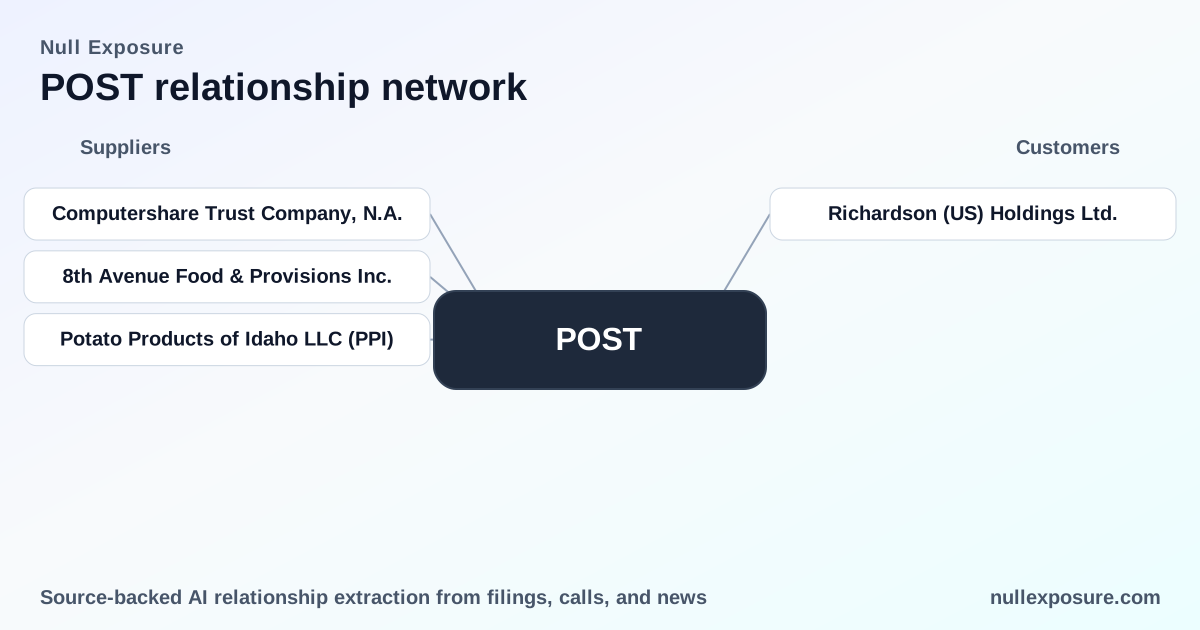
Post sold 8th Avenue’s pasta business to Richardson (US) Holdings Ltd., transferring that asset and its associated buyer relationships to Richardson. This is a portfolio‑management move that reduces Post’s exposure to the pasta business and shifts working‑capital and margin responsibility to the buyer; it reflects active rationalization of non‑core lines to concentrate capital on higher‑return brands (Food Business News, March 2026).
Constraints interpreted as investment signals
Beyond named counterparties, the filing excerpts collectively signal a few clear investor implications:
-
Concentration is a real valuation risk. When a single retailer like Walmart represents nearly a fifth of consolidated sales, loss of shelf space or adverse pricing can create meaningful EBITDA and cash‑flow volatility; value models should stress test scenarios where trade terms or volumes change by single‑digits.
-
Dual roles complicate margin forecasts. Acting as both seller and manufacturer exposes Post to margin compression on co‑packing deals while tying up capacity that could support branded growth; this operational mix requires granular capex and utilization modeling.
-
Regional licensing and IP exposure. Marketing under license agreements in NA and EMEA implies that international growth has structural limitations — Post competes through partners and licensing, which shapes long‑run margin potential in those geographies (company filing, FY2025).
What investors should do next
- Factor concentration into downside scenarios. Model a Walmart trade‑term shock and reduced Foodservice volumes to see sensitivity in free cash flow and leverage covenants.
- Monitor divestitures and manufacturing contracts. Sales like the 8th Avenue deal and co‑packing starts with Premier/Comet change the mix of recurring vs. one‑time cash flows; they are signals about management’s capital allocation priorities.
- Watch for renegotiation activity with top retailers. Any public signs of shelf delistings, promotional pressure, or margin concessions at Walmart, Kroger, Tesco or major distributors should be treated as market signals that affect valuation.
For a practical investor checklist and comparative counterparty exposure analysis, check our work at https://nullexposure.com/.
Conclusion: Post’s revenue model is robust in scale but structurally concentrated, with a hybrid seller‑manufacturer posture that creates both upside through branded penetration and downside via a small set of powerful buyers. Investors should treat the company’s major customer relationships as first‑order value drivers when modeling cash flows and downside scenarios.