Pilgrim’s Pride (PPC): customer relationships with JBS affiliates and what they signal for investors
Pilgrim’s Pride monetizes a vertically integrated meat production model: it processes, markets and distributes fresh, frozen and value-added chicken and pork products to retailers, foodservice distributors and international customers. Revenue derives from high-volume product sales across the U.S., U.K., Mexico and export markets, while margins depend on commodity input costs, contract mix and distribution scale. For investors assessing customer counterparty risk, the most important signal from Pilgrim’s FY2025 disclosures is that a portion of sales are to related JBS entities — measurable but not dominant relative to overall net sales. For a concise, company-level view and primary-source documents, visit https://nullexposure.com/.
High-level thesis for investors
Pilgrim’s Pride operates as a high-throughput food manufacturer and distributor with balanced geographic exposure and short fulfillment cycles, which keeps working-capital turnover high but leaves margins sensitive to commodity price swings. The business sells both under short-term order fulfillment and a reduced set of long-term fixed-price contracts, distributes through retail and foodservice channels, and reports no single customer that represents more than 10% of net sales — a structural safeguard against counterparty concentration risk.
What the FY2025 10‑K reveals about customer counterparties
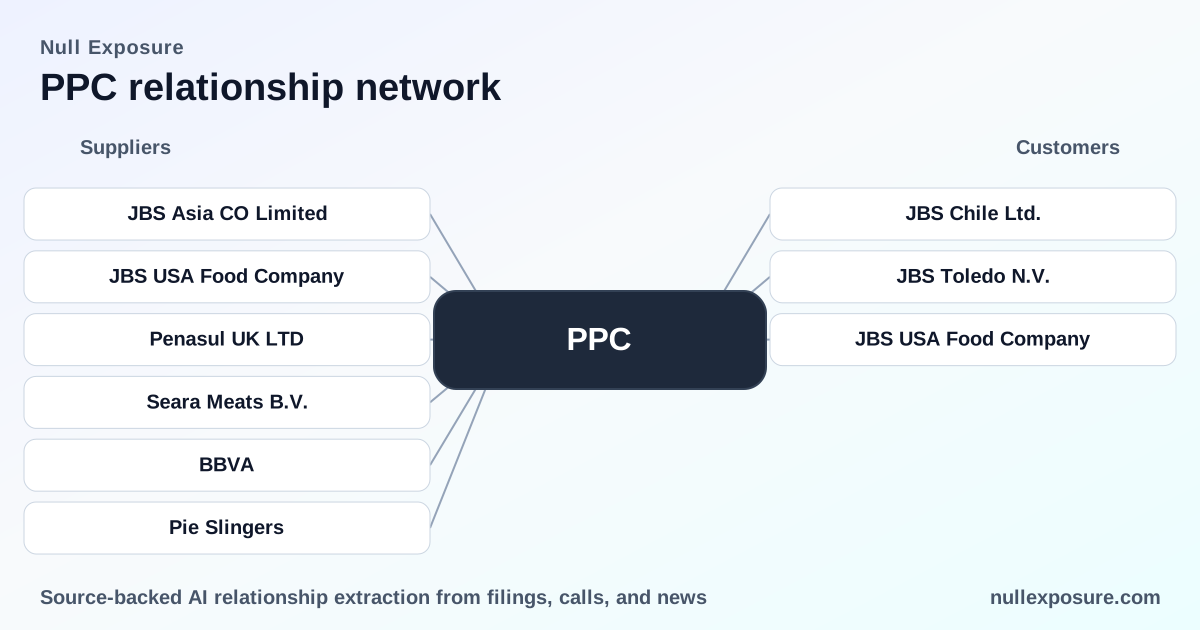
Pilgrim’s FY2025 Form 10‑K explicitly discloses sales to related parties that are JBS-affiliated entities. These line items show that Pilgrim’s conducts nontrivial transactional activity with sister companies, but the company also states that no single customer exceeds 10% of net sales, indicating limited counterparty concentration at the enterprise level.
JBS USA Food Company
Pilgrim’s reported sales to JBS USA Food Company of 23,307 for FY2025 (with prior-year comparatives reported as 28,230 and 27,687 in the excerpt). According to Pilgrim’s FY2025 Form 10‑K, these entries are presented as sales to related parties and are part of the company’s disclosure on intercompany activity. Source: Pilgrim’s Pride FY2025 Form 10‑K (sales to related parties).
JBS Toledo N.V.
Pilgrim’s reported sales to JBS Toledo N.V. of 41,947 in FY2025, as disclosed in the company’s FY2025 Form 10‑K under related-party sales. This line item confirms transactional flows to another JBS-affiliated entity noted in the 10‑K. Source: Pilgrim’s Pride FY2025 Form 10‑K (sales to related parties).
JBS Chile Ltd.
Pilgrim’s reported sales to JBS Chile Ltd. captured as 2,797 for FY2025 (with historic comparatives cited in the same table). The company presents these as related-party sales in the FY2025 Form 10‑K. Source: Pilgrim’s Pride FY2025 Form 10‑K (sales to related parties).
Operating model constraints and what they imply for customer risk
Pilgrim’s disclosure set contains company-level signals that frame how customer relationships affect revenue durability and margin volatility.
- Contracting posture: Pilgrim’s explicitly reduces the share of products sold under longer-term fixed-price contracts and broadens its contract mix, indicating intentional flexibility to pass through input cost movements. At the same time, the company notes that performance obligations are typically fulfilled within days to weeks of order acceptance, signaling a predominantly short-term transaction profile.
- Geographic diversification: Pilgrim’s reports material sales across North America, Europe, Mexico (Latin America) and Asia-Pacific, and markets products to over 120 countries. This global footprint reduces dependence on any single regional market while exposing the company to multiple regulatory and supply-chain regimes.
- Materiality of customers: The company states it does not have a single customer exceeding 10% of net sales and does not believe trade receivables are heavily concentrated by counterparty — a formal declaration that customer concentration is immaterial at the company level.
- Vertical integration and role mix: Pilgrim’s presents itself as manufacturer, seller and distributor through retail and foodservice channels. Vertical control over production enhances quality and margin management but also ties capital intensity and operating leverage to processing capacity.
These constraints tell a cohesive story: Pilgrim’s runs a short-cycle, high-throughput sales engine that deliberately limits fixed-price exposure and avoids large single-customer dependencies. Investors should weigh the benefits of flexible contracting against the margin risk of volatile feedstock and commodity prices.
(For direct access to the documents and primary excerpts, see https://nullexposure.com/.)
Why related‑party sales matter, and why these entries are not necessarily an alarm
Intercompany sales to JBS entities are notable because they document cash flow and product movement inside a broader corporate family, which can simplify logistics and optimize capacity utilization. However, Pilgrim’s public statement that no customer exceeds 10% of net sales and its disclosure of broad geographic sales distribution reduce the immediate credit and concentration risk that would concern investors. The FY2025 10‑K entries confirm the existence of related-party flows but do not, on their face, indicate excessive reliance on any one affiliate.
Risks investors should watch
- Commodity price sensitivity. The company’s choice to reduce long-term fixed-price commitments is a risk-management judgment: it preserves margin recovery potential when input prices fall, but it transfers more commodity price volatility to near-term results.
- Operational leverage. As a vertically integrated processor, Pilgrim’s has fixed-cost exposure in processing and distribution assets; short-term contract fulfillment keeps volume fluid, but margins swing with throughput and input costs.
- Related-party dynamics. Intercompany sales are normal in a corporate family, but investors should review periodic related-party disclosures and cash-flow reconciliations in subsequent filings to ensure transfers are arm’s-length and do not mask profitability shifts.
Bottom line for investors and operators
Pilgrim’s Pride runs a diversified, short-cycle customer model with some measurable sales to JBS affiliates, but company-level disclosures frame those related-party flows as non-concentrated and part of balanced global distribution. Evaluate future filings for the trend in related-party volumes, the mix between short-term and long-term contracts, and regional sales momentum as primary indicators of credit and operational risk.
For additional primary‑source extracts and to track related‑party exposures across filings, visit Null Exposure for document-level indexing and analysis: https://nullexposure.com/.