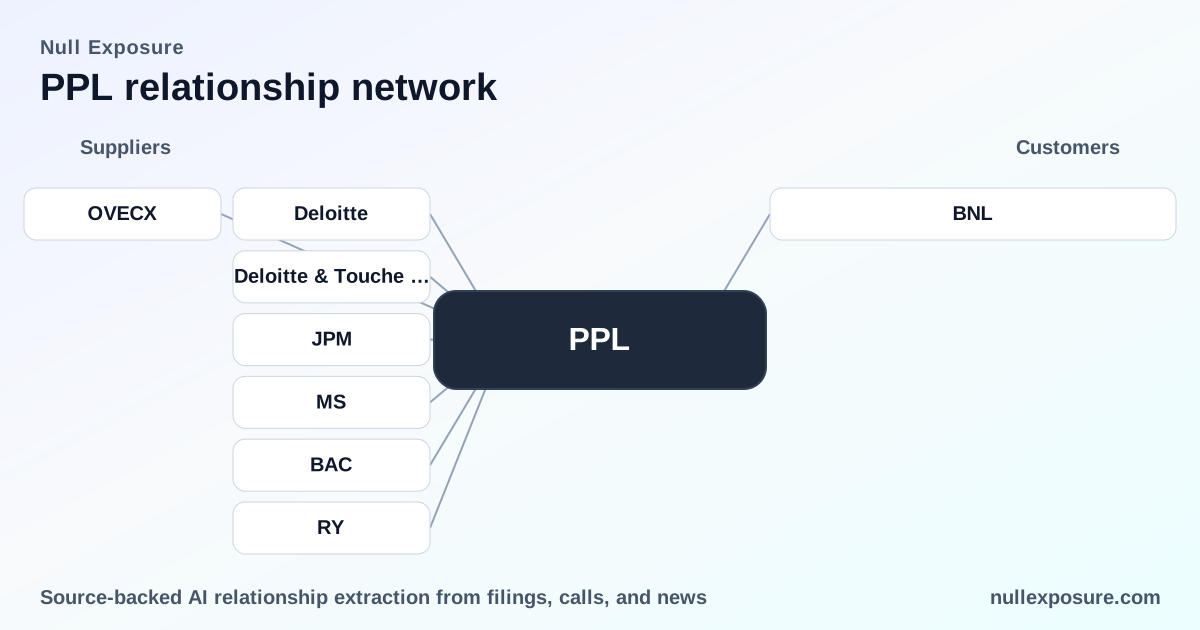
PPL Corporation’s customer map: who pays, who buys, and what that means for investors
PPL Corporation is a regulated utilities holding company that monetizes through tariffed electricity distribution and, in select jurisdictions, generation and natural gas distribution. Revenues come from a mix of volume-driven tariff charges and fixed monthly fees under regulated tariffs, supplemented by contract sales and occasional asset transactions. For investors, the profile is one of steady, utility-style cash flow underpinned by regulated rates, with earnings sensitivity to load growth, customer contract mix, and discrete asset dispositions.
If you want a concise, signal-driven view of PPL’s commercial relationships and the balance between recurring regulated revenue and transactional counterparties, read on — or visit https://nullexposure.com/ for broader commercial intelligence on counterparties and contract signals.
What the record of counterparties shows in plain language
Below I walk through each counterparty that surfaces in our customer-oriented review. Each entry is 1–2 sentences with the original source noted so you can follow up.
Broadstone Net Lease (BNL) — development-level power discussions
Broadstone Net Lease is in active discussions with PPL about delivering transmission and distribution power to a site, including negotiating T&D line paths between the two substations and structuring the first phase at roughly 300 megawatts. This engagement was discussed on Broadstone’s Q4 2025 earnings call and reflected in subsequent coverage of the company’s site development plans (Q4 2025 earnings call; InsiderMonkey transcript, March 2026).
NorthWestern Energy (NWE) — historical asset transaction
NorthWestern Energy’s 2014 purchase of a large hydroelectric system from PPL Montana is illustrative of PPL’s willingness to monetize non-core generation assets through outright sale, a precedent that shapes how investors should think about portfolio optimization. This transaction and its role in NorthWestern’s vertical integration strategy were summarized in a FinancialContent industry deep-dive (April 2026).
TVRD — commercial supply agreement for API production
TVRD discloses a commercial supply agreement with PPL to produce API, indicating PPL’s involvement as a supplier partner in an industrial production context rather than only retail distribution. The arrangement is documented in TVRD’s FY2024 10‑K disclosure (filed December 31, 2024).
Ovintiv (OVV) — unrelated LNG contract cited in news record
The news item associated with Ovintiv describes a long-term liquefaction capacity agreement with Pembina for Cedar LNG and does not reference a PPL commercial engagement; our record includes this FY2026 news mention but the excerpt does not identify a direct PPL relationship. The item is captured in market news coverage compiled on TradingView (March 2026).
National Grid (NGG) — asset purchase of PPL’s UK distribution operations
National Grid executed an acquisition of PPL’s UK power distribution assets (transaction reflected in 2023 activity), a strategic divestiture that reduced PPL’s overseas footprint and reallocated capital into core North American regulated operations. The reference appears in recent analyst and news commentary (GuruFocus summary, May 2026).
How these relationships map to PPL’s operating model and business constraints
PPL operates as a regulated utility with a mixed contracting posture that combines long-term blocks and shorter-term, load-following products:
- Contracting posture: Filings show PPL participates in 10‑year block contracts alongside 12‑ to 24‑month fixed‑price and 12‑month real‑time pricing arrangements for different customer segments, indicating a deliberate mix of revenue certainty and flexible load exposure (company solicitations and tariff disclosures).
- Revenue mechanics: The firm recognizes revenue primarily as usage-based tariff receipts (volume × price) plus monthly fixed charges, so earnings track both consumption trends and regulatory tariff outcomes.
- Customer mix and counterparty types: PPL’s customers include residential, commercial, industrial, municipal, and governmental end users, reflecting broad-based counterparty exposure across retail classes rather than reliance on a small set of corporate customers.
- Geographic concentration: Operations are North America–centric, focused on Pennsylvania, Kentucky and Rhode Island service territories and regulated under PAPUC and FERC where applicable — a regulatory concentration that both stabilizes returns and exposes the company to state-level rate decisions.
- Materiality and segmentation: Some ancillary revenues (for example, lease income in RIE) are immaterial, while the distribution segment is the primary and most material driver of tariff-based revenue.
These characteristics produce a classic regulated-utility investor profile: high revenue predictability from new and existing rate bases, tempered by regulatory timing and variation in load cycles. Contract diversity (long-term blocks plus short-term load contracts) provides flexibility to capture margin when wholesale market conditions are favorable while maintaining baseline tariff income.
Risk and opportunity implications for investors and operators
- Regulatory dependence is the dominant risk vector. Rate cases, jurisdictional rulings, and FERC action drive permitted returns and recovery of capital investments. PPL’s tariffed model protects margins structurally, but return on equity outcomes hinge on regulatory decisions.
- Asset sales provide optionality and capital redeployment. The sale of PPL Montana assets to NorthWestern and prior UK distribution dispositions to National Grid demonstrate management willingness to reshape the asset base for strategic clarity or liquidity.
- Project-level counterparties matter for load growth and capex. Development conversations with counterparts like Broadstone Net Lease can shift local load profiles and necessitate T&D investment; successful customer onboarding converts into durable distribution revenue but requires capital and interconnection coordination.
- Operational exposure is diversified across customer classes. The balance between residential/individual and larger commercial/municipate customers keeps concentration risk low but means consumption patterns and economic cycles will affect top-line volatility.
Key takeaways for investors and operators
- PPL’s business is fundamentally regulation-driven, with tariffed distribution revenue as the anchor. Contracted sales and supply agreements are supplementary and often serve to bridge project-level load requirements or monetize non-core assets.
- Customer engagements are mixed but not highly concentrated. The counterparty list includes both development partners and former buyers of assets; none of the documented relationships represent a system‑critical single customer concentration.
- Operational signals point to a mature utility with predictable cash flows and discrete opportunities for capital redeployment via asset sales. Pay attention to pending rate cases, local interconnection negotiations (as with Broadstone), and any further strategic disposition activity.
For a deeper, transaction‑level view of counterparties and contract signals tied to PPL’s commercial footprint, explore the platform at https://nullexposure.com/ — it provides structured visibility into filings, calls, and news that move regulated utilities.
Bold, factual assessment: PPL is a regulated distribution-first utility with measured commercial engagements; investors should view earnings stability as a function of regulatory outcomes and incremental load additions from development customers rather than risky merchant exposure.