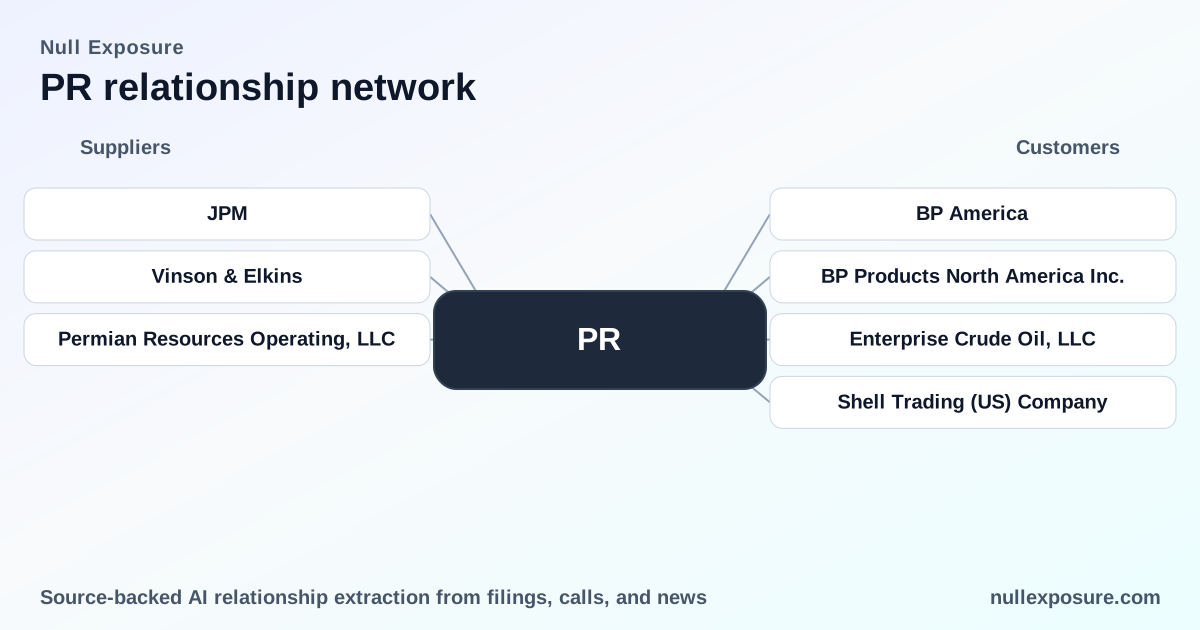
Permian Resources (PR) — Counterparty Concentration and Contracted Sales in the Permian Basin
Permian Resources monetizes by producing and marketing crude oil, natural gas and NGLs from the Permian Basin and selling those commodities to a small group of large purchasers under predominantly multi-year contracts. Revenue is driven by spot-linked sales adjusted for contractual differentials, but the commercial book is characterized by concentration: a handful of counterparties account for material shares of net revenues and committed minimums. Learn more about the coverage and how we source these relationship signals at https://nullexposure.com/.
Business model in plain English: how the contracts shape cash flow
Permian Resources operates and produces in the Permian Basin and sells production directly to purchasers at prevailing market prices, often with contractual differentials and minimum delivery commitments. The company recognizes revenue when control transfers and collectability is reasonably assured; consequently, commercial outcomes are driven by two connected factors: regional price differentials (notably Waha hub dislocations) and the contractual structure of its offtake agreements.
The 10‑K makes three investor-relevant operating points clear:
- Contracting posture: The majority of revenue contracts have terms greater than 12 months and include explicit minimum delivery obligations for NGLs and natural gas, creating predictable volume commitments over multi-year horizons.
- Concentration and criticality: The company sells to a relatively small number of customers, and the loss of any major purchaser would have a material near-term impact on revenue.
- Commercial scale and committed spend: Reported minimum remaining commitments for NGLs and natural gas aggregate to material mid-double-digit millions of dollars per contract class, signaling non-trivial counterparty exposure.
These structural elements make Permian Resources’ topline both predictable and exposed: contract tenors and minimums support revenue visibility, while counterparty concentration and regional pipeline dynamics create asymmetric downside risk.
The customer list you need to know
The FY2024 Form 10‑K discloses the purchasers that accounted for 10% or more of net revenues and cites specific commercial arrangements; below are the relationships the filing lists and what they mean for investors.
BP America — a double-digit revenue recipient
BP America accounted for 11% of total net revenues in the periods presented, placing it among Permian Resources’ core purchasers. According to Permian Resources’ FY2024 Form 10‑K (filed February 2026), BP America is a significant buyer whose share represents meaningful concentration risk for the company.
BP Products North America Inc. — an explicit sale agreement counterparty
Permian Resources cites a Purchase and Sale Agreement dated August 2, 2018 between Centennial Resource Production, LLC and BP Products North America Inc., indicating legacy or related contractual channels to BP’s downstream organization. The FY2024 10‑K references this agreement as part of the company’s commercial documentation (Permian Resources Form 10‑K, FY2024).
Enterprise Crude Oil, LLC — near‑quarter revenue contributor
Enterprise Crude Oil, LLC represented 19% of net revenues in the reported periods and is a principal crude purchaser for the company. The FY2024 Form 10‑K lists Enterprise Crude Oil as a material counterparty, underscoring the company’s reliance on a small set of crude handlers and traders.
Shell Trading (US) Company — the largest single purchaser disclosed
Shell Trading (US) Company accounted for 31% of net revenues, making it the largest disclosed purchaser in the filing. The FY2024 10‑K places Shell Trading at the top of Permian Resources’ customer concentration profile, a dynamic that concentrates price and counterparty risk with a major international trader.
What the contractual and constraint signals imply for investors
The filing contains explicit constraint signals that shape commercial risk and valuation assumptions for Permian Resources:
- Long-term contract bias: Several agreements include multi-year minimum delivery commitments — for example, NGL minimums requiring delivery of 9,000 barrels per day over ~3.3 years and natural gas minimums extending seven years — which create firm volume obligations and under-delivery penalties (FY2024 10‑K).
- Geographic price risk: Assets are concentrated in the Permian Basin; the company reports that pipeline capacity constraints and maintenance created negative regional gas pricing at the Waha hub in 2024, directly compressing realizations (FY2024 10‑K).
- Material counterparty exposure: The company sells to a relatively small number of purchasers and states that loss of major purchasers would materially affect revenues (FY2024 10‑K).
- Contract maturity and spend scale: The remaining contractual minimums for the reported NGL and natural gas agreements aggregate to roughly $123 million in committed financial exposure (NGL $35.9M; natural gas $87.2M), signaling the commercial book’s mid-range spend band.
Taken together, these constraints constitute a commercial profile of predictable volumes supported by multi-year agreements but concentrated counterparty credit risk and regional price sensitivity. Investors should model both the upside of contracted volumes and the downside from counterparty attrition or regional transportation bottlenecks.
Learn more about how we surface counterparty concentration and contract-level signals at https://nullexposure.com/.
Investment implications and monitoring checklist
For investors and operators assessing Permian Resources, the relationship map and constraints yield a focused set of actionable considerations:
- Concentration premium vs. concentration risk: The presence of Shell Trading at 31% and other double-digit buyers supports stable offtake in favorable market conditions; however, it also creates a concentrated counterparty risk that should be discounted in cash-flow scenarios.
- Contract durability matters: Multi-year minimums generate revenue visibility but also create legal and operational obligations (under-delivery fees) that will accelerate cash impact in low‑realization environments.
- Regional infrastructure sensitivity: Permian Basin transportation constraints have demonstrably depressed realized gas prices; investors must model throughput and differential risk separately from global oil-price assumptions.
- Credit and counterparty monitoring: Active surveillance of counterparties’ credit profiles, trading behavior, and contract renewal terms is essential given the materiality of these relationships.
Bottom line
Permian Resources operates with a commercial structure that balances contracted volume certainty against significant concentration and regional price risk. The FY2024 Form 10‑K identifies four principal relationships—Shell Trading, Enterprise Crude Oil, BP America, and BP Products North America—that together drive a large share of net revenues and contractual commitments. For valuation and risk management, investors must incorporate both the protective features of multi-year minimums and the asymmetric downside posed by counterparty loss or Permian Basin transport dislocations.
For a deeper read on counterparty exposure methodologies and how this profile compares across peers, visit https://nullexposure.com/.