Perdoceo Education (PRDO): Customer Relationships and What They Reveal About Revenue Quality and Regulatory Risk
Perdoceo Education operates accredited postsecondary institutions that deliver education through online, campus-based, and hybrid programs and monetizes primarily by charging tuition and fees to students and collecting government Title IV funding on their behalf. The company is fundamentally a seller of education services with a service-provider posture toward student outcomes, and its cash flows are dominated by short-term tuition billing and Title IV receipts. For readers who want a consolidated view of customer linkages and contracts, visit https://nullexposure.com/ for our relationship analytics platform.
Executive summary: the headline takeaways for investors
- Revenue is concentrated and contract-tenured at the academic-term level, with tuition billed at term start and recognized over the term.
- Title IV government funding is critical, accounting for the majority of cash receipts and representing a material single-point exposure to regulatory change.
- Perdoceo’s customer base is primarily individual adult learners in the U.S., with a sizable enrollment concentration in Colorado Technical University (CTU).
- Employer-sponsored partnerships (documented in third-party reporting) provide distribution channels but also create reputational links to high-profile employers.
- Financially, Perdoceo generates substantial cash (TTM revenue ~$846M; EBITDA ~$238M) but carries regulatory and enrollment risk that can rapidly alter near-term cash flows.
How Perdoceo actually contracts and collects — what the constraints tell us
Perdoceo bills tuition at the start of academic terms and recognizes revenue on a straight-line basis over those terms, which creates a short-term contract rhythm tied to enrollment cycles. This billing cadence means near-term revenue is highly sensitive to quarter-over-quarter enrollment movement rather than long multi-year contracts. Company disclosures indicate the firm derives a substantial majority of cash receipts from Title IV government programs, and that student receivables reflect amounts owed for services already delivered. Perdoceo’s institutions are U.S.-centric, with ground campuses in several states and nearly all students residing in the United States. Operationally the company acts both as a seller of academic programs and a service provider that supports students throughout the academic lifecycle. These features together generate a business that is profitable today but intrinsically exposed to regulatory shifts and enrollment dynamics.
What the public record shows about employer relationships
The available reporting identifies several employer partnerships or references to employer-sponsored education benefits that involve Perdoceo’s schools. Below I list every relationship captured in the public results and summarize the linkage in plain language.
-
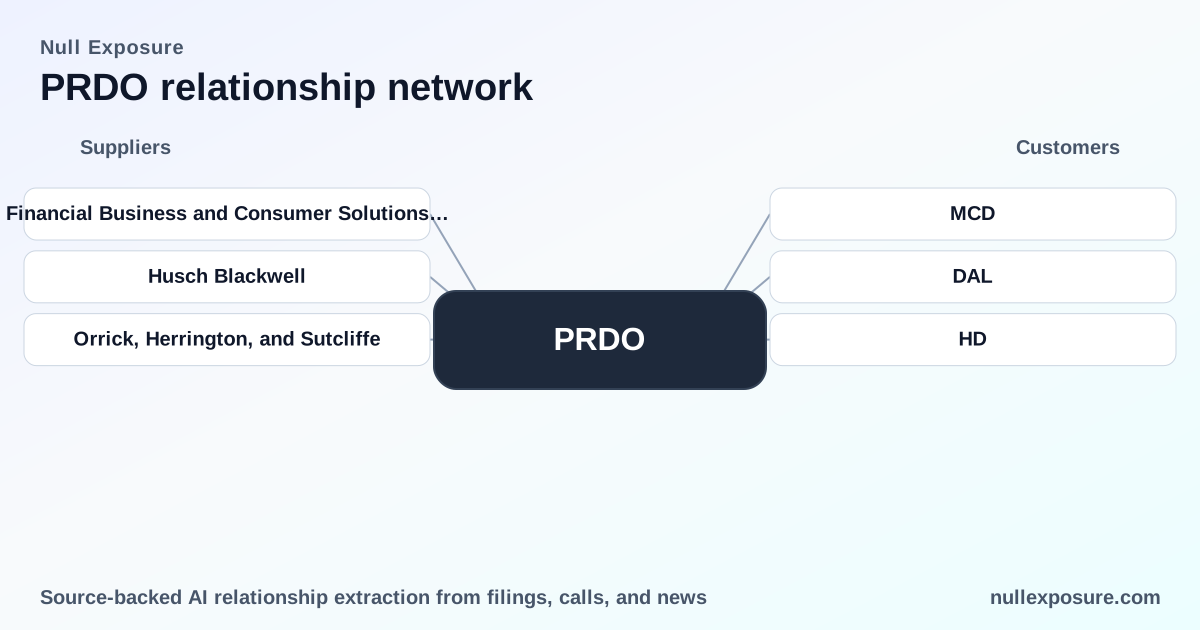
MCD (McDonald’s) — Republic Report (2022). The article reports that since 2014 McDonald’s has steered employees to Colorado Technical University (a Perdoceo school) as part of an education benefit offering. Source: Republic Report, 2022.
-
McDonald s (duplicate entry) — Republic Report (2022). The same Republic Report item reiterates the McDonald’s–CTU relationship and the company-level connection to Perdoceo’s online programs. Source: Republic Report, 2022.
-
Delta Airlines (DAL) — Republic Report (2022). Republic Report notes Delta and other large employers offered education benefits that included discounts or referrals to for-profit institutions, explicitly calling out Perdoceo’s schools in that context. Source: Republic Report, 2022.
-
HD (Home Depot) — Republic Report (2022). The reporting cites Home Depot among major employers that have offered education benefits steering employees toward for-profit providers, including Perdoceo institutions. Source: Republic Report, 2022.
-
Home Depot (duplicate) — Republic Report (2022). The article repeats the reference to Home Depot and its employee education benefits linked to Perdoceo’s offerings. Source: Republic Report, 2022.
These entries document employer relationships chiefly as distribution or referral channels; they are not disclosed as primary revenue counterparties in Perdoceo’s financial statements, but they are material as marketing and student-acquisition conduits.
Why these employer links matter to investors
Employer partnerships act as distribution channels that can boost enrollments without the company shouldering the entire acquisition cost, but they also create reputational exposure and concentration risk in student sourcing. When large employers steer employees to Perdoceo schools, enrollment and cash receipts can rise quickly — and fall quickly if employers change vendors or face public scrutiny. Given Perdoceo’s reliance on Title IV funding for the bulk of tuition cash receipts, employer-originated students ultimately convert into government-funded revenue streams; this compounds the regulatory sensitivity.
Constraints translated into investment implications
-
Contracting posture — short term: Tuition is billed term-by-term. This provides predictable recognition but makes revenue dependent on enrollment decisions made at each term start. Investors should treat revenue as cyclical and enrollment-sensitive rather than as long-duration recurring revenue.
-
Concentration — government dependency: Approximately 77% of the institutions’ cash receipts in 2024 came from Title IV funding and Perdoceo reported Title IV cash receipts of roughly $484 million in the referenced period, making federal student aid a dominant counterparty. This is a single-point material exposure that could materially compress revenue if policy or eligibility changes occur.
-
Counterparties — individuals are the effective customers: The firm’s customers are primarily individual adult learners (CTU students represented ~68% of total enrollments as of 12/31/2024). That composition means enrollment mix and student outcomes drive both top-line growth and regulatory scrutiny.
-
Geography — U.S. concentrated: Revenue and assets are substantially U.S.-based; regulatory or macroeconomic shocks localized to U.S. student finance policy will therefore have outsized effects.
-
Role and segment maturity: Perdoceo is both a seller of degree programs and a service provider focused on coaching and student support. Its business is mature within the for-profit education segment and produces consistent margins today, but a shift in legislative or oversight posture could quickly change the outlook.
Financial backdrop that frames these relationship risks
Perdoceo reported TTM revenue of approximately $846 million with EBITDA around $238 million, yielding healthy operating margins relative to peers in the education sector. Market capitalization sits north of $2.1 billion, with a trailing P/E near 13.9 and forward P/E around 11.0. These fundamentals show an operating business that is profitable and cash-generative today, but the core drivers of that cash are concentrated enrollments and Title IV funding.
For investors tracking counterparty linkages and regulatory levers, detailed customer-level analytics change the risk calculus; to explore the full relationship map and constraint signals, visit our portal at https://nullexposure.com/.
Risk/reward framework and portfolio considerations
- Upside: Stable margins and profitable cash flow profile combined with a lower forward P/E suggest upside if enrollments hold and regulatory regimes remain favourable. Employer partnerships expand distribution at low incremental customer-acquisition cost.
- Downside: Regulatory action on Title IV eligibility, enforcement, or funding levels represents an existential risk to Perdoceo’s current model because of the concentration of cash receipts and short-term billing dynamics. Reputational headlines tied to employer referrals can accelerate enrollment attrition.
Bottom line: how to position
Perdoceo should be approached as a profitable, operationally efficient operator within a regulatory-sensitive industry. Investors must underwrite the durability of Title IV access and enrollment stability, not just the current margins. Employer partnerships documented in external reporting are distribution positives but introduce reputational and channel-concentration considerations that affect near-term enrollment visibility.
For a deeper dive into counterparty networks, contract tenors, and signal-driven monitoring of Perdoceo relationships, consult our full relationship analytics at https://nullexposure.com/.