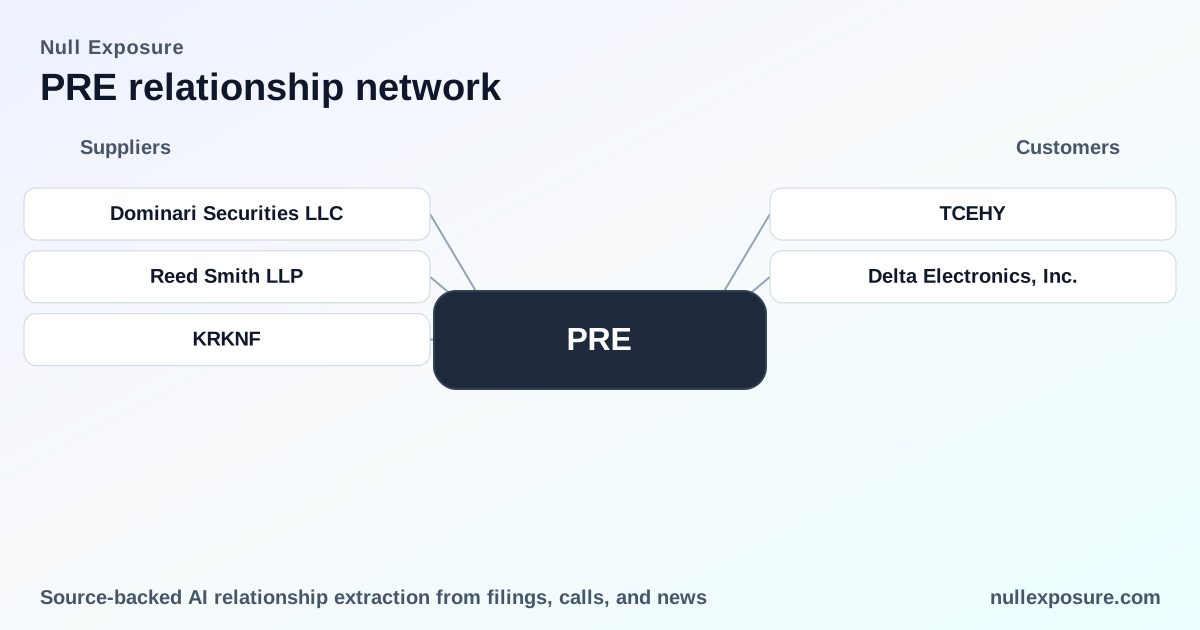
Prenetics Global Ltd (PRE): Liquidity through divestments, product-led growth, and evolving customer ties
Prenetics (NASDAQ: PRE) operates as a consumer-focused health-technology company that monetizes through diagnostic testing, genetic services, and branded consumer-health products, while selectively monetizing non-core assets to strengthen the balance sheet. Recent activity centers on strategic divestments to institutional corporate buyers and brand development for direct-to-consumer revenue—an operating model that converts IP and lab capabilities into recurring revenue streams while using asset sales to fund growth and reduce leverage. Learn more about how we track these customer and buyer relationships at https://nullexposure.com/.
How Prenetics makes money and why customer relationships matter
Prenetics sells clinical and consumer tests, plus integrated digital services, to healthcare providers, employers, and consumers. Revenue drivers are a mix of volume testing, higher-margin consumer brands (such as IM8), and occasional one-time monetizations of business units. That hybrid model produces recurring test revenue alongside episodic liquidity events—important for an operator reporting negative margins but growing top line and a strengthened cash position in FY2026.
- The company’s FY2026 communications highlight a strengthened liquidity profile following asset sales, which reduces near-term financing risk while giving management runway to invest in consumer brand growth.
- Customer and buyer relationships are therefore dual-purpose: they deliver both operational revenue and, when strategic buyers are involved, balance-sheet capital through divestments.
What the relationship data tells investors about contracting posture and concentration
The provided relationship items show transactions with large corporate buyers rather than dependency on a single healthcare purchaser. No explicit contractual constraints or exclusive supply obligations are reported in the material available, so the dataset does not surface concentrated counterparty risk or long-term locked-in revenue commitments. This is a company-level signal: Prenetics is pursuing asset-light liquidity events and consumer-brand expansion rather than relying on a narrow set of captive customers.
Transaction and customer relationship roll call — what each reported item says
Below are all reported relationship items from the results, with concise takeaways and source references.
-
Finviz (Mar 10, 2026) — Prenetics completed a $70 million sale of Insighta to Tencent, which management reported increased total adjusted liquidity to $171.1 million; the transaction is presented as a balance-sheet strengthening action. (Finviz news, March 10, 2026: https://finviz.com/news/310277/formula-1-phenom-ollie-bearman-joins-prenetics-im8-health-as-global-ambassador-and-shareholder)
-
Finviz (same item, Mar 10, 2026 — listed under “Tencent” label) — The public reporting also links Tencent as the counterparty, indicating direct strategic buyer engagement with a major technology conglomerate rather than a private financial acquirer. (Finviz news, March 10, 2026: https://finviz.com/news/310277/formula-1-phenom-ollie-bearman-joins-prenetics-im8-health-as-global-ambassador-and-shareholder)
-
QuiverQuant (Mar 10, 2026) — Prenetics announced the completion of its divestment of ACT Genomics to Delta Electronics, confirming management’s tactic of monetizing non-core or complementary units to bolster cash and focus on core consumer-health and diagnostics offerings. (QuiverQuant report, March 10, 2026: https://www.quiverquant.com/news/Prenetics+Global+Limited+Bolsters+Financial+Strength+with+%2460+Million+in+Cash+and+Accelerates+Growth+of+IM8+Supplement+Brand)
-
ADVFN / GlobeNewswire citation (reported Feb 18 / posted Mar 10, 2026) — A company release tied to a voluntary warrant exchange program also reiterated the $70 million Insighta sale to Tencent and referenced the company’s liquidity improvements alongside shareholder actions, signaling coordinated capital-structure management. (ADVFN/GlobeNewswire reporting context, February–March 2026: https://mx.advfn.com/bolsa-de-valores/NASDAQ/PRE/noticias/97550529/prenetics-provides-update-on-voluntary-warrant-exchange-program-reaching-86-7)
-
ADVFN (same item under “Tencent” label, Feb–Mar 2026) — The duplicate ADVFN mention reinforces that the Tencent transaction was disclosed through formal company communications tied to investor notices, implicating the deal as a material corporate action disclosed to markets. (ADVFN/GlobeNewswire, February–March 2026: https://mx.advfn.com/bolsa-de-valores/NASDAQ/PRE/noticias/97550529/prenetics-provides-update-on-voluntary-warrant-exchange-program-reaching-86-7)
-
Investing.com (May 3, 2026) — Reporting noted an ACT Genomics divestment to Delta Electronics for $72 million, and covered insider purchases by executives, a combination that underscores management’s commitment to capital redeployment and confidence signaling following the asset sale. (Investing.com company news, May 3, 2026: https://www.investing.com/news/company-news/prenetics-executives-purchase-14-million-in-company-stock-93CH-4374966)
What investors should read into these buyer relationships
- Strategic buyers (Tencent and Delta Electronics) are not routine clinical customers; they are corporate acquirers that delivered liquidity through asset purchases—this is a deliberate capital-management strategy rather than typical customer revenue generation.
- The presence of global technology and electronics corporations as counterparties signals perceived strategic value in Prenetics’ assets, whether in data, diagnostics IP, or market access. That enhances the company’s optionality to redeploy capital into consumer-facing growth initiatives.
- Receipts from these sales materially affect near-term solvency metrics: management explicitly tied proceeds to adjusted liquidity increases, which is a constructive signal for investors given negative operating margins.
Risks and what to watch next
- Transaction proceeds are one-off events; sustained margin improvement requires execution in core testing and consumer brands. Investors must monitor quarter-over-quarter revenue mix and gross-margin trends tied to recurring testing services.
- Concentration risk is low in the reported items, as sales were to strategic corporate buyers rather than single large healthcare customers; however, visibility into long-term commercial contracts with major institutional customers remains limited in the public reporting.
- Monitor for further divestments or strategic partnerships that change revenue composition and for any disclosure about the use of sale proceeds (debt reduction, R&D, marketing for IM8).
If you want deeper, deal-level tracking and analysis of Prenetics’ corporate counterparties and how those relationships influence valuation and liquidity dynamics, visit https://nullexposure.com/ for our investor-focused coverage and relationship maps.
Bottom line
Prenetics is executing a dual strategy: grow recurring consumer and clinical testing revenue while using selective divestments to materially strengthen the balance sheet. The reported transactions with Tencent and Delta Electronics transform asset value into liquidity, reduce financing pressure, and buy management time to scale higher-margin consumer initiatives. For investors and operators, the priority is verifying whether organic revenue and margin improvement follows the liquidity repairs — that will determine if these moves are transitory balance-sheet fixes or the foundation of durable shareholder value.