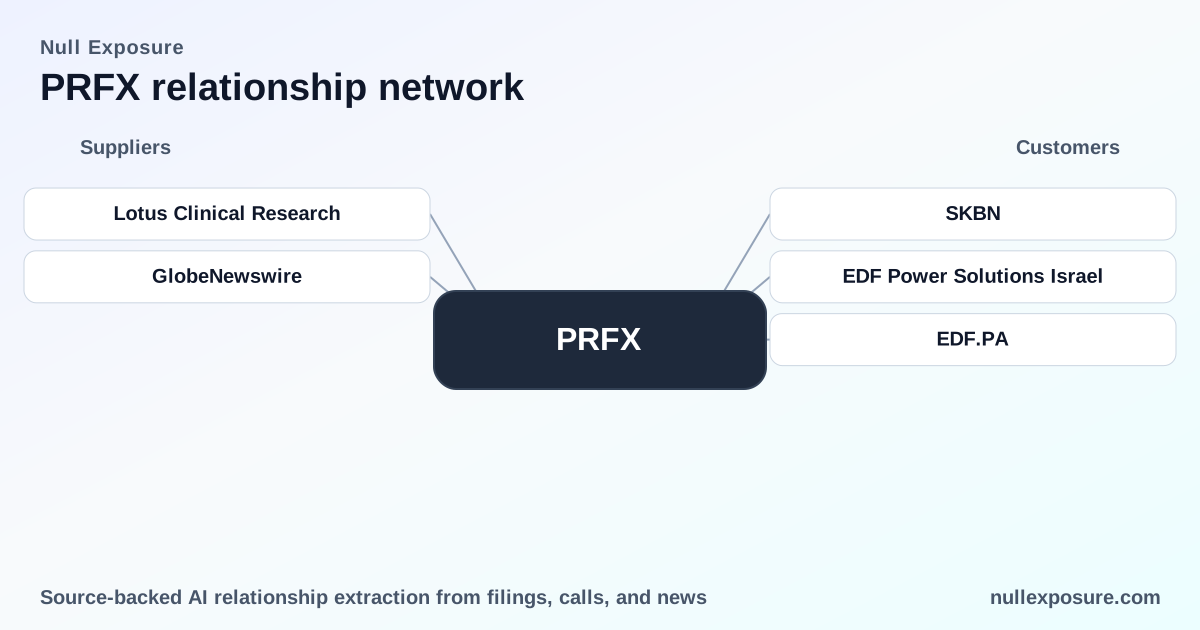
PRFX Customer Map: DeepSolar’s Early Commercial Wins and What Investors Should Expect
PRF Technologies (formerly PainReform Ltd., ticker PRFX) has pivoted from a clinical-stage pharmaceutical story into a dual-platform technology company that monetizes through healthcare R&D and an AI-driven solar analytics arm called DeepSolar. Revenue generation is primarily commercializing DeepSolar via SaaS deployments and paid technical due diligence (TDD) engagements for utility-scale solar operators, supplemented by nascent healthcare licensing/clinical progression. For investors, the company’s 2025–2026 customer announcements collectively signal a deliberate move from pilots to early commercial contracts — a revenue inflection that is real but modest relative to the company’s current financial base. (See company filings and press releases on the firm’s FY2026 disclosures; also review coverage at https://nullexposure.com/.)
Why these customers matter: the business model in plain English
PRF is selling two product behaviors to solar operators: an ongoing analytics subscription that improves operations and an onetime technical due-diligence product that accelerates transactions and risk underwriting. SaaS deals create recurring revenue; TDD engagements are higher-margin, one-time services that open doors to longer commercial contracts. The customer list for FY2026 indicates PRF is executing a classic commercialization ladder — pilot → paid pilot/TDD → SaaS deployment — which is the fastest route to scaling an analytics business in energy.
Financial context is critical: PRF’s reported revenue for the trailing twelve months is tiny (USD 17k) while operating losses remain substantial, reflecting an early-stage commercial cycle and heavy R&D investment. That mix translates to high operational leverage if DeepSolar wins a handful of mid-sized utility contracts, but also high execution risk until revenue scale materializes. Learn more about how we track these customer signals at https://nullexposure.com/.
The customer roster — each relationship investors should know
Below I summarize every customer relationship disclosed in the FY2026 news cycle and corporate updates. Each entry includes a concise, source-linked note.
Shikun & Binui Energy (listed as SKBN)
PRF signed a commercial SaaS agreement to deploy DeepSolar at the 71 MW Satu Mare photovoltaic plant in Romania, marking a move from pilot work to a live operational deployment. (GlobeNewswire press release, Feb 11, 2026: https://www.globenewswire.com/news-release/2026/02/11/3236284/0/en/PRF-Technologies-Wins-Another-European-Utility-Scale-Solar-Deployment-Expanding-DeepSolar-s-Installed-Commercial-Base.html)
EDF Power Solutions Israel (subsidiary of EDF Group / EDF.PA)
DeepSolar secured its first commercial technical due diligence engagement for an operational utility-scale plant in Israel with a special-purpose company of EDF Power Solutions Israel, demonstrating credibility with a major international renewables operator. (Company announcement and GlobeNewswire coverage, Feb 18, 2026; also reported in The Globe and Mail, Feb 18, 2026: https://www.globenewswire.com/news-release/2026/02/18/3240327/0/en/PRF-Technologies-DeepSolar-Announces-its-First-Commercial-Due-Diligence-Engagement-with-EDF-Power-Solutions-Israel-a-Global-Leader-in-Renewable-Energy.html; https://www.theglobeandmail.com/investing/markets/stocks/PRFX-Q/pressreleases/306771/prf-technologies-deepsolar-lands-first-commercial-due-diligence-deal-with-edf-in-israel/)
EDF Group (parent reference / EDF.PA)
Multiple release copies cite the transaction as involving a subsidiary of EDF Group, which is meaningful because getting a parent-group or major subsidiary engagement is an endorsement that supports broader commercial credibility for DeepSolar. (The Globe and Mail and other press coverage, Feb 2026: https://www.theglobeandmail.com/investing/markets/stocks/PRFX-Q/pressreleases/306771/prf-technologies-deepsolar-lands-first-commercial-due-diligence-deal-with-edf-in-israel/)
Econergy
DeepSolar progressed a 2025 strategic pilot at a 92 MW Romanian photovoltaic plant operated by Econergy into a commercial agreement, signaling that early pilots are converting to contracted work — a necessary step to build scale in the region. (PRF year-end business update, Mar 27, 2026; The Globe and Mail summary, Mar 2026: https://www.globenewswire.com/news-release/2026/03/27/3263728/0/en/PRF-Technologies-Provides-Year-End-2025-Business-Update-Highlighting-Strategic-Progress-Across-Healthcare-and-AI-Driven-Solar-Platforms.html; https://www.theglobeandmail.com/investing/markets/stocks/PRFX/pressreleases/1022389/prf-technologies-posts-2025-results-as-layerbio-and-deepsolar-deals-drive-dual-platform-pivot/)
Blade Ranger (BLRNF)
PRF announced a commercial engagement described in coverage as targeting global utility-scale solar portfolios with Blade Ranger, indicating new channel or partner-based distribution avenues for DeepSolar beyond direct operator sales. (Timothy Sykes press coverage, Apr 2026: https://www.timothysykes.com/news/prf-technologies-ltd-prfx-news-2026_04_06/)
Operating model constraints and business-level signals investors must weigh
- Contracting posture: PRF’s customer wins show a mixed contracting posture — short-term, transaction-focused TDD engagements and longer-duration SaaS licenses; this hybrid reduces early revenue volatility if PRF converts TDD clients into SaaS subscribers. This is a company-level signal drawn from its FY2026 announcements and product positioning.
- Concentration: The customer base is still concentrated and regionally focused (Romania and Israel), which creates downside exposure if one or two customers do not renew or expand. PRF needs more geographic and portfolio diversification to lower client concentration risk.
- Criticality: DeepSolar positions itself as an operational and forecasting tool for utility-scale plants; for customers this is operationally valuable, which supports pricing and stickiness if performance is delivered.
- Maturity: The business is in early commercialization — pilots converted to initial paid engagements in FY2026 — and the company’s financial profile (USD 17k revenue TTM, negative operating margins) confirms a high-growth, high-burn stage rather than a mature SaaS run-rate business.
Investment implications and risks
- Upside: Successful expansion of a handful of mid-sized utility contracts into recurring SaaS revenue could materially alter PRF’s revenue trajectory because analytics scale across large portfolios quickly once platform adoption begins.
- Downside: Current revenue is negligible relative to operating losses; the company’s limited institutional ownership and small market capitalization constrain liquidity and increase volatility. Execution risk is the primary near-term issue — converting pilots and TDD engagements into multi-year contracts is essential.
Bottom line: what to watch next
Investors should monitor (1) new SaaS renewals and ARR disclosure, (2) repeat business from EDF/major operators, and (3) geographic expansion beyond current Romanian/Israeli footprints. Each of those outcomes materially de-risks the story. For a structured tracker of PRF’s customer signals and to receive alerts when PRF files additional commercial updates, visit https://nullexposure.com/.
Bold takeaway: FY2026 proves DeepSolar is a live commercial product, but PRF remains an early-stage operator where revenue runway and customer diversification determine valuation re-rating.