PROG Holdings (PRG): Customer relationships that move the needle
PROG Holdings operates two complementary consumer credit businesses — Progressive Leasing, a point-of-sale lease-to-own platform that purchases merchandise from retail partners and leases it to near-prime and subprime consumers on short-term, cancellable contracts; and Vive Financial, an omnichannel provider of revolving second‑look credit products. The company monetizes through lease and loan economics (fees, finance income, and securitization/refinancing events) and occasional portfolio sales that convert receivables into near-term cash. For investors, the combination of highly transactional customer contracts, concentrated retail partnerships, and periodic receivables monetizations defines both PROG’s growth levers and its primary risks. Learn more at https://nullexposure.com/.
Why partner links and receivable flows matter more than you think
PROG’s operating model is transactional and capital-light on a per‑contract basis: Progressive acquires merchandise, structures cancellable leases with terms generally up to 12 months, and records lease income while retaining credit exposure to many individual consumers. That posture produces predictable short-duration cash flows but also high sensitivity to retail partner disruptions and consumer-credit cycles. PROG’s Vive unit supplements income through revolving credit but is also a vehicle for balance-sheet management — portfolios can be securitized or sold to free capital, as seen in recent activity.
- Contracting posture: Agreements are short-term and cancellable, creating recurring originations but limited duration credit tails.
- Counterparty concentration: Revenue depends on many individual consumer contracts but a smaller set of retail partners for distribution — losses of a large partner can be material.
- Geography and market: Operations are concentrated in the U.S. and Puerto Rico, focusing exposure to the same macro cycle that affects U.S. consumers.
- Role and maturity: PROG is both a seller and a service provider at point-of-sale; its business falls in the services segment with established scale but ongoing product evolution.
These company-level signals explain why investors should watch partner health, receivable monetizations, and short-term consumer delinquencies rather than only long-term loan vintages.
All disclosed customer relationships and what each document reports
Below I list every relationship entry surfaced in the data payload and summarize the key point from each source in plain English.
-
ATLCL / Atlanticus (intellectia.ai, March 9, 2026) — PROG sold its Vive Financial credit card receivables portfolio to Atlanticus for approximately $150 million in cash, converting receivables into liquidity. The press coverage reported the transaction as an outright portfolio sale. (intellectia.ai, first seen March 9, 2026)
-
ATLCL / Atlanticus (QuiverQuant, March 9, 2026) — Atlanticus disclosed it acquired about $165 million of retail credit receivables from PROG’s Vive portfolio, confirming Atlanticus’s post‑quarter balance-sheet expansion. (QuiverQuant summary of Atlanticus disclosure, March 2026)
-
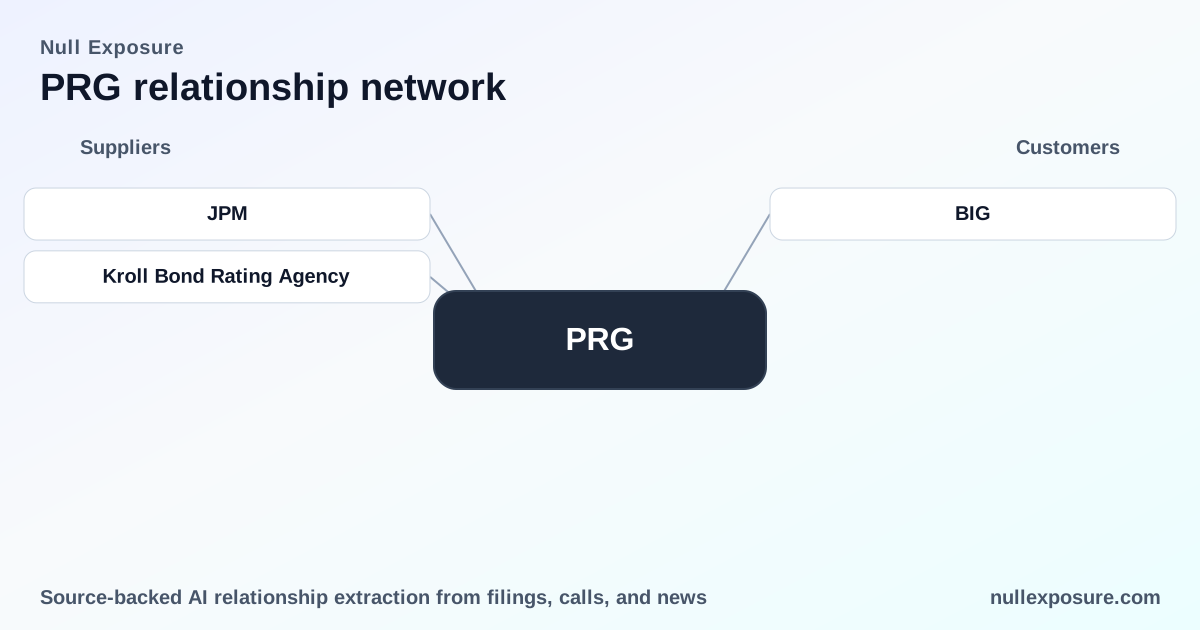
BIG / Big Lots (InsiderMonkey transcript, March 10, 2026) — PROG’s management said underlying gross merchandise volume (GMV) excluded roughly $40 million associated with Big Lots, signaling that Big Lots historically represented a material distribution relationship for Progressive Leasing. (Q4 2025 earnings call transcript, reported March 10, 2026)
-
Big Lots (InsiderMonkey transcript, March 10, 2026) — The same earnings‑call excerpt reiterates that Big Lots contributed ~$40 million to GMV, highlighting the practical impact of losing a large point‑of‑sale partner. (Q4 2025 earnings call transcript, March 10, 2026)
-
BIG / Big Lots (TradingView SEC summary, March 10, 2026) — PROG’s SEC filing explicitly warns that the loss or bankruptcy of a major partner, such as Big Lots, could materially affect financial performance, underscoring concentration risk tied to large partners. (TradingView write-up of PROG 10‑K, March 2026)
-
Big Lots, Inc. (TradingView SEC summary, March 10, 2026) — The 10‑K language repeats the same point: the bankruptcy of Big Lots served as a real example of partner risk that can materially change revenue and GMV dynamics. (TradingView reporting on PROG 10‑K, March 2026)
-
ATLC / Atlanticus (GlobeNewswire report, first seen March 9, 2026) — Atlanticus’s official quarter results noted the acquisition of the Vive receivable portfolio subsequent to quarter end, tying the transaction to its Q3 2025/early Q4 2025 reporting window. (Atlanticus press release on GlobeNewswire, November 10, 2025 as reported)
-
ATLC (StockTitan news summary, March 9, 2026) — Industry press captured PROG’s announcement and dated it Oct 22, 2025, presenting the sale as a definitive corporate action in late 2025. (StockTitan synopsis quoting the Oct 22, 2025 announcement)
-
ATLCL (Investing.com analyst coverage, May 2, 2026) — Investment notes repeated that Atlanticus acquired PROG’s Vive portfolio for $150 million in cash, and analysts used the deal to update Atlanticus valuations and coverage. (Investing.com analyst roundup, May 2, 2026)
-
ATLCL (Investing.com followup, May 2, 2026) — Another Investing.com item confirmed the cash purchase and receivable amount, reinforcing market recognition of the transaction as a meaningful balance‑sheet event for both firms. (Investing.com, May 2, 2026)
-
ATLC (Investing.com mobile summary, May 2, 2026) — Mobile/amp coverage reiterated the same facts: Atlanticus’s purchase converted approximately $165 million of receivables into Atlanticus-managed assets for roughly $150 million cash to PROG. (Investing.com mobile summary, May 2, 2026)
-
ATLCZ (The Globe and Mail, March 9, 2026) — Canadian market press framed the transaction succinctly: “Prog sells Vive credit card receivables portfolio to Atlanticus for $150M.” The headline treatment signals how the deal was positioned publicly. (The Globe and Mail press headline, March 2026)
-
ATLC (TipRanks / The Fly, May 2, 2026) — Research and news services repeated the sale headline and noted that Atlanticus’s price target commentary referenced the refinancing/receivable acquisition as a supportive event for Atlanticus’s outlook. (TipRanks/The Fly coverage, May 2, 2026)
What these relationships imply for revenue, liquidity and risk
-
Receivable monetizations are a deliberate capital tool. The Vive sale to Atlanticus turned future finance income into near-term cash, reducing credit exposure while improving liquidity. That is a repeatable lever PROG can deploy to manage capital and pursue growth or deleverage.
-
Retail partner concentration is a concrete risk factor. Big Lots contributed material GMV (roughly $40 million cited in company remarks), and its bankruptcy exemplifies how partner loss can compress originations and revenue quickly. Partner health is a top monitoring metric for PRG investors.
-
Contracts are short and consumer-focused. PROG’s lease-purchase agreements are typically cancellable and up to 12 months, exposing the business to more frequent renewal cycles and immediate consumer delinquencies, rather than long amortizing loan tails.
-
Geographic exposure is U.S.-centric. The Progressive segment operates in the United States and Puerto Rico, concentrating macro and regulatory exposure.
Investment takeaways and actionable signals
-
Positive: PROG trades at a low-teens EV/EBITDA multiple historically, and recent portfolio sales demonstrate management’s willingness to crystallize value and manage capital. Company metrics (e.g., trailing P/E ~9.2 and Revenue TTM ~$2.48B) show operational scale and current profitability.
-
Watchlist: Monitor receivable sale cadence, the health of top retail partners (Big Lots aftermath), short‑term delinquency trends among near-prime/subprime consumers, and any guidance about future securitizations or portfolio dispositions.
-
Risk checklist: Partner concentration, consumer-credit sensitivity, short-term contract churn, and reliance on balance-sheet transactions for liquidity.
For a concise monthly tracker of PROG’s partner events and receivable monetizations, visit https://nullexposure.com/ — our coverage highlights the exact items that drive quarter-to-quarter volatility in companies like PROG.
Bottom line: PROG’s model combines scalable point-of-sale distribution with balance-sheet management via receivable sales, producing predictable short-duration cash flows but leaving the company exposed to partner disruptions and consumer-credit cycles. Investors should price both the upside from receivable monetizations and the downside from partner concentration into any valuation.