Perrigo’s customer footprint: steady private‑label revenue, concentrated retail exposure
Perrigo Company plc manufactures private‑label over‑the‑counter self‑care products and monetizes by selling store‑brand pharmaceuticals and wellness goods to large retailers, wholesalers, and e‑commerce channels. The company’s business model is a B2B manufacturer of branded‑quality, store‑brand products — recurring, order‑driven revenue with margin tied to scale, category mix and retailer negotiating power. For investor diligence, the critical questions are customer concentration, geographic mix, and the degree to which recent portfolio moves simplify the go‑to‑market model. Learn more at https://nullexposure.com/.
The customer relationships you need to know right now
Below I cover each relationship reported in the available records with concise, source‑level context.
-
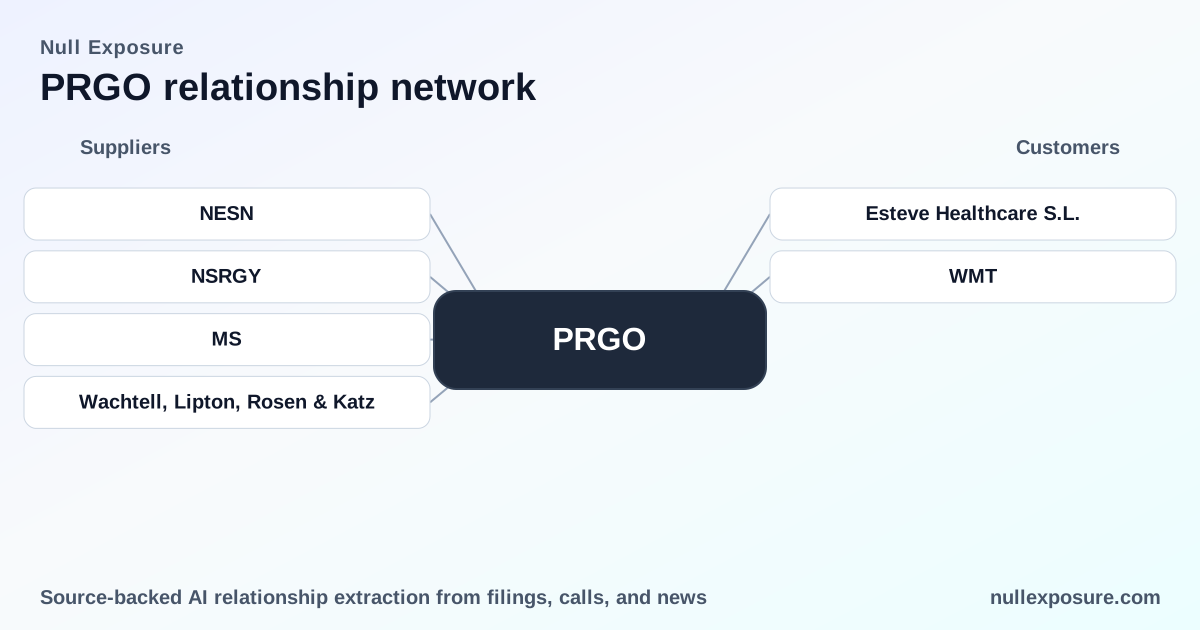
Walmart — Perrigo reported that Walmart represented 11.9% of consolidated net sales in 2024, making it the company’s single most material customer; Perrigo also disclosed that its top ten customers accounted for 46% of consolidated net sales in both 2023 and 2024. This level of concentration highlights bargaining leverage and single‑counterparty exposure in Perrigo’s revenue base, and it is documented in Perrigo’s 2024 Form 10‑K.
Source: Perrigo 2024 Form 10‑K (company filing, fiscal year ended December 31, 2024). -
Esteve Healthcare S.L. — In March 2026 Perrigo announced a binding offer from Spain’s Esteve Healthcare to buy HRA Pharma Rare Diseases for up to €275 million (~$293.9 million), a divestiture that reduces Perrigo’s exposure to rare‑disease specialty assets and refocuses the company on its self‑care, private‑label core. This was reported by Crain’s Grand Rapids in March 2026.
Source: Crain’s Grand Rapids news report (March 10, 2026).
How Perrigo’s customer set shapes the operating model
Perrigo’s disclosures and public reporting sketch a company where commercial scale, retailer relationships and geographic reach define both upside and risk.
-
Contracting posture. Perrigo functions primarily as a supplier to large retail and wholesale chains, selling products under customers’ private‑label brands as well as Perrigo’s own store brand offerings. That supplier posture means Perrigo lives inside category assortments and must accept retailer terms and promotional mechanics that compress gross margins but deliver volume and predictable reorder patterns. This is a company‑level signal drawn from Perrigo’s public filings.
-
Concentration and criticality. The combination of one customer at ~11.9% of sales and a top‑ten block equal to 46% of revenue creates meaningful concentration risk: losing or seeing materially lower volumes from a single large retail partner would be a first‑order earnings event. These are company‑level metrics from the 2024 Form 10‑K.
-
Geographic footprint and diversification. Perrigo’s revenue is principally split between North America and Europe (EMEA), reflecting a mature self‑care footprint across developed markets; the company characterizes no single product as more than 5% of revenue, which supports portfolio resilience even as customer concentration remains a structural constraint.
-
Role and maturity. Perrigo is a seller of core self‑care products with decades of category incumbency and a leading position in private label in North America; this operational maturity underpins stable manufacturing processes and long‑standing retail relationships but also exposes Perrigo to secular pressures on private‑label pricing and retailer assortment decisions.
Contracting posture and margin implications
Perrigo’s revenue stream is predominantly contractual purchase orders and replenishment sales to major chains and wholesalers, rather than direct consumer marketing. That implies:
- Low customer acquisition cost but high sensitivity to retailer promotions and procurement cycles. Contracts tend to be volume‑based with negotiated pricing tiers, which support scale economics but cap upside per unit sold.
- Margins depend on category mix and selling terms; Perrigo’s EBITDA and operating margins reflect manufacturing scale but are constrained by the retail buyer’s leverage. Investors should track product mix shifts, promotional allowances, and private‑label penetration trends inside major customers’ baskets.
Single‑relationship notes: Walmart and the divestiture
Walmart’s 11.9% share of consolidated sales is the most actionable customer signal for risk managers and investors: any meaningful change in Walmart’s assortment strategy, private‑label push, or supplier count will ripple directly into Perrigo’s near‑term revenue. This explicit figure is in Perrigo’s 2024 Form 10‑K.
Separately, the announced sale of HRA Pharma Rare Diseases to Esteve Healthcare for up to €275 million, reported in March 2026, is a strategic portfolio pruning that reduces exposure to a specialty asset and re‑concentrates management attention on the self‑care private‑label franchise. The divestiture simplifies the operating profile and modestly improves capital allocation optionality. Source: Crain’s Grand Rapids (March 10, 2026).
You can review company reporting and curated relationship intelligence at https://nullexposure.com/ for deeper diligence.
Near‑term catalysts and what to watch
- Track contract renewals and reported volumes from top retail partners, beginning with Walmart disclosures and merchandising cycles. Any incremental movement in Walmart’s private‑label strategy is a core risk/reward lever.
- Monitor product mix toward higher‑margin categories within the self‑care portfolio; category mix will determine operating leverage as promotional intensity ebbs or grows.
- Watch how proceeds and reduced complexity from divestitures like HRA Pharma Rare Diseases are redeployed — debt reduction, buybacks, or capex each signal a different allocation preference and risk posture.
Investor takeaway
- Perrigo is a mature private‑label self‑care manufacturer with predictable order flows and scale advantages, but its commercial model is exposed to retailer negotiating power and customer concentration (notably a single customer at ~11.9% of sales and top‑ten customers at 46% of sales).
- Recent portfolio pruning (the HRA Pharma Rare Diseases sale to Esteve) refocuses management on core self‑care activities and reduces specialty business complexity.
- For investors and operators evaluating Perrigo customer risk, the key questions are whether category mix can shift to higher margins, whether large retail partners will maintain volumes on current terms, and how cash from divestitures will be used to strengthen the balance sheet or fund growth initiatives.
For a deeper view of Perrigo’s counterparty exposures and real‑time relationship intelligence, visit https://nullexposure.com/.