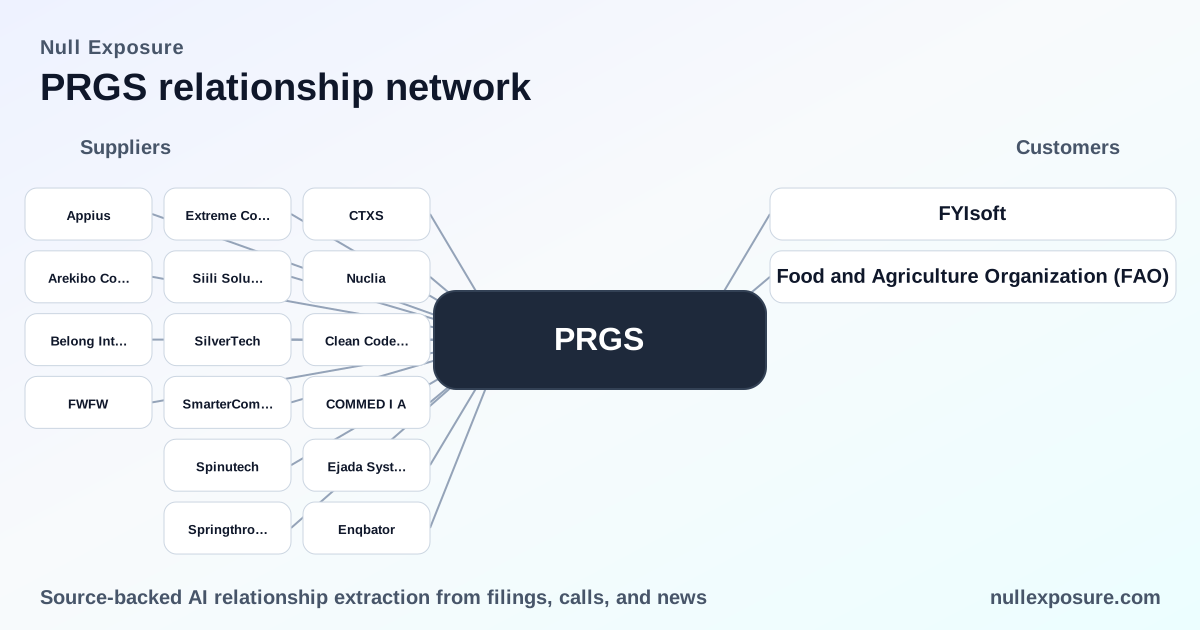
Progress Software (PRGS): Customer Relationships that Drive Revenue and Risk
Progress Software builds and sells infrastructure and developer-facing software—application development tools (Telerik/Kendo UI), digital experience platforms (Sitefinity), and secure managed file transfer (MOVEit). The company monetizes through a mix of perpetual and term licensing, subscriptions (SaaS), maintenance, and professional services, producing a revenue base that blends upfront license recognition with recurring maintenance and cloud-subscription streams. For investors, customer relationships determine renewal economics, cross-sell velocity into digital experience and AI-enabled app tooling, and exposure to operational risk tied to security-sensitive products like MOVEit.
For a concise corporate data snapshot, see the company homepage: https://nullexposure.com/
How Progress’s customer mix maps to value creation
Progress’s business model is hybrid and predictable: legacy on‑premise perpetual licenses generate upfront revenue and long-tail maintenance; cloud and SaaS offerings provide recurring revenue that improves visibility. Contracting posture reflects this hybrid mix—customers purchase licenses and subscriptions, with professional services layered on for implementation. Progress sells directly and through channels and serves both enterprise IT teams and individual developers, across North America, EMEA, APAC and LATAM. These are company-level signals drawn from public disclosures and revenue commentary.
Key operating characteristics to watch:
- Contracting posture: A mix of perpetual license recognition and subscription/SaaS contracts drives a blend of point-in-time and ratable revenue recognition.
- Customer types: Revenue comes from corporations, governmental agencies, and individual developers, which diversifies use cases but introduces different procurement cycles.
- Geographic footprint: Broad global reach mitigates single-region demand shocks but introduces operational complexity and local compliance needs.
- Business criticality and maturity: Some products are mission‑critical (file transfer for regulated industries; digital experience for large public-sector sites), increasing stickiness but heightening reputational risk from security incidents.
If you want a consolidated view of Progress’s customer relationships for diligence or modeling, visit https://nullexposure.com/ for more curated relationship intelligence.
Operating-model constraints that matter to investors
Several company-level constraints are important when modeling revenue durability and downside risk. These are extracted from Progress’s own disclosures and industry reporting:
- Licensing and subscription coexistence: Progress recognizes revenue both upfront for on‑premise licenses and over time for subscriptions and SaaS; the coexistence requires separate modeling of churn, renewal rates, and initial license sales.
- Service and professional revenue attached to sales: Professional services and implementation services create short-term revenue uplifts but are less sticky than maintenance and subscription streams.
- Public‑sector exposure: Government customers are part of Progress’s customer base, introducing longer procurement cycles and potential contract concentration in some segments.
- Global sales channels: Operating across NA, EMEA, APAC and LATAM reduces single-market dependence but increases foreign exchange and local compliance variables.
- Product segmentation: The company sells both software and services; pricing and margin dynamics differ materially between the two.
These constraints should be treated as company-level operating signals rather than attributes of any single customer unless a disclosure explicitly links them.
Relationship-by-relationship: what the evidence shows
FYIsoft — GlobeNewswire press release (Dec 10, 2025)
Progress highlighted a strategic partnership with FYIsoft as part of a broader push to bring agentic AI capabilities to Telerik and Kendo UI, signaling customer adoption of new AI‑forward features in the developer toolchain. According to a GlobeNewswire release (Dec 10, 2025), Progress positions FYIsoft as an AI-forward customer leveraging its UI and app-building products.
FYIsoft — GlobeNewswire duplicate pickup (Dec 10, 2025)
The same GlobeNewswire announcement was republished and indexed again, underscoring media pickup for the FYIsoft collaboration and the company’s marketing effort to tie customer wins to its AI roadmap.
GNW — classactionlawyers blog summarizing MOVEit impacts (FY2023)
ClassActionLawyers summarized the fallout from the 2023 MOVEit vulnerability, listing numerous organizations that used MOVEit and received breach notifications, which connects Progress’s MOVEit product to widespread enterprise usage and attendant security risk exposure. The blog cites Progress’s May 31, 2023 disclosure that the vulnerability affected versions of MOVEit going back to 2021.
FYIsoft — Yahoo Finance republish (Mar 10, 2026)
Yahoo Finance republished the GlobeNewswire release on Progress’s agentic AI and FYIsoft partnership, amplifying the message that customers are using Progress’s latest UI and AI-enabled toolsets and signaling commercial interest beyond trade channels.
FISV (Fiserv) — PaymentsDive report on MOVEit usage (FY2023 reporting)
PaymentsDive reported that Fiserv uses MOVEit for file transfer services that handle sensitive financial data, demonstrating that major payments processors and financial institutions rely on Progress’s MOVEit for bulk transfers. The article explains the role of MOVEit in banks’ and vendors’ payment operations and cites coverage around the MOVEit incident.
CADE-P-A (Cadence Bank preferred?) — TopClassActions (May 2, 2026)
TopClassActions covered a Cadence Bank class-action settlement tied to a MOVEit-related breach, stating that Cadence Bank used MOVEit for transferring sensitive information—evidence that regional banks and financial institutions are part of Progress’s user base for critical file-transfer functions.
Food and Agriculture Organization (FAO) — SahmCapital press release (Dec 16, 2025)
Progress’s Sitefinity platform is in active use at large public-sector organizations; a SahmCapital press piece quotes FAO’s IT officer praising Sitefinity’s AI-driven, governance-friendly capabilities for delivering targeted content to diverse global audiences. This underscores public-sector demand for digital-experience platforms that balance personalization and governance.
Investment implications and risk checklist
- Revenue mix advantage: The blend of licenses, maintenance, and growing SaaS subscriptions supports earnings stability while enabling expansion in higher‑margin recurring revenue. This improves forward visibility compared with pure perpetual-license models.
- Security risk is operationally and reputationally material: The MOVEit vulnerability and subsequent breach notifications to multiple large organizations demonstrate that security incidents translate directly into legal and remediation costs and can affect adoption in regulated industries.
- Customer diversity reduces single-counterparty concentration, but industry clusters (financial services, government, large public sites) create correlated exposure to specific product lines like MOVEit and Sitefinity.
- Sales channels and geographies add execution complexity that can compress near-term margins as cloud uptake shifts go-to-market dynamics.
Bottom line
Progress monetizes through a hybrid licensing and subscription model with meaningful recurring revenue upside and tangible operational risk from security-sensitive products. Relationship evidence shows adoption across financial institutions, government bodies, and software customers adopting AI-enabled tooling—factors that support growth but require active risk management around product security and renewals. For a consolidated research pack and up-to-date customer relationship mapping, visit https://nullexposure.com/.
Bold takeaways for investors: mixed revenue recognition requires separate modeling of license vs. subscription flows; MOVEit is a revenue driver and a security liability; and public-sector and financial customers create both stickiness and concentrated risk.