Presurance Holdings (PRHI): Capital partners and customer footprint under scrutiny
Presurance Holdings operates as a specialty property & casualty insurer that monetizes through underwriting and a centralized services model: the corporate parent earns management and administrative fees from its insurance subsidiaries based on a percentage of gross premiums written, while the carriers retain underwriting economics. The business combines fee-for-service revenue with underwriting exposure, concentrating distribution on small and mid-market commercial and personal lines in a handful of U.S. states. For investors, the interaction between capital providers and the parent’s intercompany service arrangements is the central earnings and governance lever. Learn more at https://nullexposure.com/ for structured diligence and alerts.
Why the recent Clarkston activity matters to equity and governance watchers
Capital support and backstop commitments have been essential to Presurance’s near-term liquidity. In 2026, Presurance executed a rights offering with a backstop from Clarkston that delivered $14 million in proceeds, but the same set of financing transactions prompted litigation alleging breaches tied to preferred stock and warrant sales. That dual signal — capital provision on one hand and litigation on the other — elevates both funding stability and governance risk as immediate investor priorities.
How Presurance actually monetizes customer and partner relationships
Presurance’s operating model is anchored in intercompany services agreements: the Parent bills its insurance subsidiaries for management, marketing, facilities and premium collection services on a percentage-of-premium basis, producing a predictable fee stream that scales with written premium. The company targets small and mid-sized businesses for its commercial lines and concentrates distribution and underwriting activity in a narrow set of states (notably Texas, Michigan, Oklahoma, Nevada, Illinois and Indiana). These are company-level signals that influence counterparty risk, portfolio concentration and the leverage of administrative revenues to underwriting performance.
- Contracting posture: The company uses framework intercompany agreements (management and administrative services) that centralize non-underwriting functions and create a revenue line sensitive to premium volumes.
- Counterparty concentration: Clients are skewed to small and mid-market businesses, which implies exposure to commercial-cycle credit and retention dynamics.
- Geography and concentration: Underwriting and service activity is concentrated in specific U.S. states, increasing sensitivity to regional weather, regulatory and economic cycles.
- Role diversity: The parent operates both as a service provider to its insurance entities and as a corporate buyer/seller in certain transactions, an arrangement that raises related-party governance considerations.
Relationship-by-relationship: what every investor should know
Below are concise, source-backed summaries for each external relationship surfaced in the public record.
-
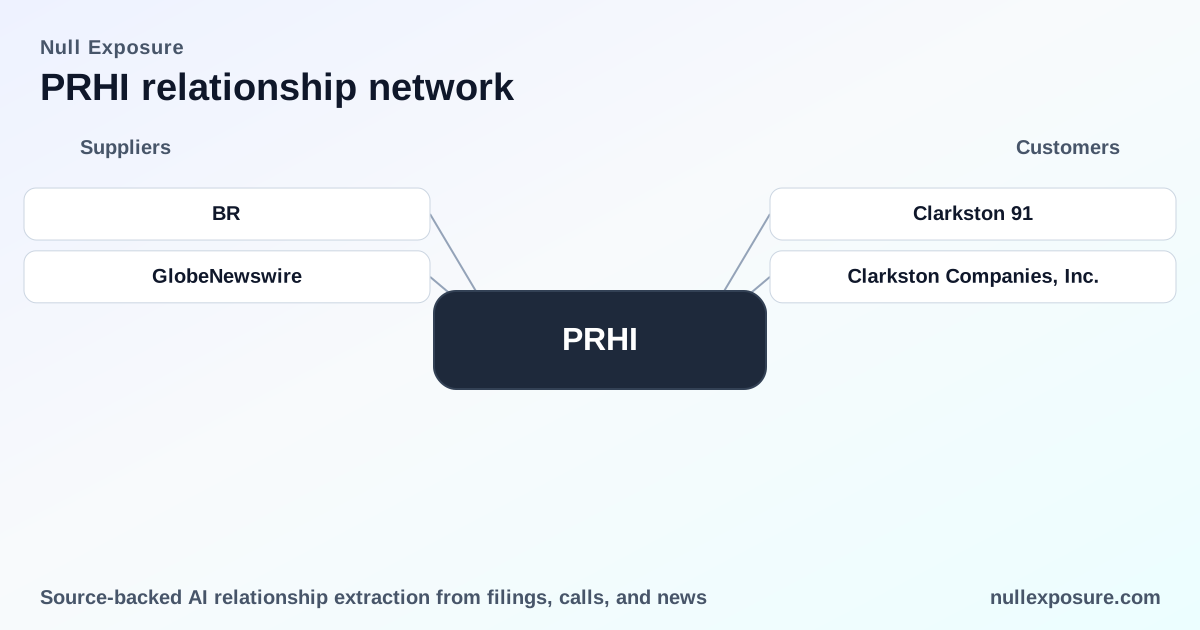
Clarkston 91 — A lawsuit filed in 2026 alleges breaches of fiduciary duty and violations of Michigan law tied to Presurance’s sale of Series B preferred stock and warrants to Clarkston 91 in February–March 2025, and the sale of Series C preferred stock to a Clarkston 91 affiliate in December 2025; this litigation places governance and disclosure practices squarely in the spotlight. According to The Globe and Mail coverage of the complaint (reported March 2026), the suit centers on the terms and conduct of those financing transactions. Source: The Globe and Mail, March 2026.
-
Clarkston Companies, Inc. — As the explicit backstop for Presurance’s 2026 rights offering, Clarkston Companies committed to purchase unsubscribed shares at $1.00 per share under a Rights Offering Backstop Agreement dated February 3, 2026; that backstop converted into actual cash when Clarkston purchased 9,715,360 shares as part of the closing and related assignments, delivering approximately $14 million of liquidity to Presurance. This is documented in company announcements and market reports describing the backstop commitment and the closing in early 2026. Source: Presurance press releases and Investing.com coverage, March–May 2026.
-
Clarkston Companies, Inc. (follow-up coverage) — Market summaries and corporate filings reiterate that the backstop was the decisive mechanism that allowed Presurance to secure the $14 million proceeds from the rights offering, with Clarkston executing its backstop purchase and related assignee activity at the contracted price. The completion of that financing round materially altered near-term cash availability and capital structure. Source: Quiver Quantitas press release coverage and company statements, March 2026.
What these relationships tell investors about operational constraints and risk
Taken together, the Clarkston financings and subsequent litigation reveal a set of structural constraints that define Presurance’s operating model:
- Capital dependence and counterparty concentration: The company relied on a single capital backstop to close a critical rights offering, creating near-term dependence on a concentrated investor/capital-provider relationship rather than a diversified financing base. This is a company-level signal; the public filings and media coverage document the backstop agreement and its execution in early 2026.
- Governance and related-party exposure: The litigation alleging fiduciary breaches tied to stock and warrant sales underscores governance friction when financing and corporate control intersect; this elevates legal and reputational risk that directly affects liquidity options and partner appetite.
- Revenue leverage to underwriting volume: Because the parent’s revenues are tied to a percentage of gross premiums written under intercompany service agreements, any sustained underwriting contraction in targeted states or segments compresses both fee revenue and the parent’s cash flow flexibility.
- Commercial customer profile: Targeting small and mid-market commercial accounts means retention and pricing power are key; economic stress in those customer cohorts will transmit to premium flows and service revenue.
Investment implications and near-term watchlist
Investors should prioritize three metrics over the next two quarters:
- Capital adequacy and debt/equity flexibility: Monitor cash amendments, any further capital commitments from Clarkston or alternate investors, and whether the company replaces one-off backstops with more diversified capital lines.
- Legal and governance developments: Track outcomes of the Clarkston 91 litigation and any SEC or state regulatory inquiries that could arise from related-party financings or disclosure practices.
- Premium growth and geographic exposure: Watch written premium trends in Texas, Michigan, Nevada, Oklahoma, Illinois and Indiana; a contraction there reduces parent fee revenue quickly given the percentage-based service fee model.
Bottom line: Presurance’s combination of fee-based parent revenue and concentrated capital backstops creates a binary operational profile — stable service revenue when underlying premiums grow, but acute funding and governance vulnerability when capital providers and legal challenges converge.
For subscribers and institutional users requiring relationship maps, timeline analysis, and ongoing alerts tied to these Clarkston interactions, visit https://nullexposure.com/ for structured monitoring and regulatory-tracking products.