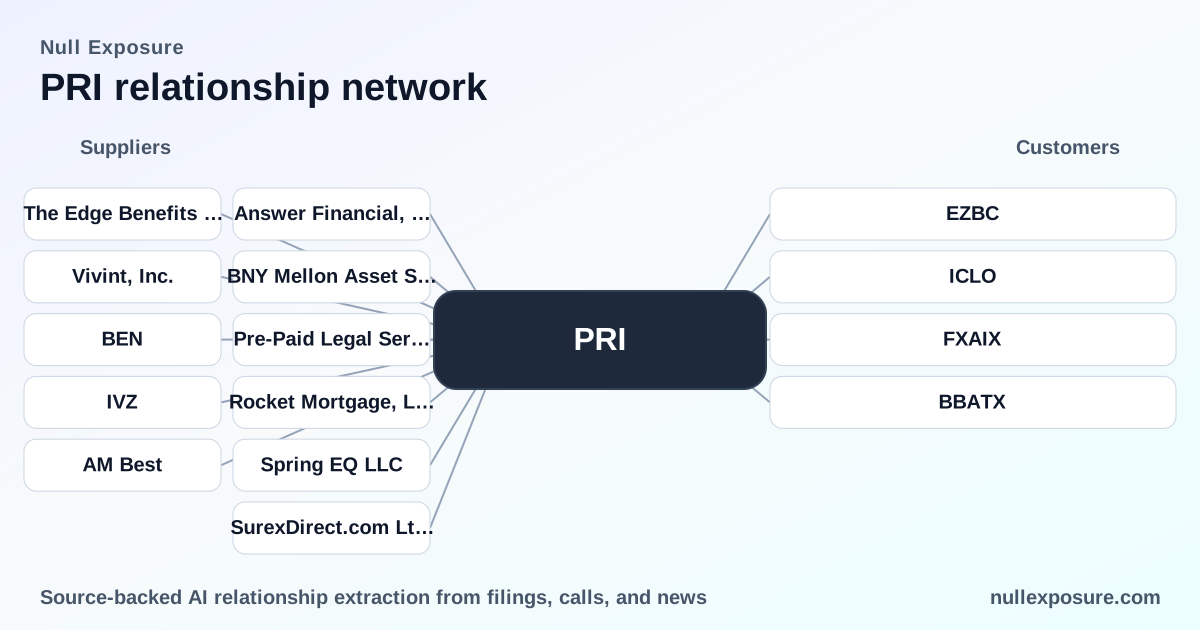
Primerica (PRI) — Customer Relationships and Distribution Risk Profile
Primerica markets life insurance, annuities and investment products to middle‑income households in the United States and Canada through an independent sales force, and it monetizes via point‑in‑time sales commissions, ongoing asset‑based distribution fees, and modest subscription fees for sales‑force support tools. Revenue is driven by three clear levers: transactional product sales, recurring asset‑based commissions, and subscription income from representatives. For a structured view of the customer relationships that underpin that model, see NullExposure’s signal hub: https://nullexposure.com/.
Concise operating thesis for investors
Primerica operates as a distribution and servicing platform: it underwrites term life insurance and acts as a principal distributor and service provider for third‑party mutual funds and annuities, while supporting an independent contractor sales force that pays small subscription fees for platform tools. The business captures upfront economics on product sales, captures ongoing asset‑based revenue from client assets, and collects ancillary fees for transfer agent and custodial services. This mix produces a hybrid revenue profile with both discrete transaction sensitivity and recurring, asset‑linked flows.
How the commercial map translates into contracting posture and business characteristics
Primerica’s contracts are not uniform; the company recognizes three distinct revenue patterns that determine cash flow stability and risk:
- Spot/point‑in‑time sales: Commissions on trade date transactions produce immediate revenue recognition and correlate strongly with sales activity and the health of the independent sales force.
- Subscription: Monthly fees from representatives for access to POL (its sales‑force support tool) create a modest, predictable recurring revenue stream and align incentives to platform functionality.
- Usage / asset‑based commissions: Ongoing commissions from mutual fund and annuity providers are variable and recognized at the end of each reporting period, making them sensitive to asset valuations and client retention.
Company‑level signals also indicate distribution concentration and geographic focus: the business is primarily North American (United States and Canada) and services middle‑income households via a large but independent sales force. The firm operates simultaneously as seller, distributor and service provider, giving it multiple touchpoints to monetize client relationships while also creating dependency on third‑party product partners.
Named relationships and what they mean for PRI investors
HUIZ — Product launch partner on retirement solutions
In HUIZ’s 2025 Q2 earnings call, HUIZ described a recent launch “with Bosun Primerica” applied to annuities and retirement products, indicating a co‑development or distribution arrangement on retirement solutions. This reference signals active third‑party product collaboration in annuities and retirement offerings (HUIZ 2025 Q2 earnings call, referenced March 2026).
EZBC — referenced in Primerica’s mutual fund sales disclosure
EZBC appears in the same FY2024 disclosure that details mutual fund distribution concentration; the Form 10‑K discussion lists several fund providers in describing mutual fund sales concentration and distribution practices. The filing treats mutual fund companies as commercial partners whose products drive a large share of distributed assets (Primerica Form 10‑K, FY2024).
Franklin Templeton — one of the dominant mutual fund partners
According to Primerica’s FY2024 Form 10‑K, Franklin Templeton is cited among the mutual fund firms that collectively accounted for approximately 98% of Primerica’s mutual fund sales in the United States during 2024, demonstrating outsized concentration toward a small set of fund providers (Primerica Form 10‑K, FY2024).
Invesco — major mutual fund distribution source
Primerica’s FY2024 filing names Invesco as one of the handful of asset managers whose funds accounted for the bulk of mutual fund sales in the United States, underscoring significant reliance on a few third‑party product suppliers (Primerica Form 10‑K, FY2024).
Fidelity — core provider of mutual fund inventory
Fidelity is listed in the FY2024 Form 10‑K among the four fund families that together accounted for roughly 98% of U.S. mutual fund sales, highlighting a concentrated product supply relationship that drives a meaningful portion of distribution revenue (Primerica Form 10‑K, FY2024).
American Funds — another concentration point in mutual fund sales
American Funds is similarly cited in Primerica’s FY2024 disclosure as part of the small group of fund managers responsible for the overwhelming majority of mutual fund sales, reinforcing the company’s concentration risk around a few product partners (Primerica Form 10‑K, FY2024).
(For a compiled view of these signals and how they rank across disclosure sources, NullExposure maintains a live index of relationship evidence: https://nullexposure.com/.)
Key constraints and what they signal about operational risk
Primerica’s SEC filing and related disclosures enumerate several relationship and revenue constraints that speak directly to investor risk and durability:
- Contracting posture: Revenue recognition mixes point‑in‑time and over‑time models. Sales commissions are recognized at trade date; POL subscription revenue is recognized monthly over the subscription period; asset‑based commissions are recognized at period end when amounts become known. This combination creates both near‑term sensitivity to sales activity and predictable small recurring subscription revenue.
- Concentration: Mutual fund distribution is highly concentrated: the FY2024 narrative says Franklin Templeton, Invesco, American Funds and Fidelity collectively accounted for ~98% of U.S. mutual fund sales, creating product‑supply concentration risk that could affect distribution economics if any partner alters terms or product availability.
- Counterparty mix and criticality: The company’s primary counterparty group is individual middle‑income households served via a sizable independent sales force; at the same time, Primerica’s role as distributor and service provider to mutual fund and annuity issuers makes those fund partners critical commercial relationships.
- Geographic concentration and scale: Revenue is concentrated in North America—United States and Canada—where the company reported the bulk of revenues and maintained over 151,000 life insurance‑licensed representatives as of year‑end 2024, underlining operational scale but limited geographic diversification.
- Relationship maturity and status: Disclosures describe the relationships as active with significant client scale—over 5.5 million insured lives and roughly 3.0 million client investment accounts at December 31, 2024—indicating mature, ongoing commercial activity.
Investment implications — what investors and operators should watch
- Concentration risk is the single largest commercial exposure. The fact that a small set of fund families accounted for the bulk of mutual fund sales creates a lever that product partners hold over distribution economics and product availability. Monitor partner agreements, revenue share terms, and any public changes in fund platform carriage.
- Revenue resilience depends on assets under administration. Asset‑based commissions dilute short‑term volatility from transactional sales but tie revenue to market valuations and retention. Volatile markets depress asset‑based flows; rising rates and strong markets enhance recurring economics.
- Subscription and service fees provide architectural stability. POL subscriptions and transfer agent/custodial fees are small but strategic recurring items that reduce pure transaction exposure and deepen representative stickiness.
- Operationally, the independent sales force is both an asset and a control risk. Representative recruitment, retention and productivity drive sales volume; any prolonged decline in sales force activity will translate quickly into reduced point‑in‑time commissions.
Bottom line
Primerica is a distribution‑first financial services company with a clear revenue mix: transactional commissions, asset‑based recurring fees, and modest subscription income. The company’s scale and concentrated mutual fund relationships create both efficiency and single‑point commercial risk that investors should monitor closely. For deeper signal comparisons and to track relationship changes over time, visit NullExposure: https://nullexposure.com/.