Priority Income Fund (PRIF-P-I): Distributor Dispute Highlights Distribution Risk for Preferred Holders
Priority Income Fund’s preferred series trades under the PRIF-P-I ticker and is monetized through the fund’s investment income and capital structure that funnels cash to preferred shareholders as fixed distributions; the fund’s economics therefore depend on portfolio performance and uninterrupted distribution flows, and its investor outcomes are sensitive to distribution partners, suitability practices, and reputational shocks. For holders and operators, the near-term lens is legal and distribution risk rather than portfolio alpha. For a concise briefing on how we source relationship intelligence, see NullExposure’s coverage at https://nullexposure.com/.
One distributor dispute, clear operational signal
A recent PR Newswire release reported that Shepherd Smith Edwards filed a seven-figure FINRA arbitration claim against United Planners' Financial Services of America alleging the unsuitable sale of the Priority Income Fund to a retired couple. The claim was publicized on March 10, 2026 and identifies the distributor relationship as a locus of investor dissatisfaction and litigation risk. According to the March 2026 PR Newswire release, the arbitration centers on sales practices tied to the Priority Income Fund and implicates United Planners as the selling broker-dealer.
What this relationship entry says for investors
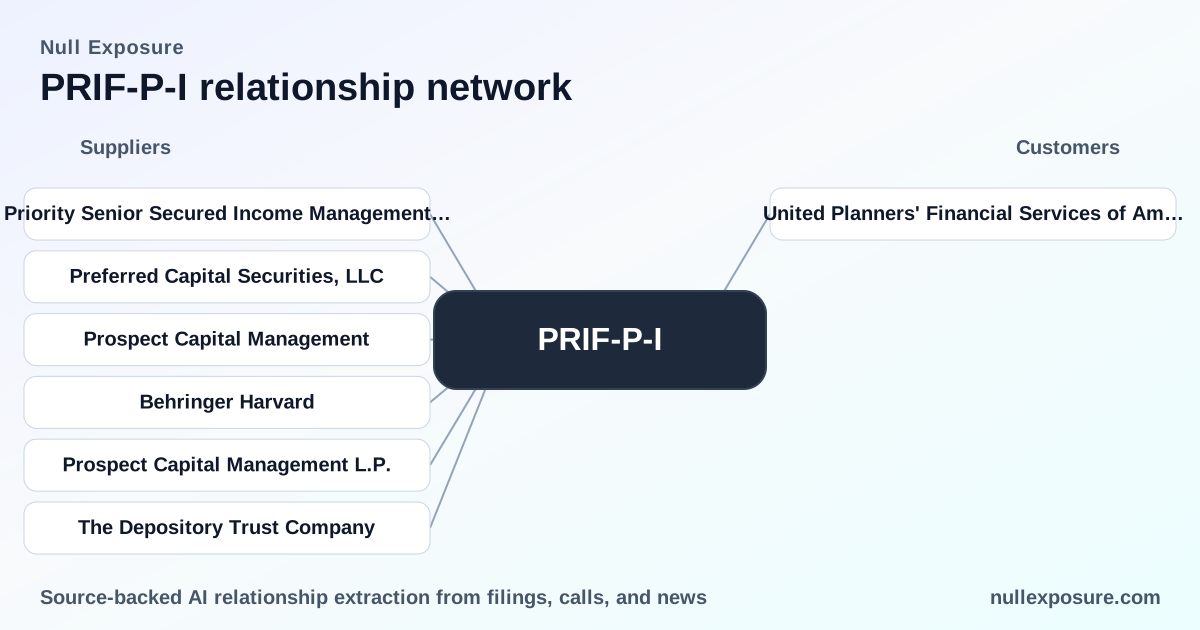
United Planners’ Financial Services of America is the sole relationship surfaced in the customer sweep for PRIF-P-I. The filing by Shepherd Smith Edwards alleges unsuitable sales of the Priority Income Fund to retirement-age clients, a claim that directly challenges distribution compliance and suitability controls for third-party sellers. The source is a March 10, 2026 PR Newswire advisory summarizing the FINRA arbitration filing.
- United Planners’ role: broker-dealer/distributor for the fund, implicated in a suitability arbitration (PR Newswire, March 2026).
- Claimant: Shepherd Smith Edwards, pursuing a seven-figure arbitration centered on the Priority Income Fund’s sale to retirees (PR Newswire, March 2026).
Together these facts create a concrete, observable link between PRIF-P-I’s market access channels and a compliance dispute now in arbitration.
Why this single dispute matters to preferred shareholders
This is not a portfolio-return story; it is a distribution and governance story. Preferred holders depend on steady distributions paid from fund income and cash management; disruption in distribution channels or large settlement liabilities can have direct and indirect consequences:
- Direct financial impact: a settlement or judgment can prompt reserve-taking, reduce distributable cash, or shift capital allocation discussions at the fund level.
- Indirect operational impact: repeated or high‑profile sales-practice claims erode intermediary confidence and can constrict new flows if broker-dealers limit or adjust shelf placement.
- Reputational effect: disputes that involve retirement investors receive disproportionate regulatory and media attention, increasing the probability of further scrutiny.
These mechanics reflect the fund’s business model drivers: revenue conversion from invested assets to paid distributions, and reliance on third-party intermediaries for retail flows.
Operating model and business-model characteristics to track
No explicit constraints were returned in the relationship metadata; the following are company-level signals that investors should treat as part of the operating-risk framework for funds with preferred shares like PRIF-P-I:
- Contracting posture: Retail distribution through independent broker-dealers and advisory networks. That contracting posture creates a chain of accountability where the fund depends on counterparties’ suitability and supervisory practices.
- Concentration sensitivity: Distribution concentration is a material governance lens—a handful of active sellers can materially influence net flows and reputational exposure.
- Criticality of relationships: Distributor relationships are mission-critical for retail liquidity and new investor acquisition; disputes with significant sellers escalate into earnings and distribution risks.
- Maturity and structural complexity: A preferred share series implies a legacy capital structure that ties fixed cash obligations to asset performance and cash management decisions, amplifying the impact of operational shocks.
These signals are company-level and reflect how fund-level disputes translate into financial and governance risk for preferred holders.
Practical monitoring checklist for investors and operators
Investors and operators should monitor the following items closely and proactively:
- FINRA arbitration developments and any settlement announcements tied to the United Planners matter (source: PR Newswire, March 2026).
- Fund balance sheet disclosures and notes that could reveal litigation reserves or changes in distribution policy in subsequent filings.
- Sales-practice communications to intermediary partners and any change in shelf access or wholesaler deployment.
- Frequency and distribution of similar claims—one dispute can be isolated, but clustering indicates systemic distribution failures.
- Dividend declaration cadence and commentary from fund management about potential impacts from legal or reputational events.
Bottom line and recommended next steps
The PR Newswire disclosure of a seven-figure FINRA arbitration involving United Planners and the Priority Income Fund is a focused but meaningful operational red flag for PRIF-P-I holders. This is a distribution-channel compliance issue that can translate into financial and reputational consequences for the fund and its preferred series. Investors should prioritize monitoring arbitration outcomes, subsequent fund disclosures, and any changes in distributor behavior.
For a fuller read on how third-party distributor disputes alter fund risk profiles and how to integrate that into investor due diligence, review NullExposure’s broader coverage at https://nullexposure.com/.
By treating distributor litigation as an operational risk vector rather than a peripheral event, investors and operators preserve optionality: manage exposures, press for transparent disclosure, and recalibrate assumptions about distribution continuity and capital allocation.