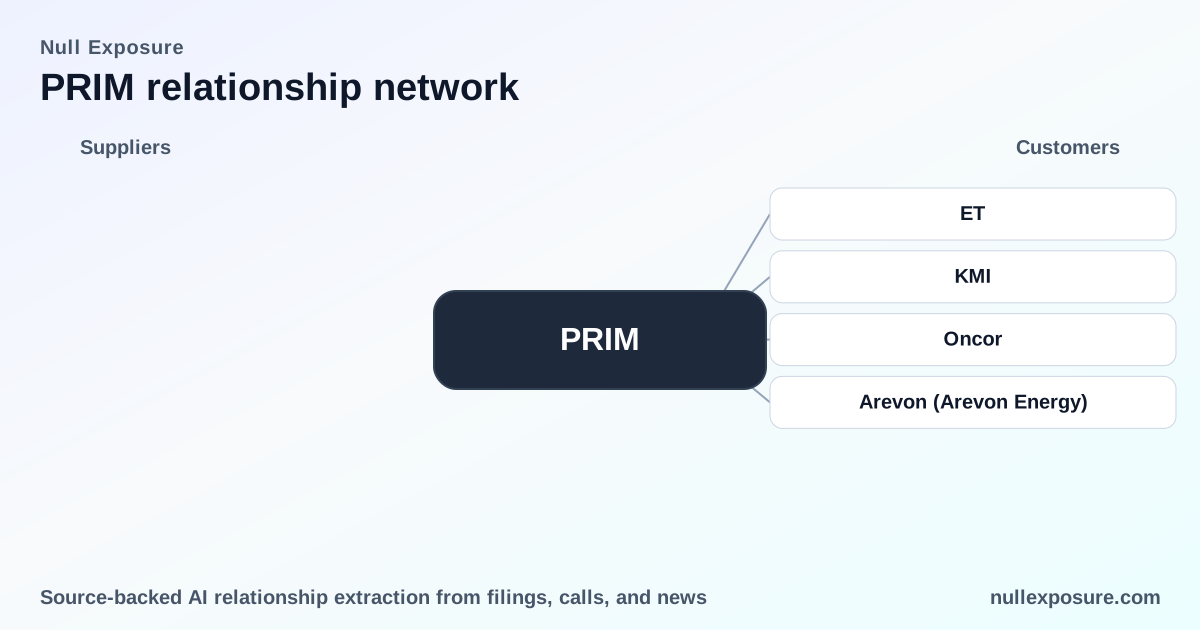
Primoris Services (PRIM): Customer Relationships Drive Recurring Infrastructure Revenue
Primoris Services Corporation is a specialty infrastructure contractor that monetizes through construction, maintenance, fabrication and engineering contracts across utilities and energy sectors in the United States and Canada. Revenue comes from a mix of multi‑year master service agreements (MSAs) and shorter project work—creating a hybrid cashflow profile: predictable backlog from renewals and MSAs, with episodic upside from discrete projects. Learn more about how this customer intelligence is assembled at https://nullexposure.com/.
What the customer footprint reveals about how Primoris operates
Primoris is a service provider to large utilities, midstream energy companies and renewable project owners. The company runs a dual contracting posture: MSAs underpin recurring revenue and relationship renewals, while a high volume of short‑duration projects drives variability and project‑level margin opportunities. Primoris’ public disclosures show that MSAs accounted for roughly 36.8% of revenue in 2024, and the company’s top ten customers generated about 41.3% of total revenue in 2024—a meaningful concentration that both stabilizes revenue when relationships renew and exposes the firm to customer‑specific execution risk.
Company filings describe a broad counterparty set that includes governmental agencies and large enterprise utilities and energy firms, and note that most activity is North American, with Canada as the principal international market. Contract lengths range from daily work orders up to 36 months and occasionally longer for major projects, reinforcing the hybrid long‑/short‑term mix. Primoris frames its relationships as mature and frequently renewing, particularly in gas, electric distribution and communications segments, which supports a high renewal rate for MSAs.
Customer map: specific relationships identified in available reporting
Below are the customer mentions surfaced in news sources and public reporting. Each entry contains a concise, plain‑English description and the cited source.
-
Energy Transfer (ET)
Primoris is listed among “most of the energy industry’s major players” served by the company, with Energy Transfer cited as a named customer in regional reporting. (Dallas News, December 2019: https://www.dallasnews.com/business/local-companies/2019/12/12/dallas-specialty-construction-firm-buys-back-50-million-in-shares-from-former-ceo/) -
ET (ticker ET)
The same Dallas News piece reiterates ET as part of Primoris’s customer roster, underscoring Primoris’s exposure to large midstream operators. (Dallas News, December 2019: https://www.dallasnews.com/business/local-companies/2019/12/12/dallas-specialty-construction-firm-buys-back-50-million-in-shares-from-former-ceo/) -
Kinder Morgan (KMI)
Houston‑based Kinder Morgan is named alongside other major energy companies as a customer, indicating Primoris’s participation in large midstream and pipeline projects. (Dallas News, December 2019: https://www.dallasnews.com/business/local-companies/2019/12/12/dallas-specialty-construction-firm-buys-back-50-million-in-shares-from-former-ceo/) -
Oncor
Oncor, a major regional utility based in Dallas, is identified in the same report as a customer, reflecting Primoris’s utility workstream and municipal/regulatory exposure. (Dallas News, December 2019: https://www.dallasnews.com/business/local-companies/2019/12/12/dallas-specialty-construction-firm-buys-back-50-million-in-shares-from-former-ceo/) -
Arevon (Arevon Energy)
Primoris was contracted to build a solar facility that Arevon will own and operate, with the first phase scheduled to be operational in late 2025—illustrating Primoris’s role in renewable infrastructure construction. (TheCooldown, coverage of Kelso solar project, 2025: https://www.thecooldown.com/green-business/kelso-solar-project-missouri-solar-power/)
What these relationships imply for financial and operational risk
-
Concentration risk is real but structured: Top‑ten customers contributing ~41% of revenue is material; however, the business model is structured to retain clients via MSAs. The company’s disclosure that substantially all gas and electric distribution customers historically renew MSAs points to durable revenue from incumbent clients, but loss of any single top customer could be consequential to margins and utilization.
-
Contracting mix supports both stability and episodic growth: The coexistence of MSAs (multi‑year) and short projects (daily to ~36 months) creates a stable base with opportunistic upside, but it also imposes execution complexity across many concurrent engagements.
-
Counterparty quality and criticality: Work with large enterprise energy and utility customers and governmental agencies increases the stickiness of relationships—these counterparties have high switching costs and regulatory requirements that favor established contractors. That said, dependence on a concentrated set of large customers increases counterparty credit and negotiation leverage risk.
-
Geographic concentration informs cyclical exposure: Primoris operates primarily in the U.S. and Canada; North America accounts for the vast majority of revenue, so macro and regulatory cycles in these markets will disproportionately affect the business.
Investment implications and valuation context
Primoris currently trades with a market capitalization and trailing metrics that reflect premium valuation assumptions for durable infrastructure exposure: market cap ~ $10.06B, EV/EBITDA ~ 20.2, trailing P/E ~ 36 (company snapshot). Those multiples imply investors are paying for steady MSAs, execution capabilities on large energy and utility projects, and growth in renewables construction. At the same time, profit margin is modest (operating margin ~4.17%; net margin ~3.63%), which means any margin compression from project overruns or customer churn would quickly pressure earnings.
Analyst coverage leans favorable (consensus target price and a plurality of Buy/Strong Buy ratings), supporting the view that the market expects continued contract renewals and successful integration of renewable project work.
Actionable takeaways for investors and operators
-
For investors: Primoris offers a hybrid of recurring and project revenue tied to utility and energy capital spending—investor returns depend on retention of top customers and discipline on project execution. Monitor MSAs renewal cadence, backlog composition, and any shifts in percentage of revenue coming from the top ten customers.
-
For operators/partners: The company’s track record of renewals and multi‑year MSAs makes Primoris a reliable counterparty for long‑term infrastructure programs; however, counterparties should conduct rigorous performance and safety due diligence on project delivery.
Explore deeper customer intelligence and contract signals at https://nullexposure.com/ for detailed relationship analytics and to track evolving counterparty exposure.
Primoris’s customer base—anchored by large utilities, midstream energy firms and renewable developers—creates a balanced mix of stability and growth; investors should weigh the predictable MSA revenue against concentration and execution risk when valuing PRIM.