Prelude Therapeutics (PRLD): Partnerships, Option Deals and What They Mean for Investors
Prelude Therapeutics is a precision oncology small‑molecule developer that monetizes principally through licensing, option arrangements and collaborative agreements that convert R&D into near‑term non‑dilutive cash and equity. The company advances select programs through early clinical milestones and then outsources late‑stage risk to partners via exclusive options, equity investments and sublicensable licenses—generating upfront payments, license fees and milestone potential while concentrating program risk across external collaborators. Investors should value Prelude as a catalytic IP engine whose near‑term cash profile is driven by partner option deals and select licensing revenues rather than product sales.
Explore more on our platform: Null Exposure.
How Prelude’s commercial model translates to cash flow
Prelude operates as a research‑stage biotech that deliberately structures programs for third‑party monetization. The company captures value by (1) discovering/developing differentiated small molecules, (2) granting exclusive or sublicensable licenses and (3) negotiating option transactions that include upfront cash and equity from larger biopharma partners. This operating posture creates low near‑term revenue concentration around a handful of partner transactions and high optionality on clinical advancement paid for by collaborators.
From a governance and capital perspective, Prelude shows typical biotech characteristics: institutional holders control a majority stake (about 61%), insiders remain meaningful stakeholders (~13.8%), and the firm intermittently raises equity with participation from dedicated healthcare investors rather than recurring product revenue. These factors underpin Prelude’s contracting strategy—prioritize marquee option/licensing agreements that de‑risk development and extend cash runway.
What the company‑level signals tell investors
- Licensing and licensor posture exist within Prelude’s model: company filings and public disclosures confirm Prelude actively licenses assets and acts as the licensor on select programs.
- Revenue is episodic and partner‑driven: the company recorded $7.0 million of recognized revenue tied to identified performance obligations in the year ended December 31, 2024, reflecting the episodic nature of partner payments rather than recurring commercial sales (FY2024 10‑K).
- Concentration and maturity: Prelude’s cash profile is heavily influenced by isolated transactions (option upfronts and equity investments) rather than diversified product revenue, signaling early‑stage maturity with partner monetization as the primary revenue lever.
Partnerships that move the needle (relationship-by-relationship)
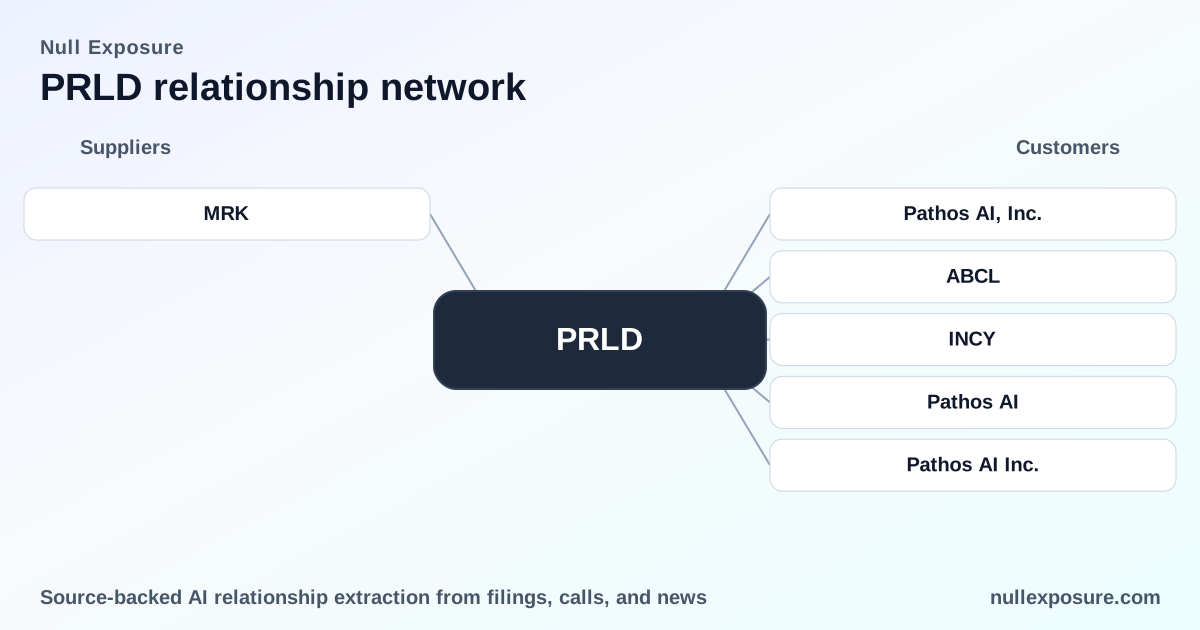
Pathos AI, Inc. — a licensed brain‑penetrant PRMT5 asset
Prelude granted Pathos AI an exclusive, sublicensable, worldwide license to PRT811, a selective, brain‑penetrant PRMT5 inhibitor in May 2024, positioning Pathos to advance the program in clinical development. This transaction is disclosed in Prelude’s FY2024 10‑K and represents a strategic out‑license of a CNS‑focused asset. (Source: Prelude FY2024 10‑K filing)
- Operating signal: This transaction is explicitly documented as a license where Prelude is the licensor, confirming the company’s active licensing posture. (Source: Prelude FY2024 10‑K)
Pathos AI (news coverage) — program advancement and trial plans
Independent reporting noted that Pathos identified launching a trial of P‑500 (licensed from Prelude) as a key priority while raising growth capital, underscoring the commercial logic of Prelude’s sublicensable license model. (Source: Fierce Biotech coverage of Pathos reporting, 2025)
Incyte Corporation (INCY) — an exclusive option that converted to non‑dilutive capital
Prelude executed an exclusive option arrangement with Incyte for the mutant‑selective JAK2V617F program that generated $60 million in upfront consideration, structured as a $35 million cash payment plus a $25 million equity investment at $4/share, in addition to downstream milestones and potential royalties. This transaction both funded Prelude and transferred late‑stage risk to a larger oncology partner. (Sources: Prelude corporate update Nov 4, 2025; Fierce Biotech reporting; GlobeNewswire and TradingView summaries, late 2025–early 2026)
- Commercial impact: The Incyte option materially strengthens Prelude’s near‑term liquidity and validates the company’s strategy of extracting value via time‑limited exclusive options.
AbCellera Biologics (ABCL) — expanded DAC collaboration and license receipts
Prelude amended and expanded its DAC (degrader‑antibody conjugate) collaboration with AbCellera, allowing AbCellera to use Prelude’s degrader payloads across additional antibody targets while enabling Prelude to license those payloads to other partners. Prelude also reported additional license payments from the expanded collaboration in October 2025. (Source: Prelude full‑year 2025 results and corporate updates, GlobeNewswire)
- Strategic read‑through: The AbCellera expansion diversifies Prelude’s partner map for its payload chemistry and creates multiple commercialization pathways for degrader payloads.
RA Capital Management — lead investor in equity offering
RA Capital Management led Prelude’s underwritten equity offering announced April 20, 2026, participating as a new investor in a transaction that raised material capital for the company. RA Capital’s lead role signals institutional endorsement and improves market access for future financings. (Source: GlobeNewswire press release, April 20, 2026; Investing.com coverage)
Soleus Capital — participating investor in the offering
Soleus Capital participated alongside RA Capital in the April 2026 equity offering, reinforcing demand among healthcare‑focused investors for Prelude’s option/licensing strategy and near‑term program value. (Source: GlobeNewswire press release, April 20, 2026; Investing.com coverage)
Why these relationships matter to valuation and risk
- Catalytic financing: Option and license transactions with Incyte and AbCellera deliver discrete uplifts to cash and validation to Prelude’s platform, enabling continued early‑stage development without immediate reliance on dilutive equity.
- Revenue concentrated and episodic: The FY2024 recognized revenue of $7.0 million illustrates how Prelude’s income is transaction‑driven; investors must model future cash flows around partner option timing and milestone delivery. (Source: Prelude FY2024 10‑K)
- Partner dependency and de‑risking: A strategy that outsources late‑stage risk to partners lowers capital intensity for Prelude but creates execution dependence on collaborator decisions and option exercise timing—an intentional tradeoff in Prelude’s commercial design.
Investment implications and next steps
- Positive read: Recent partner option proceeds and the RA Capital–led equity raise materially extend runway and validate Prelude’s licensing model; AbCellera and Incyte are the immediate commercial levers.
- Watch points: Monitor timing on Incyte option decisions and AbCellera payload licensing velocity; these milestones drive the cadence of revenue recognition and potential upstream valuation re‑rating.
For a deeper look at counterparties and continuous relationship monitoring, visit Null Exposure — our investor portal tracks partner transactions, filings and market signals relevant to early‑stage biotech investments.