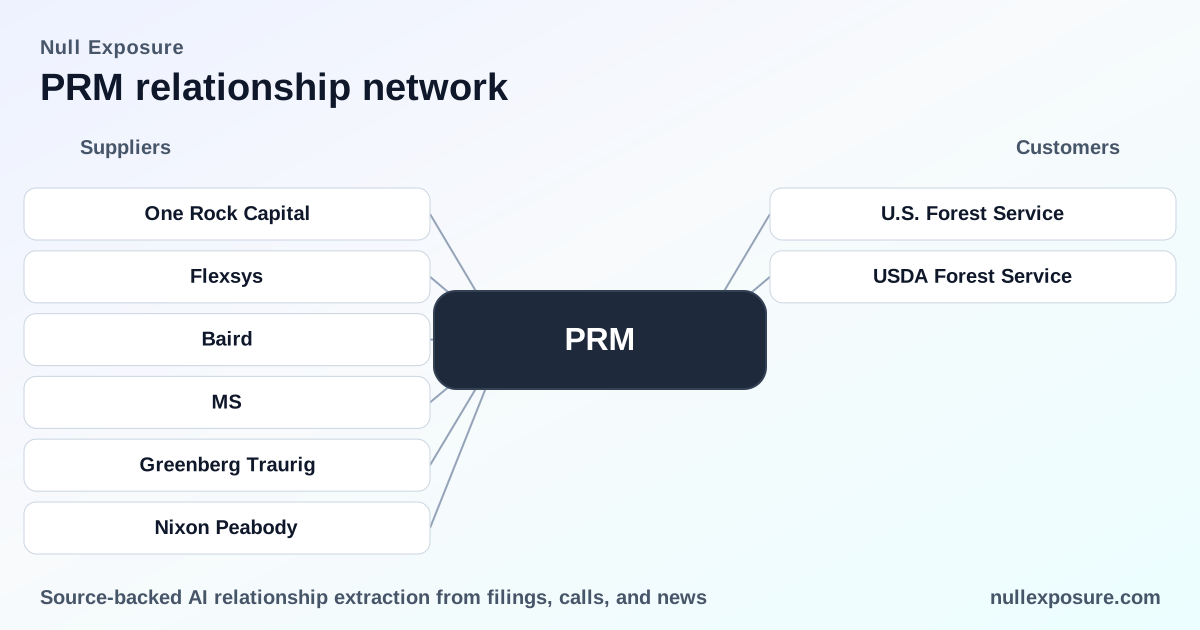
Perimeter Solutions (PRM): The government backbone to a concentrated fire‑retardant franchise
Perimeter Solutions monetizes a defensible niche: formulation, manufacturing and logistics for aerial and ground fire‑retardants and related firefighting chemistries sold principally to government agencies and industrial customers. The company converts market access—US qualification standards, a broad air‑base footprint and multi‑year supply contracts—into recurring revenue from large public customers while supplementing with spot and commercial sales; upside depends on demand volatility from wildfire seasons, contract pricing cadence and operational leverage. For investors evaluating customer risk, PRM’s relationship with U.S. government agencies is the single most consequential commercial dynamic for valuation and cash‑flow stability.
Discover the full customer intelligence offering at https://nullexposure.com/ for a consolidated view of relationship signals and source documents.
How PRM contracts and customers shape the business
PRM operates with a hybrid contracting posture that combines anchor long‑term government contracts with a parallel flow of on‑demand spot business. Company disclosures identify both contract types: certain agreements are explicitly long‑term with designated air tanker bases (including the U.S. Forest Service), while other engagements are strictly as‑needed and carry no guaranteed minimums. This structure produces two characteristics important to investors:
- Concentration and criticality: Government customers dominate revenue: in 2024, two customers—the USDA Forest Service and the U.S. Bureau of Land Management—represented 34% and 11% of consolidated revenues, respectively. That concentration creates both revenue visibility when contracts are active and single‑counterparty risk if procurement shifts.
- Regional exposure: Approximately 79% of revenues are U.S. derived, with Canada and Europe trailing; the business is effectively North America‑centric for revenue and regulatory exposure.
Operationally, PRM functions as a seller and manufacturer with active service footprints at more than 50 U.S. and Canadian air bases and equipment at over 100 bases globally, demonstrating executional capability beyond a simple supplier relationship. Spend scale is meaningful: fire safety customers collectively account for >$100m of net sales. These are company‑level signals drawn from public filings and investor commentary.
Relationship roll call — what the market has reported
Below are every customer relationship captured in the open records and news flow, each with a concise, plain‑English take and a source note.
-
U.S. Forest Service (earnings call, 2025 Q4): Management confirmed renewal of substantially all key retardant contracts over the prior two years, culminating in a cornerstone five‑year U.S. Forest Service contract, indicating a secured primary channel for aerial retardant supply. (Q4 2025 earnings call, March 2026)
-
U.S. Department of Agriculture (SimplyWallSt summary, FY2026): Press coverage noted Perimeter served as the sole aerial fire‑retardant supplier under a new five‑year USDA agreement while reporting FY2025 sales of US$652.9m and a larger net loss for the year. (SimplyWallStreet, May 2026)
-
USDA Forest Service (NewsfileCorp site visit, FY2025): A company release highlighted the Pasco, WA facility producing PHOS‑CHEK LCE20‑Fx that is shipped to air‑attack bases to support agencies including the USDA Forest Service, underscoring PRM’s manufacturing role for government operations. (NewsfileCorp press release, March 2026)
-
U.S. Department of Agriculture (SahmCapital analysis, FY2026): Independent commentary reiterated PRM’s sole supplier status under a five‑year USDA agreement, framing the deal as central to investor reaction to rising sales and deeper losses. (SahmCapital coverage, March 2026)
-
USDA/Forest Service (Investing.com recap of analyst views, FY2026): Analyst coverage (UBS) described the new USDA/Forest Service contract as reducing volatility and locking in post‑2026 price increases, yet expected the agreement’s net impact on 2026 earnings to be roughly neutral. (Investing.com summarizing UBS commentary, May 2026)
What the customer signals imply for operations and risk
Combine the relationship facts with the constraint signals and the operational profile becomes clear:
-
Contracting posture: PRM holds long‑term, anchor contracts with government buyers—explicitly named for the U.S. Forest Service—which secure base volumes and pricing negotiations over multi‑year horizons. Simultaneously, a meaningful portion of sales is delivered on a spot, as‑needed basis without minimum guarantees, exposing near‑term revenue to wildfire season variability. (Company filings and call excerpts)
-
Concentration and leverage: Revenue concentration to a handful of government buyers is material (34% and 11% shares for the two largest customers in 2024). That concentration produces strong negotiating leverage on the vendor side when the supplier is qualified and accepted, but also elevates counterparty risk if procurement practices change. (2024 annual disclosures)
-
Geographic and strategic footprint: The business is North America‑heavy (≈79% U.S.) but operates globally and invests in international expansion, positioning PRM as both a local manufacturer for U.S. agencies and a specialist exporter of qualified retardants. The company’s qualification to USDA/Forest Service standards is a barrier to entry that reinforces supplier criticality. (Annual report excerpts; site releases)
-
Commercial maturity and spend scale: Fire Safety is a core product segment with active, mature supply operations across many bases and customer spend in the $100m+ band, indicating institutional procurement cycles and high operational fixed costs that amplify cost‑structure sensitivity to volume swings.
Investor implications — upside and risks
- Upside: Long‑term government contracts, particularly the five‑year USDA/Forest Service agreement, stabilize baseline demand and create a platform for pricing resets and margin recovery over contract cycles. Qualification standards and an expansive logistics footprint create durable competitive barriers.
- Risks: Revenue and margin volatility stem from spot demand swings tied to wildfire seasons and inventory cycles; concentration to a few government accounts creates single‑counterparty exposure; recent results show operating losses and negative EBITDA, so operational execution and pricing recovery are required to convert sales into positive free cash flow. UBS’s analyst note summarized the tradeoff succinctly: the contract reduces volatility but delivers limited near‑term earnings upside for 2026. (Investing.com / UBS commentary, May 2026)
Final read: how to position on PRM’s customer thesis
For investors and operators focused on customer relationships, PRM is a supplier whose value rests on government qualifications, long‑term anchor contracts and the ability to convert episodic wildfire demand into stable, contracted volume. Monitor three metrics closely: contract renewal terms and price escalators for the USDA/USFS deals, seasonal demand and fill rates for spot business, and margin recovery tied to operating leverage. For a consolidated view of the customer evidence base and source documents, visit https://nullexposure.com/.
Key takeaway: PRM is strategically essential to U.S. wildland fire operations—this creates durable demand—but company valuation depends on translating that strategic position into consistent, profitable cash flows rather than revenue alone.