Prime Medicine (PRME): Customer relationships that move the valuation needle
Prime Medicine commercializes its proprietary prime-editing technology by partnering with large biopharma players on R&D and licensing deals and by advancing its own clinical programs; the company monetizes through upfronts, research funding, milestone payments and downstream royalties or shared economics on any co-developed products. Strategic collaborations—rather than product sales—are the primary revenue engine today, and these partnerships materially shape capital allocation, dilution risk, and upside potential for investors.
Explore more on NullExposure.
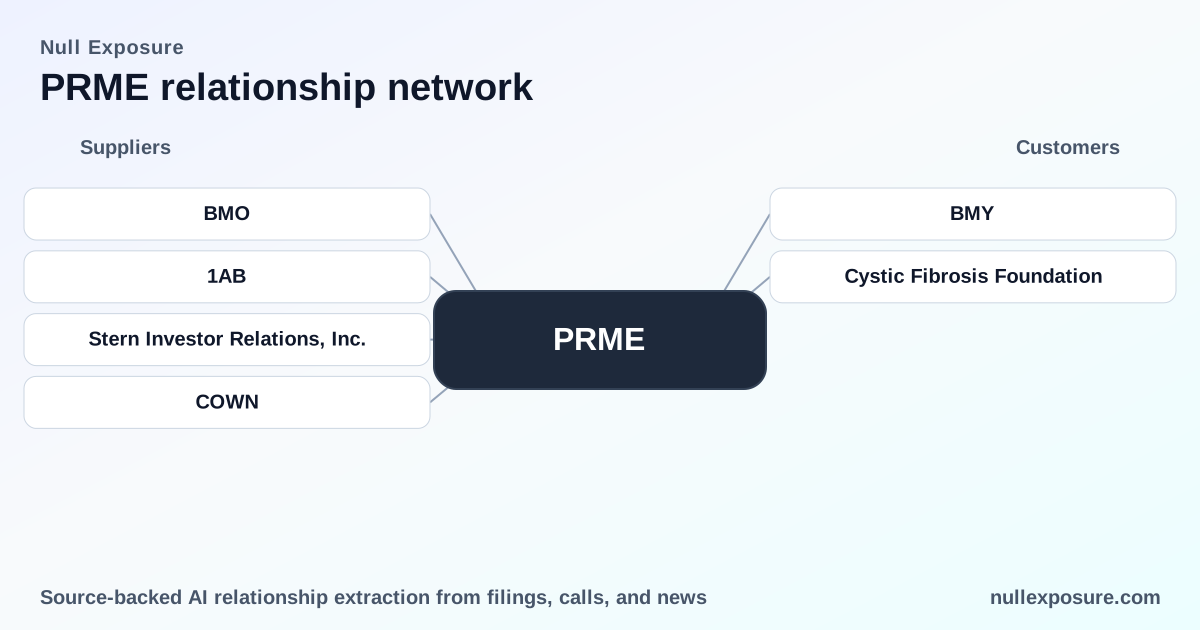
Bristol Myers Squibb: a marquee R&D partner that underwrites scale-up of ex vivo T‑cell work
Prime Medicine has a strategic research collaboration and license agreement with Bristol Myers Squibb to develop reagents and multiple prime-edited ex vivo T‑cell therapies for oncology and immunology. The partnership explicitly covers development and potential commercialization of multiple ex vivo T‑cell products and positions Prime to capture research funding, license fees and milestone/royalty upside tied to a large-cap payer. The collaboration’s structure and public reporting point to a classic biotech partnering model: R&D funding up front, staged milestones, and material downstream economics. Sources include Prime Medicine’s Sept. 30, 2024 press release to GlobeNewswire and follow-up coverage in MedCityNews and BiopharmaDive; media summaries in March–May 2026 also reference potential milestone pools in the multi‑billion dollar range. (GlobeNewswire press release, Sept. 30, 2024; MedCityNews report, Sept. 2024; BiopharmaDive, May 3, 2026; TradingView summary, Mar. 2026.)
Cystic Fibrosis Foundation: financial buyer in a public offering, not a therapeutic customer
The Cystic Fibrosis Foundation purchased shares of Prime Medicine in a public offering, acquiring 1,818,181 shares without underwriter discount or commission. This interaction is capital-market activity—strategic from a funding standpoint but not a commercialization or R&D partnership—signaling financial support from a disease-focused foundation rather than a customer relationship for therapeutics. The purchase was reported in the public offering notice and related news coverage in early 2026. (QuiverQuant reporting on the company’s offering, FY2025 disclosure, reported Mar. 2026.)
What the relationships together tell investors about Prime’s operating model
Prime’s observable customer landscape is concentrated, partnership-driven, and development-first. The company’s top external engagement (Bristol Myers Squibb) reflects a dependence on a relatively small number of large pharma collaborators to (1) validate technology platforms, (2) supply near‑term revenue through R&D funding and (3) unlock large milestone and royalty windows that drive long-term upside. The foundation share purchase is a financing event rather than a commercial contract.
- Contracting posture: Prime negotiates strategic research and license agreements rather than volume-based supply contracts; terms typically include research funding and layered milestone economics. This posture favors non‑dilutive or partially dilutive capital via partnership payments rather than immediate product revenues.
- Concentration: Customer/revenue concentration is high by design—few, deep partnerships drive funding and risk-sharing—so single-partner outcomes (trial success, exercise of options, or program termination) will disproportionately affect near- to mid-term cash flows.
- Criticality: External collaborators are critical to Prime’s go‑to-market and scale strategy. The Bristol Myers Squibb deal functions as a validation node and a potential commercial channel, elevating partner decisions to a firm-level risk/return driver.
- Maturity: The relationships and the company’s financial profile indicate early clinical/late‑preclinical maturity: limited product revenue, negative EBITDA, and R&D‑intensive operating leverage suggest Prime is still monetizing primarily through collaborations and financing events rather than product sales.
Valuation and risk implications investors should weigh
Prime’s economics are governed by the typical biopharma partnership playbook: upfronts and research payments improve near-term cash runway; milestones and royalties carry asymmetric upside but are binary in realization. Investor focus should be on three variables:
- Partner execution: Clinical progress and BMS’s decisions on program prioritization will influence milestone capture and future royalty streams. Press reports cite potential milestone pools that are large in aggregate—this materially upsides valuation if realized.
- Capital strategy: The Cystic Fibrosis Foundation’s share purchase underscores ongoing reliance on equity markets and strategic non‑dilutive supporters for funding; expect further capital raises if R&D spend escalates before material partner milestones are achieved.
- Concentration risk: With a small number of marquee collaborators, downside from a major partner deprioritizing a program is magnified; conversely, successful partner-driven advancement de‑risks multiple programs at once.
Key takeaway: Prime’s business is asymmetric—high downside from R&D and collaborator concentration, but significant upside via milestone‑linked economics with large pharma partners.
How to track relationship catalysts and what to monitor next
Investors should monitor a short list of high‑signal items tied to the documented relationships:
- Formal updates and option exercises from Bristol Myers Squibb (development decisions, program prioritization, and milestone triggers).
- Clinical readouts or IND filings related to ex vivo T‑cell programs that fall under the collaboration.
- Financing notices or foundation-led placements that affect dilution and runway.
- Any new partnership announcements that broaden the counterparty base and reduce concentration.
If you want an ongoing, relationship‑level view designed for investment workflows, NullExposure maps partner events and documents with an investor focus. Learn more at the NullExposure homepage: https://nullexposure.com/
Bottom line for investors
Prime Medicine is a platform biotech that monetizes primarily through strategic collaborations and financing events rather than product sales today. The Bristol Myers Squibb collaboration is the most consequential relationship on record and shapes both upside potential and execution risk; foundation participation in equity offerings supports the balance sheet but does not substitute for commercial traction. For investors, the tradeoff is clear: high partnership concentration and development risk in exchange for outsized milestone and royalty upside if the prime-editing platform translates into approved, partner‑deployed therapeutics.