PRPL: Who Buys Purple and Why the Wholesale Push Matters
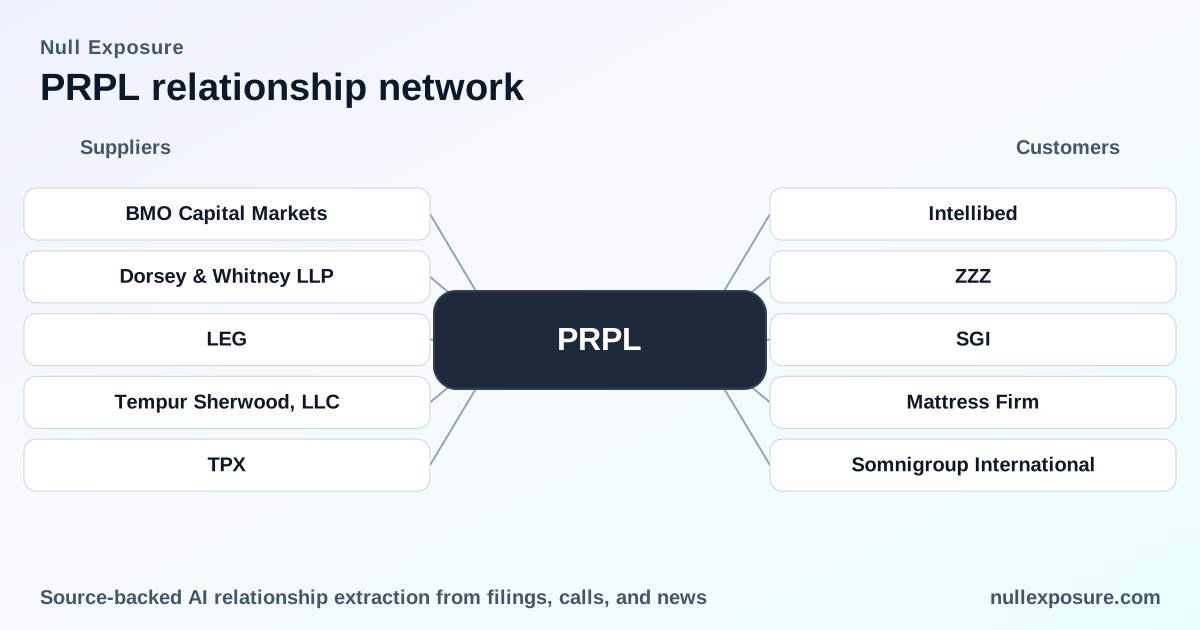
Purple Innovation designs and manufactures premium comfort products—mattresses, pillows, cushions and bedding—and monetizes through a mix of direct-to-consumer sales and expanding wholesale partnerships that place Purple SKUs in national chains and online marketplaces. Revenue growth over the last year is being driven by expanded wholesale placements (notably Mattress Firm and Costco) while e‑commerce softened, and that channel mix shift is central to revenue durability and margin recovery. For a concise view of Purple’s customer relationships and operating constraints, see https://nullexposure.com/.
How Purple runs the business and what investors should watch
Purple’s operating model combines a branded DTC engine (Purple.com, showrooms and call center) with a wholesale engine that sells into large retailers and online partners. The company is both a retailer-facing seller and a DTC seller, which creates a blended margin profile: higher gross margins on DTC and volume leverage from wholesale.
Key company-level operating signals:
- Long-term warranty exposure: Purple runs 10‑year mattress warranties and recognizes an increasing estimated warranty liability, which creates a long-dated cost profile that investors must model into lifetime unit economics.
- Significant individual customer concentration in receivables: One individual customer historically accounted for ~29% of accounts receivable at year-end 2024 and contributed materially to revenue in prior years, establishing a single-counterparty receivable concentration.
- North America centricity: Reported income and showroom footprint are essentially U.S.-centric, underscoring exposure to North American retail cycles and wholesale partners.
- Active, core product relationships: Relationships are current and tied to Purple’s core mattress and bedding lines—these are not one-off non-core programs.
For more granular relationship signals and sources, visit https://nullexposure.com/.
The customer map: every notable relationship and what it means for PRPL
Intellibed
Purple acquired Intellibed and consolidated intellectual property and manufacturing capabilities, which strengthens Purple’s control over gel‑based comfort technology and internal manufacturing scale. This was announced in a PR Newswire release covering the strategic consolidation (FY2022 disclosure referenced in March 2026 coverage).
Source: PR Newswire press release on the Intellibed acquisition (reported March 2026).
Somnigroup International (SGI)
Purple entered a materially expanded commercial agreement with Somnigroup (NYSE: SGI), under which Somnigroup will showcase Purple beds in its Mattress Firm stores and significantly expand placements; the company framed this as a major commercial expansion in FY2025. This is a strategic wholesale lift that scales distribution across a national footprint.
Source: Company announcement via PR Newswire and related FY2025 coverage.
Mattress Firm
Mattress Firm will increase Purple mattress slots from roughly 5,000 to a minimum of 12,000 slots nationwide, directly expanding retail shelf presence and wholesale revenue run‑rate; management highlighted the expanded Mattress Firm placement as a primary driver of wholesale growth in FY2026 commentary.
Source: PR Newswire and company FY2026 results commentary reported on Finviz and Seeking Alpha (Q4/FY2025 and Q1/FY2026 disclosures).
Costco
Costco programs are delivering continued momentum and contributed meaningfully to wholesale growth in the most recent reported quarters; management cited Costco alongside Mattress Firm as a primary wholesale growth contributor during FY2026 results commentary.
Source: FY2026 results commentary reported on Finviz and Seeking Alpha (Q4/FY2025 and Q1/FY2026 disclosures).
Walmart
Management lists Walmart among the “traditional and non‑traditional” partners impacting wholesale performance and future outlook, indicating that Walmart is part of Purple’s broader wholesale strategy even if specifics on placement were not disclosed in the same level of detail.
Source: Company Q1 2026 results press release and investor commentary (PR Newswire, FY2026).
Amazon
Purple products continue to be available through Amazon and other e‑commerce marketplaces, supporting DTC reach when combined with Purple.com and showrooms; consumer press coverage highlights Amazon as a standard online channel for Purple inventory.
Source: GoodHousekeeping mattress review coverage (FY2025 press coverage).
Wayfair
Wayfair operates as an additional online retail channel for Purple products, giving Purple presence in specialty home-furnishings e‑commerce alongside Amazon and the company’s own website. Consumer press referenced Wayfair listings in FY2025 coverage.
Source: GoodHousekeeping reporting on marketplace availability (FY2025).
Home Depot
Home Depot has listed Purple bedding products (for example, sheets) in retail promotions, indicating Purple’s penetration into home improvement retail assortments beyond mattresses. This expands non‑traditional wholesale exposure.
Source: GoodHousekeeping pricing/retailer coverage (FY2025).
What the relationships imply for growth, margins and risk
Purple’s recent results and relationship disclosures create a clear working thesis: wholesale scale is the lever for revenue and operating‑margin improvement, while DTC softness places more importance on retailer partnerships to deliver stable volume.
- Growth driver: expanded Mattress Firm and Costco placements drove sequential wholesale revenue growth in the latest reported periods (FY2026 commentary). Management frames premium SKUs (e.g., Purple Royale, Rejuvenate 2.0) as the products benefiting from these partner placements.
- Margin dynamics: Wholesale increases should generate fixed-cost absorption, improving operating efficiency; however, wholesale typically carries lower per‑unit gross margin than DTC, so margin recovery depends on mix and showroom profitability improvements.
- Concentration and credit risk: Accounts receivable concentration is a material company‑level risk, with one large individual customer historically representing a meaningful share of receivables and revenue in prior years—this amplifies counterparty credit and collection risk.
- Warranty tail and cost: The 10‑year mattress warranty represents a long-term liability that will grow as more units age into the warranty period, which constrains free cash flow unless mitigated by improved margins or pricing.
Source: Company filings and PR Newswire Q1/FY2026 results commentary; historical receivables figures noted in the company’s financial disclosures (evidence summarized in the company constraints).
Bottom line for investors
Purple is executing a deliberate pivot into wholesale scale to restore revenue growth and improve showroom economics. The Mattress Firm and Costco expansions are the most consequential customer relationships for near-term top‑line and operating leverage, while marketplace channels (Amazon, Wayfair) and non‑traditional retail (Home Depot, Walmart) provide breadth. However, warranty exposure and receivables concentration are material company-level constraints that require monitoring.
If you are evaluating Purple for investment or commercial partnership, prioritize tracking wholesale slot growth, wholesale vs DTC margin trends, and the company’s management of warranty liabilities and receivable concentration. For an aggregated view of Purple’s partner signals and the primary source links cited above, visit https://nullexposure.com/.