Precipio (PRPO): Distribution-led diagnostics with an outcomes-oriented revenue mix
Precipio operates a clinical-diagnostics and reagent business that monetizes through three clear channels: direct patient diagnostic testing performed in its CLIA laboratories, biomarker and clinical research services sold to biopharma sponsors, and product sales routed through major healthcare distributors. The company’s revenue base scaled to approximately $24.0M in unaudited FY2025, with a mix that includes a substantial government payor component (≈34%), placing Precipio squarely in the niche of oncology diagnostics with both recurring testing volumes and project-based research fees. For a concise company-level view, visit https://nullexposure.com/.
Distribution partnerships form the backbone of commercial reach
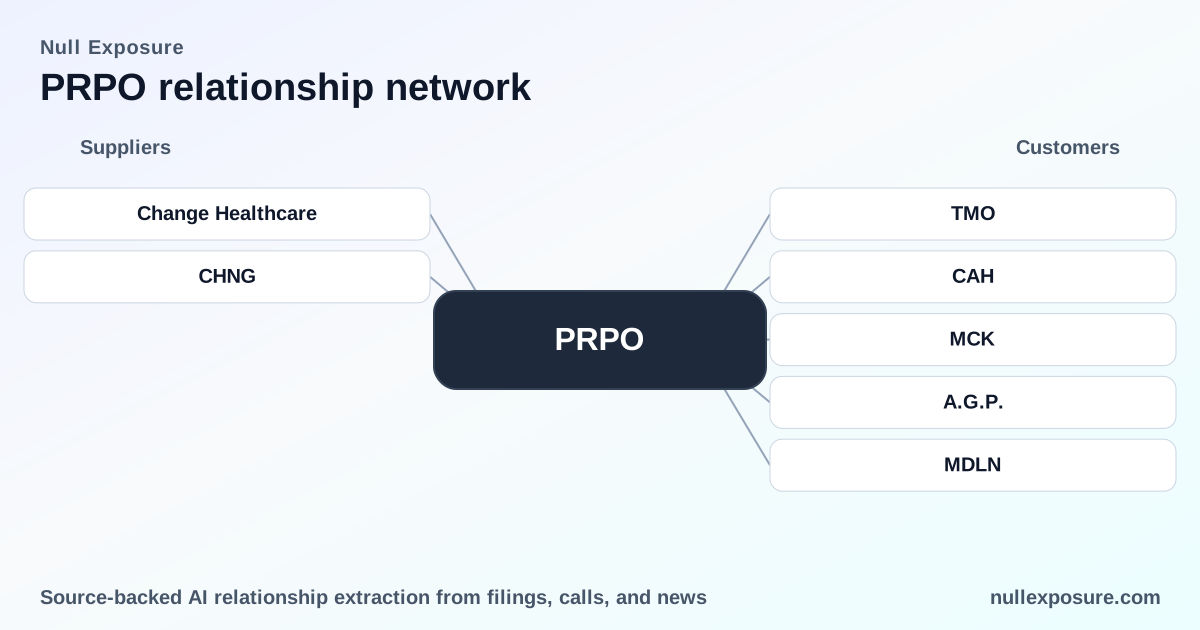
Precipio’s go-to-market is built on distribution agreements with industry incumbents that extend reach into hospital and laboratory channels. A FY2025 SEC filing summarized in market coverage lists ThermoFisher, McKesson, Medline, and Cardinal Health as strategic distribution partners that enable access to a broad set of laboratories nationwide. That distributor network is the principal mechanism by which Precipio scales its proprietary products alongside its direct testing services (TradingView coverage of the FY2025 10‑Q).
ThermoFisher (TMO)
Precipio launched HemeScreen in collaboration with ThermoFisher’s field organization, targeting a first‑year ThermoFisher revenue run‑rate of $10M when the product was introduced. CityBiz covered the HemeScreen launch and the assignment of sales leadership to manage that relationship in FY2022; the FY2025 SEC disclosure reiterates ThermoFisher as a named distribution partner (CityBiz, FY2022; TradingView summary of FY2025 10‑Q).
McKesson (MCK)
McKesson is listed in Precipio’s FY2025 filings as one of the national distributors supporting product placement into labs and hospitals, supplying the logistics and channel reach absent from a small-cap company’s direct sales effort (TradingView summary of FY2025 10‑Q).
Cardinal Health (CAH)
Cardinal Health is likewise named in the FY2025 commercial disclosures as a distribution partner that helps place Precipio reagents and kits into clinical laboratories across the U.S., amplifying adoption beyond direct laboratory customers (TradingView summary of FY2025 10‑Q).
Medline (MDLN)
Medline is included among the global healthcare distributors referenced in the FY2025 filing, supporting Precipio’s stated objective to commercialize proprietary products for the global laboratory community while expanding domestic lab penetration (TradingView summary of FY2025 10‑Q).
A.G.P.
Precipio terminated a sales agreement with A.G.P., as noted in a securities filing reported by MarketScreener; the termination was disclosed in connection with FY2026 filings and signals active reshaping of reseller relationships (MarketScreener, SEC filing referenced FY2026).
How the contracts and revenue mechanics shape financial predictability
Precipio’s commercial and contract profile produces a blend of revenue certainty and variability that investors should price explicitly:
- Contracting posture: The company operates predominantly under short‑term payment terms (30 days) and point‑in-time revenue recognition for patient lab testing, which produces immediate cash conversion but limits long-term revenue visibility. Evidence in filings emphasizes 30‑day payment terms and delivery-based recognition for lab reports.
- Revenue mix mechanics: Clinical research and biomarker services are recognized over time using an effort‑based method, translating into usage or project-based revenue streams that scale with client engagement intensity.
- Payor concentration and spend band: Approximately 34% of revenue derives from Medicare, Medicaid, or other government programs, providing a stable base but exposing the company to reimbursement policy risk; Medicare-related receipts are material at the $1M–$10M spend band shown in filings.
- Geographic footprint and operational maturity: Precipio operates CLIA‑certified labs in New Haven, CT and Omaha, NE, delivering national coverage for oncologists and signaling operational maturity of core lab assets.
- Role and criticality: The company functions as both seller and service provider—selling reagents through distributors while providing essential diagnostic services directly to clinicians, which elevates service criticality in oncology workflows.
- Relationship stage: Filings describe active commercial relationships and ongoing lab service delivery across more than 20 states, indicating established market participation rather than early-stage pilots.
These structural characteristics create a capital allocation profile where inventory and channel execution matter as much as direct lab volume growth; investors should value Precipio on a mix of recurring testing economics and project-driven research margins.
Operational implications for growth and risk
Precipio’s distributor strategy accelerates market access but also shifts margins and concentration risk:
- Upside: Partnerships with ThermoFisher and the other national distributors provide scalable sales channels and faster product uptake than an in‑house sales force could deliver, supporting product commercialization such as HemeScreen.
- Risk: Reliance on distributors introduces counterparty and execution risk (reseller terms, prioritization among many vendors) and creates potential lumpy revenue recognition. The termination of the A.G.P. agreement demonstrates active portfolio management of reseller relationships and the potential churn in that channel.
- Reimbursement exposure: With a meaningful government payor share, reimbursement policy and payment rates directly affect revenue and collections.
- Visibility: Short payment terms and point‑in‑time recognition translate to high cash conversion on sales but limited long‑term visibility, amplifying the importance of monthly volumes and pipeline disclosure.
Investment takeaways for operators and research teams
- Distribution-led scale is the core go-to-market lever. ThermoFisher, McKesson, Medline and Cardinal Health are named channel partners that expand reach into clinical labs (FY2025 10‑Q reporting).
- Revenue is a hybrid of recurring tests and project work. Patient diagnostics are recognized at delivery; clinical research is effort‑based and usage-sensitive (company filings).
- Government payors are material. Roughly one third of revenue is tied to Medicare/Medicaid, supplying stability but raising policy exposure risk.
- Operational maturity is real. CLIA labs in two states and active service to oncology practices across 20+ states indicate an implemented service model rather than nascent capability.
- Reseller mix is dynamic. The A.G.P. sales agreement termination shows Precipio will actively re‑tool distribution relationships to optimize GTM execution.
If you evaluate diagnostics platform investments or vendor partnerships, integrate the distributor concentration and payor composition into both revenue forecasts and operational diligence. For a single source of compact market intelligence on customer relationships and distribution posture, visit https://nullexposure.com/.
Precipio sits at the intersection of scalable product distribution and mission‑critical clinical services; underwriters and operators should price both the growth optionality from partnerships and the cash‑flow characteristics imposed by short contracts and government payor exposure.