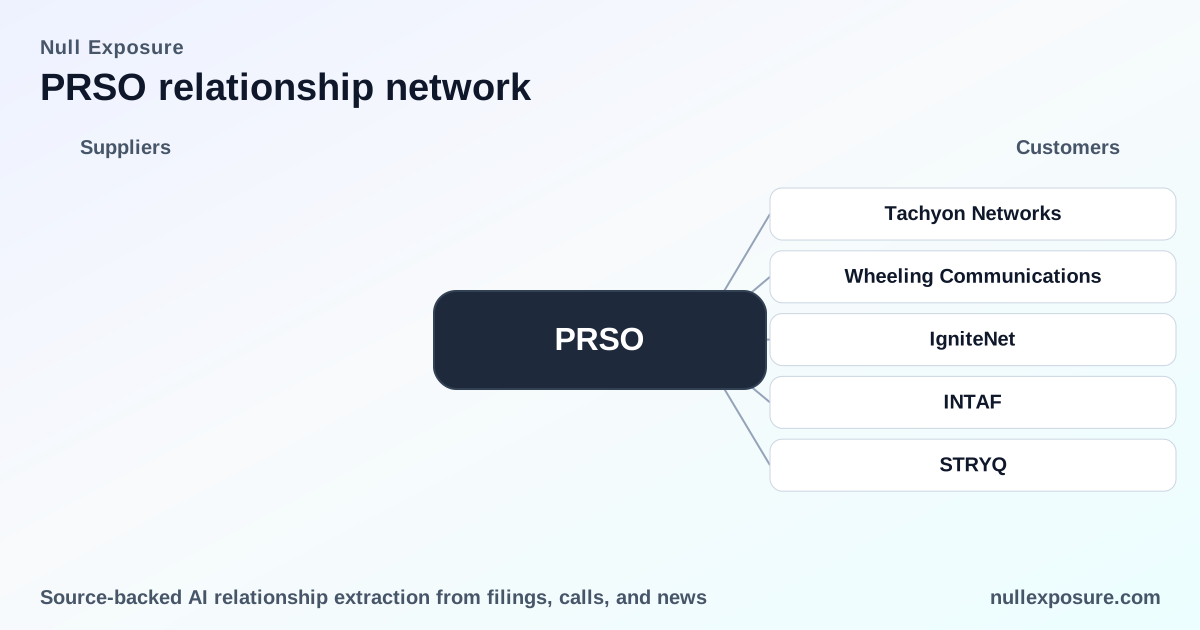
Peraso (PRSO) — Customer Map and Commercial Risk Profile
Peraso Inc is a fabless semiconductor company that designs and sells 60 GHz mmWave semiconductor devices and integrated modules, monetizing through product sales, non‑recurring engineering (NRE) services and licensing royalties. The company recognizes revenue largely at shipment, operates with short payment terms, and serves a concentrated set of OEMs, wireless ISPs and an expanding set of defense and mobility customers.
For a deeper look at counterparties and commercial levers, visit the NullExposure homepage for ongoing customer intelligence: https://nullexposure.com/
What the customer list tells investors about Peraso’s business model
Peraso’s revenue model is product-led with service and licensing adjacencies. The company sells modules and semiconductor devices directly and through distributors with payment terms typically 60 days or less, and licenses IP under royalty arrangements that are recognized when the licensee uses the technology. Revenue is geographically concentrated in North America, representing the bulk of reported sales in the latest disclosure, and the company’s top customers historically account for a very large share of revenue — the three largest customers represented roughly 86% of total revenue in 2024. That concentration produces both upside when design wins scale and downside if one large OEM shifts sourcing.
Peraso’s go‑to‑market posture is consistent with a fabless OEM supplier: it is primarily a seller/manufacturer of hardware with NRE and licensing services layered on top. The company is in mixed relationship stages — active product shipments to FWA and enterprise partners, pilot and proof‑of‑concept engagements with defense contractors that have progressed to initial production shipments, and a defined wind‑down of legacy memory IC business with an EOL backlog.
Customer roster — who is buying Peraso today
Below are Peraso’s customer relationships found in public coverage. Each entry is a concise, plain‑English take and a source reference.
IgniteNet
Peraso chips are used in IgniteNet’s point‑to‑point and point‑to‑multipoint 802.11ad radios, indicating deployment in commercial fixed wireless access gear. According to WiFiNow Global coverage of Peraso fundraising (article published March 2026), IgniteNet devices integrate Peraso silicon.
Wheeling / Wheeling Communications
Wheeling’s mesh‑based fixed wireless architecture leverages Peraso’s 60 GHz technology for multi‑gigabit service in dense urban neighborhoods, demonstrating Peraso’s traction with WISPs and urban FWA operators. This is described in Peraso’s Q3 and Q4 2025 earnings call transcripts (InsiderMonkey, published May 2026).
Tachyon Networks
Tachyon selected Peraso’s prospective modules, including a version with an integrated 16‑element base array antenna, for an outdoor 60 GHz gigabit wireless solution targeting both urban and rural deployments. Peraso disclosed these module wins in Q3 and Q4 2025 call materials and press coverage (InsiderMonkey and The Globe and Mail, 2025–2026).
MicroSeq
MicroSeq launched a next‑generation 60 GHz NRA point‑to‑point product that incorporates Peraso technology and showcased it at Mobile World Congress, signaling OEM productization of Peraso’s modules. This was reported in Peraso’s Q4 2025 earnings call transcript and in The Globe and Mail coverage of Peraso’s product strategy (InsiderMonkey and Globe and Mail, early 2026).
Bayer Wertz
Peraso is supplying 60 GHz perspective modules to power Bayer Wertz’s BX60 platform, which targets robotaxi fleet connectivity and on‑vehicle physical AI applications — a notable vertical mobility use case for mmWave links. The relationship was highlighted in Peraso’s Q4 2025 earnings call transcript (InsiderMonkey, May 2026).
MicroTig
Peraso referenced expected shipments and timing with MicroTig in its public calls, noting a hoped‑for large shipment that shifted timing into the next quarter. This operational commentary comes from the Q4 2025 earnings call transcript (InsiderMonkey, May 2026).
InTACT (INTAF / iNTACT / Intact)
Peraso’s 60 GHz mmWave modules were selected by Israeli defense contractor InTACT for a next‑generation drone Identification Friend‑or‑Foe (IFF) system, and Peraso delivered an initial limited production shipment, marking production readiness for defense applications. Multiple press releases and news items document selection and shipment (AccessNewswire, Benzinga, Investing.com and several market news outlets, March–May 2026).
Starry (STRYQ)
Peraso is reported as the believed sole‑source provider of Starry’s 60 GHz mmWave technology for high‑bandwidth, low‑latency broadband where fiber is impractical, indicating strategic dependency by an FWA provider. This supplier role is noted in press coverage of Peraso’s FWA expansion (OpenPR, March 2026).
Constraints that drive the commercial risk profile
These company‑level signals explain how Peraso contracts and where operational sensitivity lies.
- Short‑term commercial posture: Peraso sells products with payment terms typically 60 days or less, indicating transactional order cycles and short cash conversion windows rather than long multi‑year supply contracts. (Company disclosure on sales and payment terms.)
- Licensing royalty economics: Licensing agreements are structured around royalties recognized in the quarter the licensee uses the technology, providing episodic license revenue tied to partner productization. (Company licensing description.)
- Geographic concentration: North America represents the bulk of reported revenue (roughly $12.5m of $14.6m in the referenced period), concentrating market and geopolitical exposure. (Revenue by geography disclosure.)
- High customer concentration / critical counterparty risk: The three largest customers made up ~86% of revenue in 2024, and specific customers have represented more than 10% individually, establishing a high materiality profile where single customer shifts change financial outcomes materially. (Significant customer disclosure.)
- Mixed relationship maturity: Peraso runs active product relationships with FWA OEMs and WISPs, pilot and early production defense engagements (proof‑of‑concept through to initial shipments), and a winding down of legacy memory IC orders with an EOL backlog of approximately $2.3m expected to ship early in 2025. These stages require different execution skills — volume manufacturing, qualification for mission‑critical defense, and orderly product discontinuation. (Company statements on relationship stages and EOL orders.)
- Hardware‑centric revenue with service/licensing add‑ons: The core business is hardware sales (semiconductors and modules) supplemented by NRE services and licensing, exposing gross margins to silicon sequencing and manufacturing unit economics. (Company segment description.)
- Spend band and order size signal: Backlog and purchase order evidence put notable individual engagements in the $1m–$10m band, consistent with small to mid‑scale production runs for specialized mmWave modules. (Backlog disclosure.)
Investment implications — what investors should monitor
- Customer concentration is the central risk: a small number of large OEMs and WISPs drive results; loss or delay of a major ship can swing results materially. Watch quarterly shipment disclosures and customer‑level revenue breakdowns.
- Defense selection and initial shipments are validation events: the InTACT selection and initial limited production shipment represent a move into higher‑value, higher‑margin military applications, but scaling these wins demands robust production and supply‑chain discipline.
- Product timing execution matters more than long‑term contracts: given short payment terms and royalty recognition timing, revenue is sensitive to shipment schedules and customer product ramps.
- Operational focus needed on manufacturing scale and qualification for automotive/robotaxi and defense platforms; these customers are critical and require rigorous qualification to convert pilot business into recurring revenue.
For continued, structured customer intelligence about Peraso and other semiconductor suppliers, see our research hub at https://nullexposure.com/ — the site tracks counterparties, contract stages and materiality signals across small cap hardware vendors.
Bold capital allocation and valuation calls should reflect the company’s concentration exposure, hardware margin dynamics, and the timing risk inherent in converting pilot defense and mobility wins into scaled revenue. Investors should track next‑quarter shipment schedules, customer disclosures, and any material changes in the composition of the top three customers.