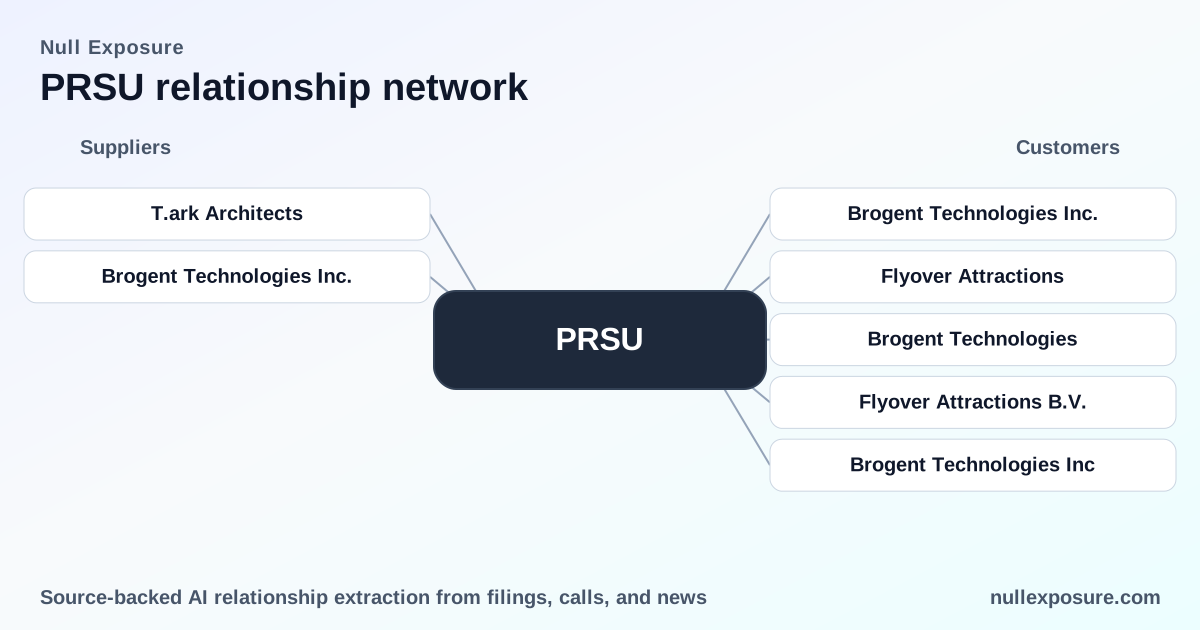
Pursuit Attractions & Hospitality: Customer relationships after the Flyover divestiture
Pursuit Attractions and Hospitality operates and monetizes a portfolio of attractions, hotels, restaurants and integrated services by selling experiences — ticketing, rooms, F&B and transportation — to largely individual leisure travelers and tour groups across North America and selective international markets. The company’s revenue mix is services-driven, with hospitality and attractions generating recurring cash flow from admissions and lodging while management and brand arrangements intermittently convert into one-off asset dispositions. For a concise briefing and ongoing signals on Pursuit’s partner landscape visit https://nullexposure.com/.
Strategic reset: the Flyover sale clarifies customer focus
Pursuit’s January 2026 decision to sell its Flyover flying-theater business for $78.4 million is a purposeful reallocation of capital away from specialty attractions toward higher-return, asset-light hospitality and iconic destination experiences. The transaction transfers the Flyover operations to a buyer with core flying-ride technology capabilities and frees Pursuit to redeploy proceeds into its larger resort and attraction footprint — a structural move that materially affects the company’s customer and partner map. According to multiple press reports in March and May 2026, the buyer is Brogent Technologies (and an acquiring entity named Flyover Attractions B.V.), with the deal framed as an equity purchase and subject to customary post-closing adjustments.
Key takeaway: the Flyover divestiture reduces Pursuit’s exposure to hardware-heavy, specialty attractions and concentrates revenue growth and customer relationships around hospitality, F&B and integrated guest services.
Who’s on the record: relationship-by-relationship review
Below are the named counterparties and media-reported relationships tied to Pursuit in the available signals. Each entry is a plain-English summary with a concise source reference.
Brogent Technologies Inc.
Pursuit entered into a definitive agreement to sell its Flyover flying-theater business to Brogent Technologies for approximately $78.4 million in cash, a deal positioned to accelerate international expansion of the Flyover brand under Brogent’s ride-technology leadership. This move was widely reported by outlets including Finviz and Investing.com in early 2026. (Finviz; Investing.com, March–May 2026)
Flyover Attractions
Pursuit executed an Equity Purchase Agreement to transfer all outstanding equity interests in the Flyover business to an acquiring entity called Flyover Attractions for $78.4 million in cash, with customary post-closing adjustments to working capital, debt and cash. The agreement and transaction mechanics were detailed in TradingView’s coverage of the January 21, 2026 announcement. (TradingView, March 2026)
Brogent Technologies (alternate mentions)
Additional industry coverage frames Brogent as the operational buyer expected to enhance Flyover’s creative and engineering capabilities and drive international roll‑out; analysts and trade press reiterated the buyer identity and strategic rationale across March 2026 briefs. These same items reinforce that Brogent’s acquisition is oriented toward operating and expanding the Flyover product globally. (InPark Magazine; Intellectia.ai, March 2026)
Flyover Attractions B.V.
Pursuit’s press release indicated that all subsidiaries comprising Flyover were being sold to Flyover Attractions B.V. for $78.4 million, explicitly naming the Dutch acquiring vehicle in the corporate announcement of January 21, 2026. The Globe and Mail republished the corporate notice when the transaction was announced. (The Globe and Mail, January 2026)
OTH (Off-The-Hook Yachts / OTH)
Off-The-Hook Yachts’ investor materials and press releases note that recent acquisitions will represent respected brands “like Pursuit” in new service areas, indicating that Pursuit’s brand and regional representation are viewed as distributable assets by third-party consolidators in marine and leisure markets. Those references appear in Off‑The‑Hook’s February 2026 press releases and subsequent investor webinars. (GlobeNewswire; Barchart; Yahoo Finance, February–March 2026)
ONEW (OneWater Marine / ONEW)
OneWater Marine’s commentary highlighted the value of working at scale with companies such as Pursuit, noting that broader geographic reach allows faster inventory rotation and seasonal responsiveness — an operational observation that positions Pursuit as a desirable partner for multi-location dealers and service networks. This quote appeared in OneWater’s Q3 2024 commentary republished in industry press. (MarineIndustryNews, FY2024 / republished 2026)
What the constraints tell investors about Pursuit’s operating model
The structured signals in the record form a coherent company-level profile:
- Customer base is individual- and group-oriented. Company-level text flags leisure travelers and tour groups as the primary counterparty types, implying a retail-facing contract posture rather than enterprise long‑term contracting.
- Geographic exposure is North America-first with selective EMEA presence. Revenue data and narrative show heavy concentration in North America (U.S. and Canada) with meaningful operations in Iceland and guest draw from Western Europe, APAC and Central America — a footprint that is regional but globally visible.
- The relationship role is service provider and seller. Pursuit’s revenue mix is dominated by services — tickets, rooms, and integrated transport — which positions the firm as a front-line seller of experiential services rather than a pure product manufacturer.
- Maturity and criticality: the company operates mature hospitality assets and attractions with recurring cash flows from admission and lodging, while certain assets (like Flyover) are non-core and divestable, suggesting portfolio prioritization between core hospitality cash generators and specialty experiential assets.
- Concentration and contracting posture: given the leisure-focused customer base and reliance on walk-in and booked experiences, the company’s revenue is less protected by long-term contracts and more sensitive to seasonal and regional demand shifts.
Investment implications: concentration, de‑risking and optionality
Pursuit’s divestiture program and the media-reported buyer roster generate three investment-relevant conclusions:
- De-risking through disposal of non-core experiences improves balance-sheet optionality and allows capital redeployment to higher-margin hospitality assets.
- Customer exposure remains concentrated in retail leisure demand across North America, so top-line volatility tracks travel cycles and macro leisure spending.
- Third-party acquirers view Pursuit’s brands as distributable assets, which increases optionality for future brand licensing, representation or further portfolio rotations.
For a deeper, up‑to‑date signal stream and partner mapping for Pursuit, see https://nullexposure.com/ — the site consolidates press and filing signals relevant to investor diligence.
Final read: what to monitor next
Track closing conditions and post-closing adjustments on the Flyover sale, management’s reinvestment cadence for the $78.4 million, and bookings/occupancy trends across North America and Iceland. Key risk factors are seasonal demand sensitivity and the lack of long-term contracted revenue; key opportunities are asset-light growth via brand licensing and reinvestment into iconic hospitality properties.
If you’re evaluating counterparties or modelling reallocation of Pursuit’s proceeds, prioritize occupancy trends, F&B margins and any announced brand‑representation deals that convert the company’s geographic footprint into durable revenue streams.