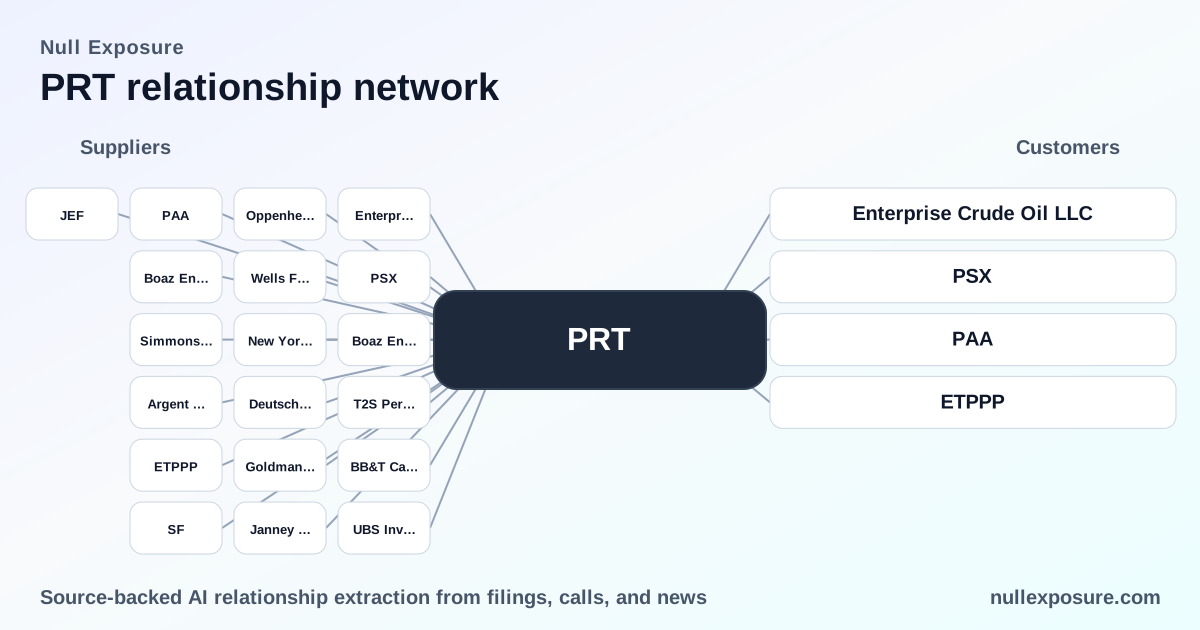
PermRock (PRT) — Customer Relationships and Commercial Posture
PermRock Royalty Trust owns net earnings interests in oil and gas production in the Permian Basin and monetizes those interests through cash flows generated by Boaz Energy II’s production and marketing of hydrocarbons; the Trust receives its share of proceeds and distributes them as dividends to shareholders, reflected in a high dividend yield (≈13.8%) and a payout profile tied directly to commodity sales and processing economics. For investors, the relevant commercial read is straightforward: revenue flows are driven by sales to a small set of large purchasers under short‑term, market‑priced arrangements, with processed natural gas settled on a percentage‑of‑proceeds basis. For a portfolio-level view of counterparty profiles, visit https://nullexposure.com/.
How the 10‑K frames counterparty exposure and commercialization
PermRock’s disclosures (via the Boaz Energy operating information in the Trust’s FY2024 10‑K) present a clear, market‑facing sales model: oil and gas are sold on short‑term contracts at market prices to third‑party purchasers in the United States, and processed natural gas is settled under percentage‑of‑proceeds arrangements that feed into the Trust’s net profits interest. The filing describes the purchaser base as competitive and numerous in the Permian Basin and explicitly states that the operator does not view the loss of any single purchaser as materially disruptive to operations.
- Contracting posture: sales are executed under short‑term contracts at market prices, creating flexibility but leaving revenues exposed to spot price and marketer behavior.
- Revenue mechanics: a portion of gas revenue is usage‑based/percentage‑of‑proceeds when NGLs are removed, so receipts vary with processing yields and NGL pricing.
- Geography and market: all purchaser activity is within the United States (Permian Basin), concentrating operational counterparty risk regionally.
- Materiality / concentration tradeoff: while the top buyers concentrate a large share of sales, management’s position is that replacement capacity is available because of a competitive purchaser market.
- Relationship posture: the buyers are active, third‑party purchasers (buyers) under live contracts during FY2024.
These company‑level signals define the Trust’s commercial characteristics: concentrated counterparty receipts, short‑term market pricing, and a partially usage‑based settlement mechanism for processed gas.
Counterparty roster — who the buyers are and why they matter
The FY2024 10‑K discloses four purchasers that together accounted for the bulk of Boaz Energy’s oil and gas revenues. Below I cover each counterparty exactly as listed in the filing.
Phillips 66 — the largest single purchaser
Phillips 66 accounted for 30.59% of Boaz Energy’s total oil and natural gas revenues for the year ended December 31, 2024, making it the Trust’s single largest purchaser in FY2024. According to the PermRock FY2024 10‑K, this concentration gives Phillips 66 a meaningful share of receipts but sales are governed by short‑term market contracts. (Source: PermRock 10‑K, fiscal 2024.)
Plains All American Pipeline — a major midstream buyer
Plains All American Pipeline represented 20.23% of Boaz Energy’s oil and gas revenue in FY2024, positioning it as the second‑largest counterparty and a significant conduit for oil flows out of the Permian. The 10‑K lists Plains alongside other top purchasers as part of the operator’s marketing mix. (Source: PermRock 10‑K, fiscal 2024.)
Energy Transfer Partners — material midstream counterparty
Energy Transfer Partners was responsible for 18.44% of Boaz Energy’s total oil and natural gas revenues in FY2024, supplying midstream capacity and buyer demand that materially contributed to the Trust’s receipts. The 10‑K identifies Energy Transfer among the four purchasers that collectively captured the majority of sales. (Source: PermRock 10‑K, fiscal 2024.)
Enterprise Crude Oil LLC — a meaningful purchaser
Enterprise Crude Oil LLC accounted for 12.79% of Boaz Energy’s oil and gas revenues for the year ended December 31, 2024, rounding out the four named purchasers that constituted the bulk of marketed production for the period. The 10‑K names Enterprise Crude Oil LLC as one of the primary buyers. (Source: PermRock 10‑K, fiscal 2024.)
Collectively, these four counterparties accounted for approximately 82.1% of Boaz Energy’s oil and gas revenues in FY2024, concentrating receipts into a small set of buyers while the Trust’s legal structure keeps payments flowing to unitholders.
What investors should watch: concentration, contractual terms, and payout sensitivity
The commercial profile set out by the filing creates a straightforward risk/reward map:
- Concentration risk: >80% of FY2024 marketing went to four counterparties, so counterparty credit events, negotiated pricing practices, or changes in routing preference could reallocate receipts quickly. Management’s public position is that the Permian’s competitive buyer market limits disruption, but concentration is a tangible exposure for yield investors.
- Contractual exposure: short‑term contracts at market prices mean cash flows are directly sensitive to spot differentials, basis changes, and midstream logistics; there is no long‑dated buyer protection embedded in the disclosed arrangements.
- Revenue variability: usage‑based settlements on processed gas tie a slice of receipts to processing efficiency and NGL realizations, introducing operational and product‑price correlation into distributions.
- Geographic concentration: sales are domestic (Permian Basin), concentrating operational and regional market risk.
These characteristics make PermRock a dividend‑sensitive vehicle: distributions reflect near‑term commodity realizations and marketing dynamics more than long‑dated contractual stability. For active investors who price yield against counterparty concentration and spot volatility, these are the primary levers of downside and upside.
Bottom line and next step for due diligence
PermRock’s FY2024 disclosure clarifies that the Trust’s cash flows are driven by a small group of large, active purchasers under short‑term, market‑priced arrangements, and that some gas receipts are settled on a percentage‑of‑proceeds basis. The combination produces attractive current yield but meaningful sensitivity to spot markets and counterparty allocation.
For further context on counterparty exposures and how they map into portfolio risk, review PermRock’s full investor materials and filings at the Trust’s site or explore an aggregated counterparty view at https://nullexposure.com/.
If you want a focused counterparty risk brief or a comparative view across royalty trusts, I can prepare a short memo benchmarking PermRock’s buyer concentration and contractual profile against peers.