Prothena (PRTA): Partner-driven cash flow with large upside from milestone triggers
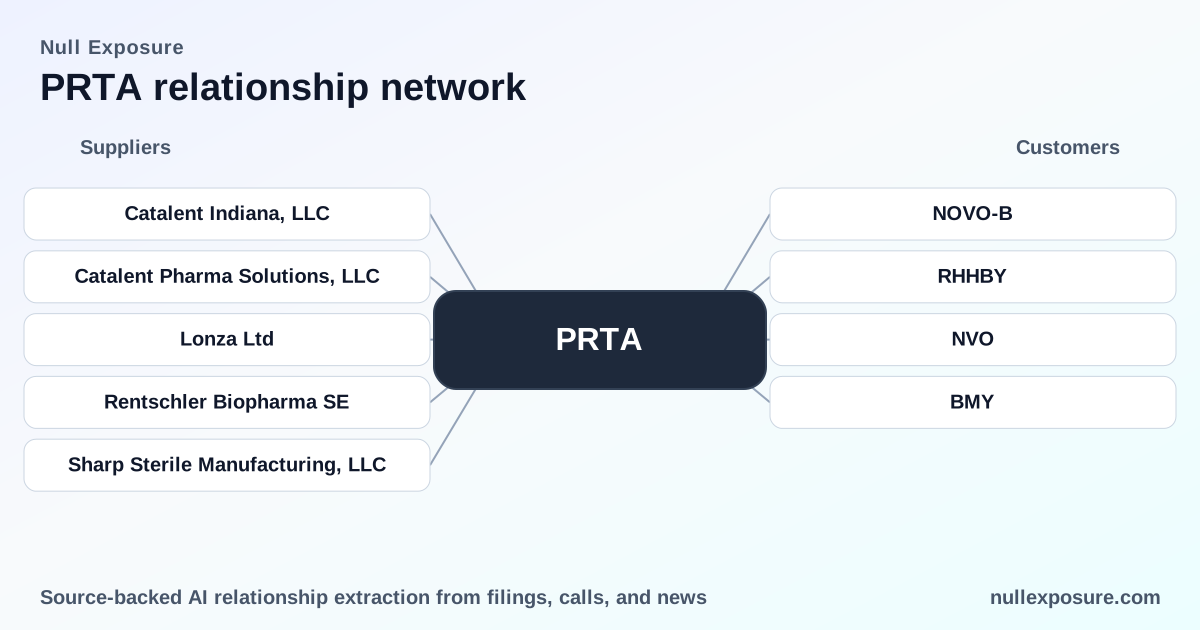
Prothena monetizes discovery-stage neuroscience and amyloidosis assets primarily by out-licensing clinical programs to large pharma and capturing upfront/license fees, clinical milestones and tiered royalties. The company's operating model is partnership-first: near-term revenue is concentrated in collaboration receipts and milestone payments, while shareholder returns hinge on partners advancing late-stage programs into commercial territory. For investors, Prothena is a play on execution by big-cap partners rather than a stand-alone commercial rollout.
For a concise mapping of partner exposure and milestone timing, visit https://nullexposure.com/ — the partner breakdown below is central to any valuation or counterparty risk assessment.
What drives Prothena’s economics today
Prothena has transitioned from a balance of internal programs to a portfolio largely funded and advanced by partners. Revenue in recent reporting is almost entirely collaboration-driven, with license fees and clinical milestone payments dominating reported top-line. This model lowers Prothena’s capital intensity for late-stage development while concentrating commercial optionality—and counterparty risk—with a handful of large pharmaceutical partners.
- Contracting posture: Prothena’s agreements typically transfer development and commercialization responsibility to partners in exchange for milestones and royalties, reflecting a permissive contracting posture that reduces direct development expense but creates dependency on partner decisions.
- Concentration: A small number of partners account for essentially all near-term revenue and milestone potential, making financial outcomes highly concentrated by counterparty progress and decisions.
- Criticality and maturity: Partnered assets sit in late clinical stages (Phase III for coramitug; Phase III advancement decisions for prasinezumab) which increases the binary nature of milestone payments and royalty streams.
- Geography signal: Prothena states the U.S. would be its most important market if it commercializes products, signaling commercial strategy and regulatory focus centered on North America (company disclosure).
Partner map — detailed relationship summaries
Roche (RHHBY / F. Hoffmann‑La Roche Ltd.)
Roche holds development and commercialization responsibility for Prothena’s anti‑alpha‑synuclein asset prasinezumab and has agreed to pay double‑digit teen royalties on net sales; Prothena has previously recognized license fees and milestone receipts under the Roche agreement. According to company disclosures and press releases (Q1 and partnership announcements), Roche advanced prasinezumab into Phase III following positive Phase II data and has funded upfront/license considerations to Prothena (Biospace press releases and TradingView coverage, 2024–2026).
Source: Biospace press release on the Roche partnership (Q1 2025 reporting cycle) and TradingView coverage noting license fees and milestones (March 2026).
Novo Nordisk (NVO / NOVO‑B / Novo Nordisk A/S)
Novo Nordisk acquired Prothena’s ATTR amyloidosis program including coramitug (formerly PRX004) in July 2021 and is advancing coramitug in a large Phase III CLEOPATTRA program; Prothena retains milestone and royalty upside—aggregate deal economics cited up to ~$1.2–1.23 billion with $100 million already paid and additional milestone payments tied to Phase III enrollment targets. Prothena announced achievement of a $50 million clinical milestone from Novo Nordisk following a prespecified enrollment target in March 2026, reflecting active value realization from this acquisition (SEC filing, Pharmaweb and MarketBeat/Yahoo finance coverage, March 2026).
Source: Company filing and press releases (SEC exhibit filing and Pharmaweb, March 2026) and TradingView/MarketBeat articles referencing the milestone and acquisition terms (2021 acquisition notice and 2026 milestone reporting).
Bristol Myers Squibb (BMY / BMS)
Bristol Myers Squibb is Prothena’s partner on PRX019 and related neurodegeneration programs, and the company’s top-line in recent periods has been driven primarily by collaboration revenue from BMS tied to PRX019 trial obligations. Management has disclosed potential to earn significant future milestones—public commentary quantifies up to an incremental ~$562.5 million of future milestones plus tiered royalties up to high‑teens on a weighted average basis, and Prothena indicated potential to receive up to $105 million aggregate in 2026 from partner milestones across Novo and BMS (InsiderMonkey transcript and TradingView/Yahoo Finance coverage, Q4 2025–2026).
Source: InsiderMonkey earnings-call transcript and TradingView reporting of Q4 2025/Q1 2026 results (March 2026), plus Yahoo Finance/Biospace releases describing the composition of collaboration revenue (Q1 and Q3 2025 reports).
How the partner relationships translate to financial sensitivity
Prothena’s P&L and cash flow are highly sensitive to:
- Milestone timing and realization: Large one‑time cash inflows (e.g., $50M Novo milestone in Mar 2026; prior Roche payments) cause step changes in liquidity and reported revenue. TradingView and Pharmaweb reported the March 2026 milestone, illustrating near-term revenue lumpiness.
- Partner decisions on pivotal trials: Roche’s choice to move prasinezumab into Phase III and Novo’s enrollment-triggered milestone payments are determinative of near‑term upside; a partner pause or discontinuation would immediately reduce projected receipts.
- Royalty upside vs. concentration risk: Royalties provide long-term upside if partners commercialize, but they are dependent on partners’ global commercialization strategies and competitive execution.
Key takeaway: Prothena’s intrinsic valuation is driven by partner-managed clinical advances and milestone capture rather than internal commercialization, concentrating both upside and downside in counterparties.
Constraints and company-level signals investors need to price
The relationship analysis implies several company-level constraints investors should incorporate into models:
- Geography: Prothena explicitly anticipates the U.S. market as the primary commercial opportunity if it ever commercializes its own products, indicating regulatory and commercial focus on North America (company disclosure).
- Concentration: A handful of partners substitute for in‑house pipelines; investors must model counterparty execution as a primary input rather than internal hit-rate assumptions.
- Contracting posture: Agreements typically transfer development cost and regulatory responsibility to partners in exchange for milestones and royalties, which reduces R&D burn but increases dependency.
- Maturity: Partnered assets are late-stage, reducing scientific uncertainty but increasing binary regulatory and enrollment risks that produce lumpier revenue.
Bottom line — what investors should watch next
- Catalyst calendar: Track Novo’s CLEOPATTRA enrollment/readouts and Roche’s Phase III milestones for prasinezumab; these events are primary drivers of milestone inflows and medium‑term re‑rating.
- Revenue seasonality: Expect headline volatility as milestone receipts post and normalize; recent reporting shows material year‑over‑year swings (e.g., revenue down from prior periods driven by collaboration timing).
- Counterparty execution: Assess Roche, Novo Nordisk and BMS trial progress and enrollment updates—partner decisions will determine Prothena’s realized economics.
If you are modeling Prothena for investment or counterparty exposure, prioritize partner trial timelines and milestone recognition patterns over standalone commercialization assumptions. For a tailored partner-risk memorandum or timeline charting these milestone triggers, see our analyst resources at https://nullexposure.com/.
Bold, partner-driven cash flows define Prothena’s risk/reward: milestone milestones provide asymmetric upside but introduce concentrated counterparty dependency that must be explicitly priced into models.