PureTech Health (PRTC): Partner-triggered cash flows, milestone economics, and what the customer map tells investors
PureTech Health builds value by incubating and de-risking drug programs inside founded entities, then realizing returns through milestone receipts, royalties and partner transactions rather than through large-scale commercial revenue today. The company monetizes by retaining equity in spin-outs, negotiating milestone and royalty arrangements with biopharma partners, and selectively licensing programs — a structure that generates episodic cash inflows tied to third‑party clinical and regulatory events rather than predictable product sales. Investors should value PureTech as a portfolio of partnered assets whose near-term cash visibility depends on partner milestones and regulatory timing.
For a concise view of signal-driven partner intelligence, see Null Exposure’s coverage at https://nullexposure.com/.
How PureTech’s model translates into cash and risk
PureTech is a clinical‑stage biotech holding company with limited operating revenue (TTM revenue of roughly $4.66 million) relative to a market capitalization of about $415 million, negative operating margins and recurring net losses. That financial profile underscores a business model driven by capital markets and discrete partner payments rather than product cashflow. The company’s economics concentrate on a handful of high‑value partner outcomes: FDA approvals, licensing exits, and royalty monetizations.
- Contracting posture: Predominantly milestone-and-royalty based; partners pay on achievement of regulatory or commercial milestones.
- Concentration: Revenue is concentrated and episodic — a single approval or milestone can generate material near‑term receipts.
- Criticality: Counterparty performance (partner development and commercialization execution) is critical to PureTech’s ability to crystallize value.
- Maturity: Clinical-stage portfolio with limited self-generated commercial revenue; maturity of cash flows depends on partner-stage progression.
Relationship map — the events and partners that drive value
Below I cover every partner relationship surfaced in the results and what each means for investors.
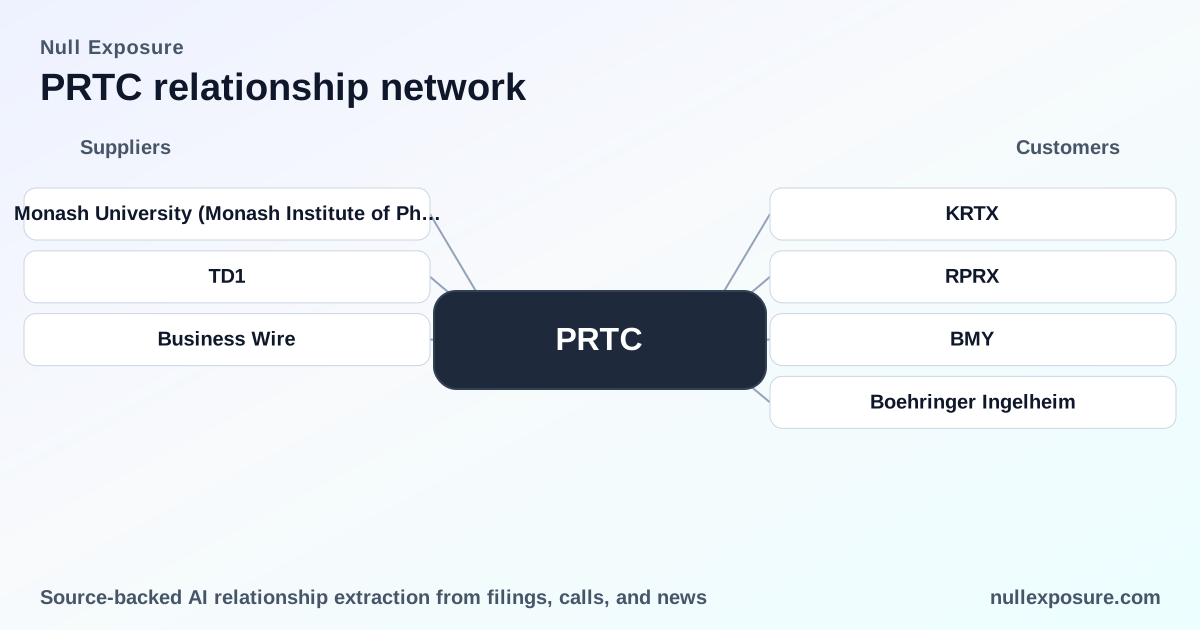
Karuna Therapeutics (KRTX)
PureTech recorded two milestone payments totaling $29 million tied to an FDA approval event connected to Karuna, which PureTech identified as a founded entity. These payments reflect PureTech’s stake and milestone rights in companies it incubates. According to PureTech’s FY2025 annual results press release on BioSpace (reported March 10, 2026), the approval triggered these receipts. (Source: BioSpace press release, Mar 10, 2026 — PureTech annual results.)
Royalty Pharma (RPRX)
Royalty Pharma is reported as the counterparty to one part of the $29 million aggregated milestone payment structure, indicating PureTech has arrangements where third‑party royalty investors share in or fund milestone/royalty economics. The same BioSpace FY2025 release states the milestone payments were made under agreements with Royalty Pharma. (Source: BioSpace press release, Mar 10, 2026 — PureTech annual results.)
RPRX (duplicate entry)
The dataset lists RPRX again as a separate item reflecting the same Royalty Pharma relationship; the disclosure reiterates that Royalty Pharma’s agreement contributed to the $29 million in milestone receipts tied to the approval event. The duplication signals that Royalty Pharma is a material counterparty in PureTech’s monetization mechanics. (Source: BioSpace press release, Mar 10, 2026 — PureTech annual results.)
Bristol Myers Squibb (BMY)
PureTech’s FY2025 narrative links Bristol Myers Squibb to the same approval milestone chain via Karuna (noting Karuna is now BMS in the disclosure), indicating a downstream corporate owner acquired or partnered with PureTech’s founded entity and that corporate action triggered contractual milestone obligations to PureTech. The BioSpace release (Mar 10, 2026) makes this explicit: the milestone payments arose under agreements with Royalty Pharma and the Founded Entity, Karuna (now BMS). (Source: BioSpace press release, Mar 10, 2026 — PureTech annual results.)
Boehringer Ingelheim
A separate report recalls a strategic alliance announced in 2019 between PureTech and Boehringer Ingelheim to evaluate applying PureTech’s Glyph technology to an immuno‑oncology candidate, highlighting PureTech’s practice of forming targeted alliances to advance platform applications. The mention comes from a 2026 article referencing the 2019 alliance, indicating multi‑year evaluation partnerships are part of PureTech’s customer/partner mix. (Source: Samoa Observer article referencing PureTech’s 2019 alliance with Boehringer Ingelheim; reported context FY2021 in the coverage.)
What each relationship implies for valuation and downside
- Milestones matter more than product sales right now. The Karuna/BMS and Royalty Pharma receipts demonstrate how single regulatory events can materially improve liquidity and dilute near‑term financing risk.
- Counterparty credit and corporate M&A are value levers. Bristol Myers Squibb’s acquisition or ownership change of Karuna converted a development event into cash for PureTech; such corporate moves materially reprice risk and accelerate monetization.
- Alliances prolong upside without immediate revenue. The Boehringer collaboration illustrates the long‑horizon nature of platform deals: they preserve upside but do not guarantee near‑term cash.
Operating constraints and company-level signals investors should watch
The provided relationship signals include no explicit contractual constraints beyond the milestone disclosures, but the company‑level picture reveals actionable constraints and structural characteristics:
- Episodic cash generation: Reported TTM revenue of approximately $4.66 million and negative operating margins indicate PureTech cannot self‑fund large programs long term without milestone cash, partner funding, or capital markets activity.
- Dependence on partner execution: The firm’s economics are tightly coupled to partner clinical progress and regulatory approvals; investors should overweight partner pipelines and corporate M&A risk when modeling cash flow timing.
- Concentration risk: A small number of large counterparties and a few critical events (approvals, acquisitions) can dominate near‑term value realization.
- Maturation pathway: Successful exits or royalty monetizations (as with Royalty Pharma) are repeatable ways to monetize, but their timing is unpredictable and binary.
For practitioners wanting uninterrupted access to partner-level signals and to monitor incoming milestone triggers, visit Null Exposure for coverage and tracking tools: https://nullexposure.com/.
Bottom line for investors and operators
PureTech’s value is realized through intermittent partner events rather than recurring commercial revenue; milestone receipts and royalty monetizations are the company’s primary near‑term cash levers. Monitor partner development calendars, corporate M&A activity (which can crystallize value), and any shifts from milestone to recurring royalty structures. The recent $29 million of milestone receipts tied to Karuna/BMS and Royalty Pharma validates the model — it also reinforces concentration and timing risk that should be front‑and‑center in valuation scenarios.
If you evaluate biopharma holding companies, focus on partner alignment, contractual milestone structures, and how much optionality PureTech retains in founded entities — those elements drive both upside and downside in the coming quarters.